As I glanced in the mirror above the wash basin, my stomach dropped. Light from the restaurant’s bathroom spotlights was bouncing off my crown, my hair so sparse my scalp was showing through, pink and shiny.
As I blinked back tears, I realised there was no more denying it; I was losing my hair.
Then aged 51, I’d known for a while my hair was getting thinner. In fact, I’d never been blessed with lustrous locks. Like my mother and grandmother, my hair was thin, and I’d never been able to grow it much past my shoulders. In my 20s, I’d turned to hair mousse to give me the volume that nature couldn’t.
Having studied Chinese medicine, I tried natural hair-growth supplements, but they only helped so much.
In my early 30s, I booked in for my first hair extensions, which were attached with a soft resin. Finally, I had the long, thick hair I’d always wanted. At £800 every few months, the upkeep was eye-watering. But it was a price I was willing to pay for the confidence boost.
After having my daughter in 2004 at 31, my husband and I wanted more children. But we struggled to conceive and, aged 34, tests revealed that I had premature ovarian insufficiency (POI). My ovaries had basically stopped working.
‘It’s unlikely you’ll conceive naturally again,’ a doctor confirmed. I was devastated. Eventually, we had a successful round of IVF using donor eggs and our twins were born when I was 36.
But after the birth I was exhausted and my periods became erratic. At 41, they stopped completely and it was confirmed I’d gone through early menopause, a side-effect of POI. Menopause took a toll on my hair, too.
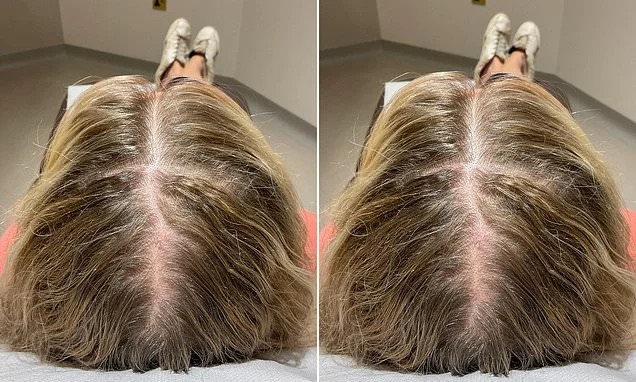
Katie's hair before her trip to Ouronyx, a clinic in London, which offers a stem-cell treatment called micrografting, which uses your own scalp tissue to create a growth-factor solution
And Katie's hair after her treatment, which cost £2,950, but given what she was spending on her hair – £60,000 in the past 20 years – it was a no-brainer to get her confidence back
Almost overnight, I could see my scalp on top. My hair became brittle and the strands felt thinner. No matter how long I left between haircuts, my natural hair wouldn’t grow longer than my ear lobes, making my extensions around the back and sides a necessity. It felt mortifying.
As a wellness practitioner often on camera, I didn’t want to try chemical regrowth products like Minoxidil, so I bought all the natural growth-boosting serums and supplements going.
But they just made my hair look lank.
My husband did his best to boost my confidence. But as the years passed I became really self-conscious about how much of my scalp was visible. I spent a small fortune on volumising weekly blowdries, but was painfully aware one gust of wind would reveal my scalp.
After that painful moment in the restaurant I went to my hairdresser. She confirmed it wouldn’t be possible to fix extra extensions near my crown – there just wasn’t enough of my own hair there. The traction on the existing follicles could also make thinning worse.
‘You could try a clip-in hair topper?’ she suggested. ‘Won’t that be really obvious?’ I asked, worried. ‘Not at all,’ she replied.
She said if I had one specially made, it would be virtually undetectable. So I did.
Once I’d had my bespoke hair piece made for £500, I was thrilled by how natural it looked. I simply clipped it on to the crown of my head each morning. But, after a while, my natural hair was looking even thinner. The piece was probably causing strain on existing strands, causing them to fall out. I grew increasingly desperate, my confidence at an all-time low.
Now, Katie's hair is back to how it was pre-menopause and her self-esteem at an all-time high
It didn’t help that the same year my marriage ended. Though the split was amicable, the thought of meeting someone new, then have them eventually realise my hair was all smoke and mirrors, was excruciating.
I just didn’t feel sexy any more.
I knew hair transplants were a possibility, but I wasn’t keen and the recovery time felt overwhelming. Desperate, I hit Google in search of an alternative and discovered that stem cell treatments to boost hair growth were available in South Korea. I was about to book flights to Seoul when I saw a clinic in London, Ouronyx, was also offering a stem-cell treatment called micrografting, which uses your own scalp tissue to create a growth-factor solution.
This is injected into your scalp, with the goal of re-activating thinning follicles and boosting growth. There was no down-time and results could last up to two years. Stem cell-based treatments are also on offer at IK Clinics in Leicester and Dynamic Regenerative Medicine in Birmingham. It felt like my only hope.
As soon as I sat down in the Ouronyx doctor’s office, I burst into tears. ‘I’m so miserable about my hair,’ I sobbed. The doctor confirmed that I’d be a good candidate for micrografting, suitable for those in the early to mid stages of male or female pattern hair loss.
He explained they’d take a small-punch 2.5mm biopsy of scalp tissue from the base of my neck to create the growth solution. After it was injected into thinning areas, I’d hopefully see a reduction in shedding in six weeks and regrowth in under six months. It cost £2,950, but given what I was already spending on my hair – £60,000 in the past 20 years – it was a no-brainer to get my confidence back. I had the treatment last July, aged 52. It was surprisingly pain-free, just a local anaesthetic for the biopsy. After the jabs, I couldn’t wash my hair for two days, but that was the only downtime.
The doctor also recommended monthly Tricopat treatments, starting at £1,600 for four sessions, for six months.
Tricopat uses a mechanised device to create micro-incisions in the scalp to boost blood flow while electrical impulses push growth factors, vitamins and hyaluronic acid into the scalp to reactivate follicles and further bolster growth. LED light therapy sessions were included too, to reduce inflammation.
A month after the micrografting and tricopat, I noticed my hair felt a little thicker.
Two months on, new baby hairs sprouted from my scalp and temples.
They continued growing and now, a year on, you’d never know I’d been so thin. It’s even grown past my chin for the first time in over a decade.
Now 53, friends tell me I look amazing and I believe them. My hair is back to how it was pre-menopause and my self-esteem is at an all-time high.
Finally, I feel like I can fully embrace my new chapter.
Follow Katie at @katie_brindle
As told to BETHAN KING