Thomas R. Verny is a clinical psychiatrist, academic, award-winning author, poet and public speaker. He is the author of eight books, including the global bestseller The Secret Life of the Unborn Child and The Embodied Mind: Understanding the Mysteries of Cellular Memory, Consciousness and Our Bodies.
Creativity is something our society values highly. But what is it exactly? Contemporary psychology offers what is known as the standard definition of creativity. It holds that creativity requires both originality and effectiveness. It must serve a practical purpose and be appropriate to the task at hand. The idea, process, or product must be unique, novel, or unusual. An idea that is purely original but completely useless is not considered creative by modern scientific standards. [1]
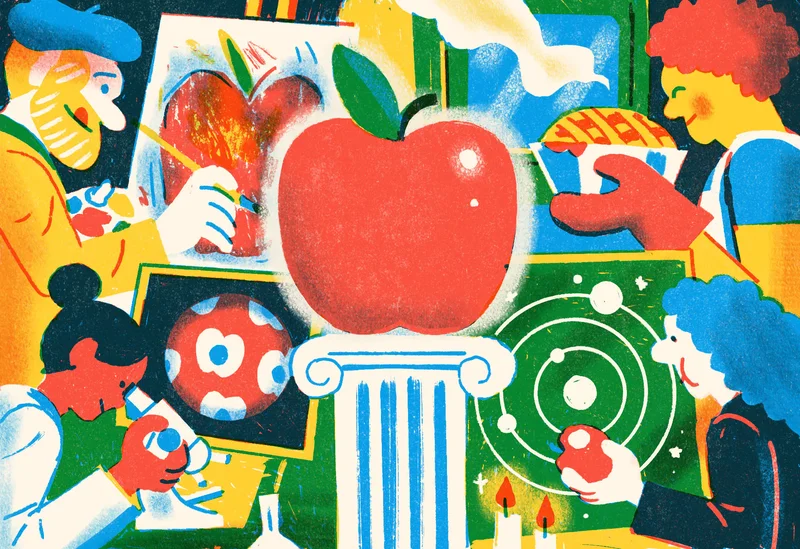
You may remember from your high school days the story of Isaac Newton and how watching an apple fall from a tree led to his discovery of the law of gravity. It is probably part history and part legend, but it captures one of the key features of creative thought.
Millions of people had seen apples fall before. But it occurred to no one before Newton to ask, as he did, whether the same force that pulled the apple to the ground also existed in space, keeping celestial bodies in their orbits. In doing so, Newton connected two phenomena that everyone else treated as unrelated.
Newton’s discoveries, like those of extraordinary scientists from Archimedes to Stephen Hawking, align with the information-gap theory of curiosity first formulated by Prof. George Lowenstein at Carnegie Mellon University. He hypothesized that when we notice a gap in our knowledge it feels like an itch we want to scratch, driving us to look for an answer. [2] Recent advances in brain imaging have begun to reveal how curiosity recruits the same dopaminergic circuits that underlie motivation and reward. Additionally, curiosity increases communication with the hippocampus and thus enhances learning and memory. [3, 4]
Creativity is not just a chance phenomenon. Creativity emerges in people with a solid knowledge in a particular area, be that physics, cooking, arts, etc. who are curious, intelligent and under some pressure to solve a problem.
These fundamental principles of creativity are well exemplified by Julia Child, the first person to make cooking shows on television popular. She was curious and encouraged curiosity in her viewers. She would ask questions of herself such as: How would longer browning change the flavour? Might another herb improve the dish? Could there be a more effective technique? The necessity of needing to produce a new show weekly was a good motivator. And she was obviously highly intelligent.
She treated recipes as living experiments and if anything went wrong, she embraced her mistakes with humour. By example, she taught her viewers to be adventurous, to view failure not as a catastrophe but as a positive learning experience that will eventually pay off.
Curiosity is one of the primary engines of evolution. It is in our DNA because those most eager to investigate and understand their environment were often the ones most likely to survive. [5]
We are born curious but depending on the attitudes of our parents, community and culture, that curiosity can be supported or suppressed. One comment from an authority figure like, “Stop asking stupid questions” often suffices to put the lid on an inquiring young mind. On the other hand, responding to every question seriously and positively will contribute to a child’s potential for creativity.
In our thirst for knowledge, we often turn to universities and other places of learning such as teaching hospitals. It is commonly assumed that these places are wellsprings of information and creative thinking. Sadly, this is not always the case. Often new ideas are met with resistance as they are perceived to threaten professional identities, institutional authority and long-held beliefs.
A tragic illustration of this attitude was the case of Ignaz Semmelweis, a Hungarian physician working at the Vienna General Hospital in the 1840s. After a colleague died from an infection acquired during an autopsy, Semmelweis surmised that doctors were carrying invisible “cadaverous particles” from the dissecting room to the maternity ward on their unwashed hands. In 1847 he made all physicians and students wash their hands with a chlorinated lime solution before examining patients. The results were dramatic. Mortality from childbed fever fell from about 10 to 18 per cent to roughly one to two per cent.
Many senior physicians rejected his explanation. Semmelweis’s theory implied that doctors were inadvertently killing their own patients. What an absurd idea, they thought. Semmelweis could not explain why hand washing worked, making his claims easy to dismiss. Increasingly frustrated by the profession’s opposition and vitriol, Semmelweis became severely mentally ill. In 1865 he was committed to an asylum, where he was beaten senseless, put into a straitjacket and thrown into a dark cell. He died three weeks later. Ironically, 20 years after his death, Louis Pasteur’s discovery of bacteria as transmitters of diseases and Joseph Lister’s use of carbolic acid as an antiseptic vindicated Semmelweis’s radical insight.
Academia has not drastically changed in the intervening years. The path to advancement and tenure at most universities is paved with published research papers that support the views of the senior scholars. You can rock the boat, but not too much. Incremental adjustment to the status quo is sanctioned – within limits.
A case in point is the illustrious career of Prof. Gerlinde Metz. In response to my inquiring about her academic education she told me that soon after she completed her postgraduate studies in neuroscience at the ETH Zurich, a world-renowned science university in Switzerland, she became interested in the then nascent science of epigenetics. As a young faculty member, her grant reviewers were outraged. They said epigenetics – the study of how environment and behaviours can lead to changes that affect how your genes work – was a myth. Urged her to drop the whole idea. That was 20 years ago.
Today, Prof. Metz holds the Dr. Bryan Kolb Chair in Neuroscience at the University of Lethbridge. With 263 publications and more than 11,000 citations to her credit, she has become one of the world’s leading scientists advancing epigenetics.
I asked her how she decides what subject to pursue next. Where do her ideas come from? She said that much of her work is collaborative but when pressed for more details, she did note that she likes the challenge of connecting data that had not been connected before. Also, occasionally, an idea just springs into her mind. Apparently from nowhere. Like when she got out of the shower the other day and thought of a new research project.
“Creative people have the kind of curiosity that draws them toward learning new things and experiencing the world in new ways,” noted Anna Abraham, director of the Torrance Center for Creativity and a professor in the neuroscience program, integrated life sciences, at the University of Georgia. [6]. Modern creativity research adds that expertise provides the foundation for innovation particularly when combined with flexible thinking and strong motivation. [7, 8]
From scientific breakthroughs to the arts, innovation propels humanity forward and adds enjoyment to our lives. David Cronenberg, world renowned novelist, film director, screenwriter, producer and actor, is a living example of a creative artist. I found him visiting Rome and spoke with him virtually.
My favourite Cronenberg movie was A Dangerous Method. The 2011 film follows the turbulent relationships between Carl Jung, founder of analytical psychology, Sigmund Freud, founder of the discipline of psychoanalysis and Sabina Spielrein, initially Jung’s patient and later one of the first female psychoanalysts. [9]
He has been called the father of body horror films in which he explores visceral bodily transformation, infectious diseases, and the interlacing of the psychological, physical and technological. His most recent film is The Shrouds, about a widower who invents a shroud that broadcasts a live, interactive 3-D image of his deceased wife’s decomposing body in her grave.
He noted that the label body horror was coined by journalists, not by him. Though he thinks it is a misnomer, he has learned to live with it. His films, he stressed, are less about horror than about the strange beauty and complexity of the human body. For him, creativity does not follow a predictable path. Every film begins differently, driven by what he described as an internal pressure to tell a story. His own life often provides the initial spark, whether he is making films or writing fiction, but he was careful to add that his characters are not versions of himself.
In addition to the factors already discussed, creativity requires the presence of a certain level of intelligence. A flash of insight has little value unless the individual can recognize its significance, evaluate it critically, and develop it into something useful or beautiful.
Psychologists have long examined the relationship between intelligence and creativity. [10] Intelligence generally refers to the reasoning and problem-solving abilities measured by IQ tests, whereas creativity is the capacity to generate ideas that are both original and useful. Research by Andreas Jauk and colleagues at the University of Graz suggest that higher intelligence is associated with greater creative potential. They determined that an IQ of roughly 120 is a kind of threshold beyond which additional intelligence contributes relatively little to creativity. Once this threshold is reached, personality characteristics, particularly the tendency to think outside the box and persistence, become stronger predictors of creative achievement. [11, 12]
What studying creativity has taught me is that flexibility and originality are key attributes of creative thinkers. Their thought processes favour a free-flowing, spontaneous, and non-linear approach to a question or problem. This approach, called divergent thinking, plays a significant role in creative thought. Divergent thinking is often contrasted with convergent thinking. Convergent thinking organizes and structures ideas and information, which follows a particular set of logical steps to arrive at one solution, the “correct” solution. [13]
Creativity is best understood as intelligence working in concert with curiosity, openness and imagination in a society that permits and supports unconventional ideas. The creative mind is constantly combining old ideas into new forms, always testing possibilities, discarding dead ends, and occasionally stumbling upon insights that help us to better understand and enjoy our world.
Creativity is not limited to geniuses. All of us have the capacity to solve problems, adapt and improve life. If you want to exercise your creative potential, live boldly. Do not be embarrassed to ask questions. Fear not failure, fear not criticism, do not worship tradition.
References
- Runco, M. A., & Jaeger, G. J. (2012). The standard definition of creativity. Creativity research journal,24(1), 92-96.
- Loewenstein, G. (1994). The psychology of curiosity: A review and reinterpretation. Psychological bulletin,116(1), 75.
- Gruber, M. J., Gelman, B. D., & Charan Ranganath (2014). States of curiosity modulate hippocampus-dependent learning via the dopaminergic circuit. Neuron, 84(2), 486–496.
- Gruber, M. J., & Charan Ranganath (2019). How curiosity enhances hippocampus-dependent memory: The Prediction, Appraisal, Curiosity, and Exploration (PACE) framework. Trends in Cognitive Sciences, 23(12), 1014–1025.
- Kidd, Celeste & Hayden, B. Y. (2015). The psychology and neuroscience of curiosity. Neuron, 88(3), 449–460.
- Weir, K. (2022). The science behind creativity. Monitor on Psychology, 53(3).
- McInerney, D. (2023). Insights into product design students’ perception of, and engagement with, creativity in design education. International Journal of Technology and Design Education.
- Yesuf, Y. M., Getahun, D. A., & Debas, A. T. (2023). Factors affecting employees’ creativity: The mediating role of intrinsic motivation. Journal of Innovation and Entrepreneurship, 12, Article 31.
- Kerr, John (1993). A Most Dangerous Method: The Story of Jung, Freud, and Sabina Spielrein, New York: Alfred A Knopf, 1993.
- Kaufman, James C. & Beghetto, Ronald A. (2023). Creativity. In R. J. Sternberg (Ed.), The Cambridge Handbook of Intelligence (2nd ed.). Cambridge University Press.
- Jauk, E., Benedek, M., Dunst, B., & Neubauer, A. C. (2013). The relationship between intelligence and creativity: New support for the threshold hypothesis by means of empirical breakpoint detection. Intelligence,41(4), 212–221.
- Ilagan, M. J., & Patungan, W. (2018). The relationship between intelligence and creativity: On methodology for necessity and sufficiency. Archives of Scientific Psychology,6(1), 193–204.
- Guilford, J. P. (1950). Creativity. American Psychologist, 5(9), 444–454.