Apple’s cautious entrance into the smart glasses field means that we have a reasonably good idea what to expect, and have been able to preview some of the capabilities through existing devices.
Ray-Ban Meta glasses have given me two years’ experience of the kind of capabilities we’re expecting from the first Apple Glasses model, and the Even Realities G2 are currently giving me a preview of what we can expect from a later model: smart glasses with a display …
First-gen Apple Glasses
The wait for Apple Glasses won’t be over for some time yet. The latest expectation is that they will be announced at WWDC27 and then go on sale later in the year.
They will be equipped with a camera and therefore able to see what we can see, which will enable them to perform a similar role to Visual Intelligence on the iPhone. The primary benefit here will be the seamlessness of the experience. Instead of having to take our iPhone out of our pocket and open the camera app before pointing it at whatever interests us, we can simply say “Hey Siri” and it will already be able to see what we’re looking at.
We’re also expecting them to be able to announce notifications by voice and read messages to us. It’s also a safe bet that they’ll have translation capabilities similar to some AirPods.
It’s been suggested that Apple hasn’t yet decided whether or not the glasses will be able to take photos and shoot video. I recently argued that while I can fully understand privacy concerns, my own view is that the product would be dead in the water without this capability.
What they won’t have is a display. That’s something we’re expecting to see in a later model, perhaps in 2028.
Apple Glasses with display
Way back in 2019, it was being suggested that senior Apple execs eventually expected smart glasses with displays to replace the iPhone. I expressed skepticism at this idea, arguing that they would be more likely to replace the Apple Watch.
I said then that I could definitely see benefits to this form factor.
I love navigating via taps on my Apple Watch, as I don’t have to walk along with my phone in front of me. Getting AR directions through glasses would be even better. For any augmented reality application, glasses are the perfect device.
There are plenty of other use cases that make sense. You see lots of people walking down the street head down in their phone, reading their WhatsApp messages instead of watching where they are going. Apple Glasses would be perfect for that – those times when you just want to catch up with messages, or check the weather, or glance at your Activity rings, or see news headlines… Essentially any time you want to (literally) keep an eye on something while walking down the street.
However, I wondered whether people who don’t currently wear eyeglasses would be willing to do so just to get these benefits.
Sure, if you already wear glasses, then I can absolutely see smart glasses making sense. Indeed, this is a no-brainer to me: as you’re wearing glasses anyway, why not display information on them too? But for the rest of us? I could never see myself wearing any glasses full time, dumb or smart.
I’m now getting the chance to find out how well the concept sells itself to me.
Even Realities G2
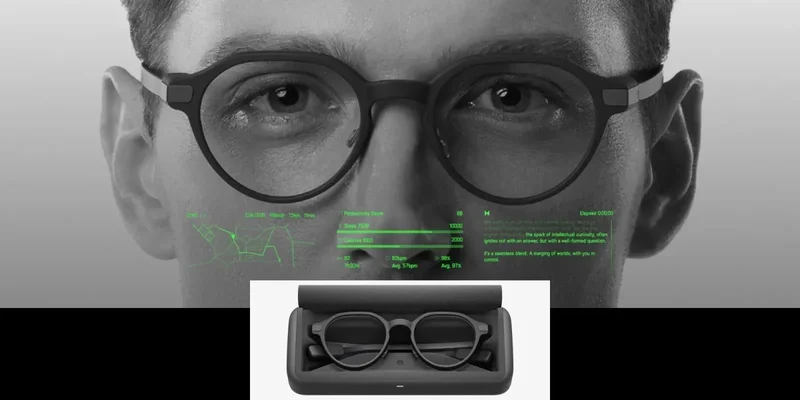
The Even Realities G2 look remarkably unremarkable. The built-in lenses are clear, with clip-on sunglass covers. It’s really only the bulky touchpads at the end of the arms that make them stand out somewhat. It’s the same story when wearing them: they weigh just 36g (1.3 ounces), so don’t feel any different to conventional eyeglasses or sunglasses.
They use waveguide technology for the displays – that is, small projectors embedded into the front of the arms project light onto lenses embedded into each side of glasses. This creates a green monochrome display very much reminiscent of old-school cathode-ray tube monitors.
They’re controlled by tiny trackpads at the end of each arm. Supported gestures are taps, double taps, long presses, and swiping back and forth.
What can they do?
- Conversate: Transcribe conversations, and provide AI context
- Answer AI questions
- Translate between languages
- Act as a teleprompter, with speech recognition for automated scrolling
- Display notifications
- Provide turn-by-turn navigation (only walking and cycling supported as yet)
- Add spoken items to a to-do list, and display that list
- Display a dashboard with configurable info like calendar, health data, etc
First impressions
I should say that not all of the capabilities are particularly relevant to me. I don’t see great value in an AI answering quick questions by displaying text on a screen. Even with Ray-Ban Meta glasses, with their built-in camera to perform the equivalent of Apple’s visual intelligence, I consider it mostly as a gimmick for now – though I do think there is long-term potential. Similarly, I don’t need to give speeches, so a teleprompter feature isn’t relevant to me.
The three features that do impress me to varying degrees are navigation, translation and notifications.
For cycling in particular, having a live head-up display is massively better than having to look down at an iPhone, even when it’s mounted on the handlebars. For walking too, it’s just a far slicker experience. I said years ago that I saw this as one of the killer apps for smart glasses with a display, and using one has very much reinforced my view – though there is one cautionary note I’ll get to in a moment.
The translation feature is fantastic. Sure, it doesn’t do anything that can’t be done on the iPhone, but it feels like a much more natural thing to maintain eye contact with the person you’re speaking with, and seeing the translation hovering in the air between you somehow quickly grows to feel very normal.
I’ve tested it with several languages, each time also letting the native speaker wear the glasses to see the translation of their own words, and all were impressed.
Is it better than AirPods translation, which uses audio rather than text? I think this is probably a matter of taste, but I have to say that personally, I greatly prefer being able to listen to the person’s voice while seeing their words transcribed.
The question here, of course, is whether this feature helps justify a purchase. If you travel frequently, then this may well be the killer feature for you. The rest of us, however, don’t need translation in our day-to-day lives: it’s something we need perhaps once or twice a year. In my view, even a really great feature that meets only a rather occasional need is a tough sell.
Having notifications appear on the glasses while either walking or cycling is for sure more convenient than having them pop up on a phone or Apple Watch, but it’s not a big enough deal to make it a selling point. It’s only a nice bonus if you can already justify glasses like these for another reason.
A potential safety issue
The glasses do not in any way obstruct your view of the world around you. They are either completely transparent or act like perfectly standard sunglasses. The text that appears is just a few pixels wide and is in any case semi-transparent.
However, I’ve found that the display can be a distraction. When cycling, for example, I found myself concentrating on the map for a few seconds rather than the road ahead of me, and although nothing happened, I was quite startled by how completely my attention had been diverted despite a completely unobstructed view of what was in front of me. I’ve found a similar effect while walking.
My jury is currently out on this one. I don’t know whether the novelty of the glasses have an impact, nor whether it’s something we would adapt to. I’ll report back on this next time.
The big question: Are they enough?
The UK is having an uncharacteristically hot and sunny summer, so I’m wearing sunglasses pretty much full-time while outside. There is literally no downside to using smart display glasses in these circumstances, given I’d be wearing ordinary sunglasses otherwise.
But what about times when I wouldn’t otherwise be wearing glasses? Are the benefits of these sufficient to justify doing so? This is the question I had when I first wrote about the concept many years ago, and I haven’t yet reached a conclusion.
They cost $599 for the clear glasses, with the clip-on sunshades adding another $99. Prescription lenses cost anywhere from $159 to $349 depending on the strength. For someone who wears eyeglasses anyway, I could see that the additional cost might be worth it. Whether the cost would be justified for the rest of us is a very different question, and of course we can expect Apple’s equivalent to be significantly more expensive.
Right now, I’m pretty wowed by the experience of using them. They are undoubtedly a very cool form of tech, and when I’ve invited friends to try them, they’ve universally felt the same. But will they feel worthwhile once the novelty wears off? That’s the big question for me right now.
Watch this space.