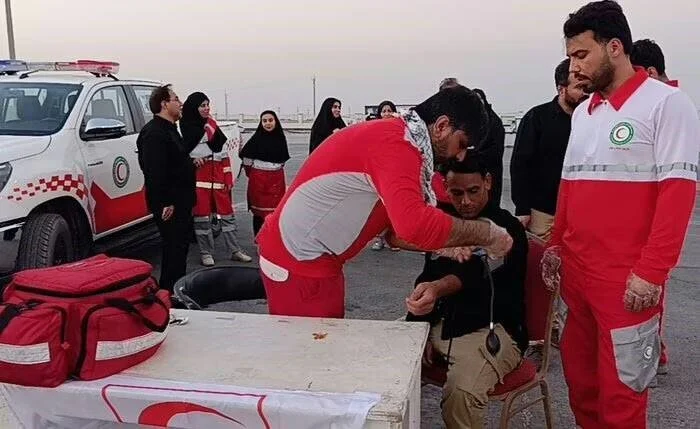
IRCS elaborates on services provided for Arbaeen pilgrims
TEHRAN – The head of the Iranian Red Crescent Society (IRCS), Pirhossein Kolivand, has expounded on a diverse range of services offered by the IRCS staff to people attending the Arbaeen pilgrimage.
Some 120,000 operational teams in the country and 8,500 relief workers and volunteers have been dispatched to Iraq to provide health, medical, rescue, and relief services to the pilgrims, ISNA quoted Kolivand as saying.
The official made the remarks on Thursday while overseeing the IRCS services in Khuzestan province.
The IRCS utilizes rescue equipment like ambulances, ambulance buses, rescue vehicles, command vehicles and helicopters to cover the Arbaeen pilgrimage. The society has also set up four hospitals and tens of clinics to serve pilgrims on the way from Najaf to Karbala, he added.
Mobile medical teams equipped with medical backpacks deliver health services between clinics and hospitals, Kolivand noted.
The official went on to say that the IRCS, in cooperation with Iraq’s ministry of health, the Iraqi Red Crescent Society, and other medical institutions, continuously monitors pilgrims’ health, communicable diseases, and supervises food preparation and distribution in mawkebs.
In case needed, ambulances or helicopters will transport patients to the borders to be treated inside the country, he further noted.
According to the IRCS, more than 36,000 pilgrims have received rescue services from the IRCS over the past ten days. From July 21 to 31, a total of 184 operational teams consisting of 621 rescuers provided medical services to 36,609 individuals, IRNA reported.
The IRCS relief teams transported 98 people to medical centers, provided emergency accommodation for 36,284 individuals, and treated 227 others on site.
‘Regional countries can use Iran’s experience in managing Arbaeen pilgrimage’
Hossam Elsharkawi, the International Federation of Red Cross and Red Crescent Societies (IFRC) Regional Director for the Middle East and North Africa (MENA), has highlighted Iran’s experience in managing the Arbaeen pilgrimage, saying that the country can serve as a regional hub to train other nations and share expertise with them.
The shared mission of Red Cross and Red Crescent societies worldwide is to support people and provide humanitarian services to them; Iran has valuable expertise in mass gathering management, which has to be shared internationally, Mehr news agency quoted Elsharkawi as saying.
The official made the remarks while addressing the sixth International Congress on “Health in Arbaeen”, being held in Tehran on July 19 to 20.
“The international federation is striving to create a platform to transfer Iran’s knowledge, scientific documentation, and experience on mass gathering management to other countries, as this experience is truly golden and unparalleled globally,” he stressed.
The official went on to say that the IFRC is currently is consulting and exchanging views with Iranian officials to establish an educational hub for mass gathering management in the country, a center that would provide ongoing specialized training, preserve and pass on the knowledge to future generations.
This year, 515 articles were submitted to the congress, out of which 19 articles will be delivered as lectures, and 22 as posters. The congress is hosting 105 lecturers in different sectors this year, IRNA reported.
The congress includes 25 scientific panels and eight training workshops, which highlight the idea that health in mass gatherings depends on interdisciplinary research and multi-center studies, analyzing data, and utilizing modern technologies—including artificial intelligence and modeling.
Later, Elsharkawi, in a letter to Kolivand, highlighted that the IRCS’s extensive readiness to serve millions of Arbaeen pilgrims is an inspiring manifestation of the noble spirit of humanitarianism.
The high readiness of the relief fleet, specialized vehicles, and rescue helicopters; coordinated earthquake response drills; the capabilities of search-and-rescue teams; and the efficiency of communication and aerial relief systems demonstrate the full preparedness, expertise, and operational capacity of the IRCS, which have developed over many years, he stressed.
He said the society’s capabilities in producing medical items, equipment, and relief supplies are a testament to self-reliance, innovation, and sustainable humanitarian development,
According to Elsharkawi, these achievements serve as a model of excellence for all national societies within the International Red Cross and Red Crescent Movement.
The official expressed hope that the cooperation between IFRC and IRCS would expand further, advancing their shared humanitarian missions.
MT/MG