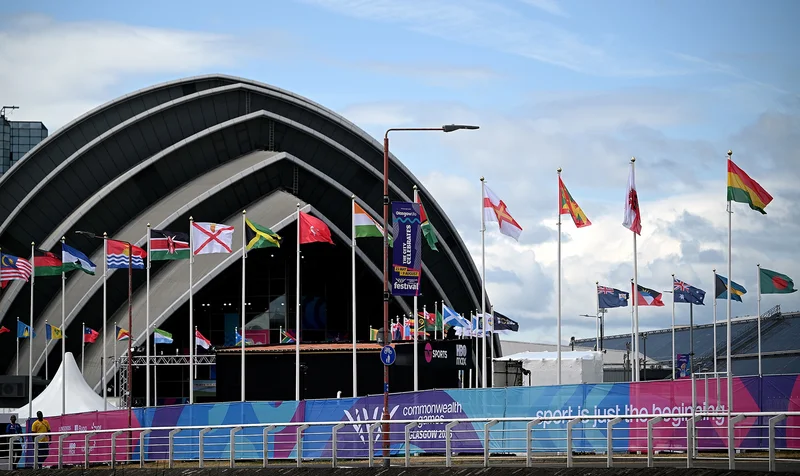
This yearâs Commonwealth Games in Glasgow look a little different.
When Australia withdrew as host of the 2026 edition three years ago, the withdrawal reignited concerns about the sustainability of a sporting event that has increasingly struggled to attract hosts amid rising costs and a crowded international sporting calendar.
Eventually, in late 2024, the Scottish city of Glasgow was confirmed as the host city with a reduced model featuring just 10 sports across four existing venues.
Dr Donald Rukare, the president of Commonwealth Sport, previously argued that this âreimaginedâ version of the Games represents the model of the future and will keep the event relevant.
In contrast, Tony Simpson, sport industry lead at Oliver Wyman and a senior fellow at the World Economic Forum, said that while Glasgow 2026 offers a model, it is not the model.
Simpson told Daily Maverick that the Commonwealth Games could survive if they moved away from an expensive, Western-centric hosting model and instead embraced Africa and Asia through shared hosting and a broader âfestival of sportâ concept.
The current model is unsustainable
The challenges of sustainability facing the Commonwealth Games are not unique.
The Olympics faced similar struggles. Just two cities bid for the 2024 Summer Games, which resulted in Paris and Los Angeles being awarded 2024 and 2028 respectively. Brisbane was later awarded the 2032 Games as the sole bidder. For the 2022 Winter Olympics, at least five potential hosts withdrew from the bidding process.
The contrast can also be seen in Commonwealth Games budgets. Glasgow 2026 cost approximately £160-million, which is a drastic drop from Birminghamâs budget of £778-million. Before Victoria withdrew, projections suggested the Australian edition would cost four times that amount.
Part of the leaner budget for Glasgow stems from the smaller sports programme, but also the city could rely on existing infrastructure.
âI think the single biggest reason for the dropout of any country is the cost of infrastructure and the cost of hosting and running the games, which is an outdated model,â said Simpson.
For Simpson, the future of the Commonwealth Games, and major sporting events more broadly, lies in the use of existing infrastructure and co-hosting arrangements similar to the recent Fifa World Cup.
âSo if you had Lagos, Accra and Nairobi co-hosting something, or South Africa, Nairobi and Cairo hosting an African version of this, I think it would be really dynamic and really different,â he said.
Additionally, with the Commonwealth Gamesâ colonial legacy, Simpson also envisioned a cultural evolution of the Games which he called a âfestival of sportâ spread across multiple countries and over a longer period.
âThe key thing for a Commonwealth Games â the value for the country or the host cities â is the opening and closing ceremonies,â he said.
âI can see a time where the opening and closing ceremonies are things that people bid for and, over a two- or three-month period, youâd have swimming in Australia, you could put T20 cricket in the Caribbean, cycling in Rwanda and you could have your track and field in London. Thereâs no reason why you canât do that.
âIt then becomes a greater broadcast product. Itâs over a bigger period of time, you can monetise it better, itâs more equitable and youâre not competing with an international calendar.
âIt is something that should be joyful. Itâs something that might involve culture, music and economics. And so weâre creating a new gathering and a new reason to be the Commonwealth.â
Why Africa and Asia are central to the future
Simpson argued that continuing to focus primarily on traditional sporting markets in Europe, North America and Australia was ultimately limiting the Gamesâ, and mega-sporting eventsâ, long-term potential.
âThe current model of going to North America or Europe or Australia for these sports, because thatâs where the money is, is short term and a race to the bottom,â said Simpson.
The mission was to always grow the game and drive participation, said Simpson. Reimagining the Commonwealth Games started with recognising where its future participants and fans lay to be able to exploit economic opportunities.
âYou can collect as much money as you like but thereâs a point where youâre thinking, thereâs nobody watching or thereâs nobody playing.â
The Commonwealth consists of 56 nations, with Africa and Asia accounting for more than half of its membership and a significant share of its young population. Africa alone is home to roughly 28% of the worldâs young people.
That demographic profile gave the Commonwealth Games something unique, Simpson argued, and something events such as the Olympics and World Athletics Championships, for example, could not easily replicate.
âThe reality is, Africa and Asia represent the future in many ways of young people, certainly on our planet and in sport participation. So, it needs to be African- and Asian-centric in terms of the Commonwealth Games itself,â said Simpson.
A shift toward Africa and Asia would require a shift from its dependence on Western and Eastern broadcasters, said Simpson, and with that a rethink of the sporting programme itself.
India, for example, in terms of population, was the Commonwealthâs largest member and one of the worldâs biggest cricket markets. Therefore, cricket should sit at the centre of a modern Commonwealth Games, argued Simpson. He also pointed to sports such as kabaddi, which attracts hundreds of millions of viewers in India.
âIt takes the empire-ness out of it and represents the new Commonwealth,â said Simpson. âI think thatâs a great way to bring in fresh money, fresh eyeballs and fresh thinking.â
Sportâs future tied to environmental, social sustainability
According to the World Economic Forumâs 2026 Sports for people and planet report, sport was a major global economic driver, generating $2.3-trillion annually in total revenue and was projected to grow to $3.7-trillion by 2030.
However, that growth was increasingly threatened by rising physical inactivity and environmental pressures such as extreme heat, pollution and severe weather.
The report warned that these challenges were interconnected in that environmental degradation discouraged participation in sport and physical activity, while less active populations were more vulnerable to climate-related health risks.
If these trends continued unchecked, the global sports economy could lose up to 14% of its annual revenue ($517-billion) by 2030.
Additionally, it risked condensing an already compact sporting calendar even more, said Simpson.
âThere will then be less revenue opportunities for broadcasters and less time for athletes to perform at their best, because if there are only eight months of the year where you can stage major events, the calendar becomes incredibly condensed,â he said.
âThe calendar is really full and thereâs only a finite amount of money to spend in sport. Ultimately everybodyâs chasing the same dollar, but actually the weather is condensing it down.â
For Simpson, the solution lies partly in designing cities and event infrastructure with accessible green and blue spaces where communities can run, swim and participate in sport safely, especially once an event has come and gone.
âWe donât want a situation where elite sport is perceived as something for people flying in and out of the country, and then the locals donât have any real benefit,â he said.
Going back to the Commonwealth Games, the starting point was not trying to replicate any other major sporting event in the world, said Simpson. The future of the event did not lie in becoming a smaller version of itself or a version of the Olympics, but in embracing its own identity, one that was centred on youth, local communities, culture and the rapidly growing sporting markets of Africa and Asia. DM