WASHINGTON — Members of Congress can watch tanks maneuver, tour warships and see combat aircraft fly. Space Force leaders have no comparable way to demonstrate the battlefield they oversee — one where satellites travel at thousands of miles an hour, but the maneuvers that determine an encounter can unfold over days.
Satellites can be inspected while they are being assembled, but a spacecraft on a factory floor reveals little about how it will operate in orbit, support military forces on Earth or become the target of an adversary. That problem led the Space Force Association to develop a visual environment that could make military operations in space more comprehensible to policymakers and the public.
The result is the National Spacepower Center, an industry-backed education and simulation center organized by the association. Its developers are building an unclassified digital environment that combines orbital tracking data, spacecraft engineering models, command-and-control software and immersive displays to illustrate how satellites operate — and how a confrontation in orbit could affect a military campaign thousands of miles below.
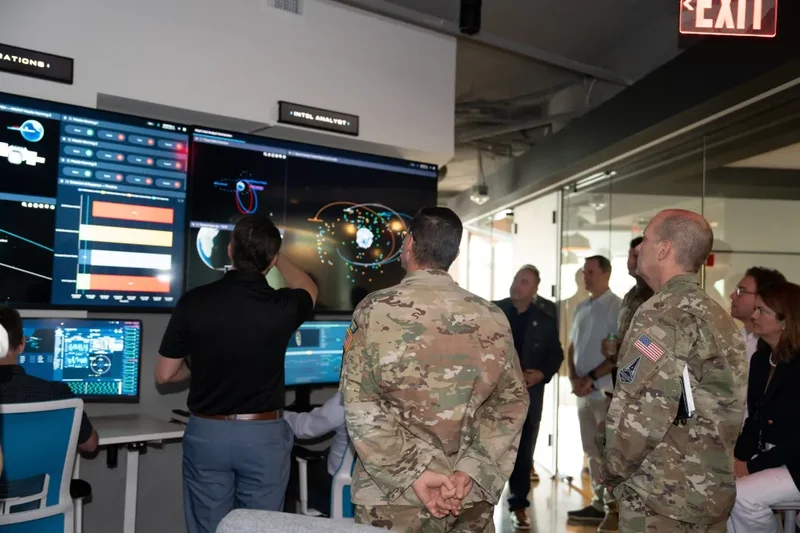
The center’s first integrated prototype, demonstrated July 21 at the Arlington, Virginia, offices of simulator software company Sedaro, took on a concept known within the space community as “dogfighting.” Space Force Chief of Space Operations Gen. Chance Saltzman and Lt. Gen. Douglas Schiess, who is expected to succeed him, watched a simulated encounter in which an adversary spacecraft approached a U.S. missile-warning and missile-tracking satellite.
‘Space dogfighting’
The phrase “space dogfighting” evokes fighter aircraft turning tightly in pursuit of one another. Orbital combat bears little resemblance to that image. Spacecraft cannot simply change direction, accelerate toward a target and then turn away. Their operators must work within the constraints of orbital mechanics, plan engine burns at precise times and wait as small changes in speed gradually alter the satellites’ relative positions.
The prototype was intended to make that slow, highly choreographed process visible. It showed how an adversary satellite in a highly elliptical orbit could maneuver near a U.S. missile-tracking spacecraft supporting an operation in the South China Sea. In the scenario, the approaching spacecraft jammed the U.S. satellite, disrupting the missile-warning and tracking data being supplied to forces on Earth. A second vignette introduced a friendly satellite that could intercept the adversary spacecraft and allow the military mission to resume.
“It showed the dynamic environment,” said Dillon Cox, a Sedaro executive and Space Force Association chapter leader overseeing the National Spacepower Center.
The demonstration also confronted a basic problem with portraying orbital activity. The spacecraft themselves move extremely fast, but the strategic maneuver may take hours or days to develop. A useful visualization has to compress that passage of time without distorting the underlying physics. Viewers must be able to see how a relatively small engine burn changes a satellite’s path and eventually places it close enough to observe, jam or otherwise threaten another spacecraft.
Cox described the encounter as less a chase than a carefully timed performance.
“It looks like this is happening really fast, but in reality, we are planning and going out and actually doing a ballet,” he said. “All of this has to be executed at the perfect time. It needs to be in harmony.”
Depicting an orbital battle
That distinction is central to the Space Force’s broader effort to explain its operations. Service leaders have frequently noted that lawmakers can visit bases, ships and training ranges operated by the other military services but cannot tour an orbital battlefield. Officials can describe a satellite’s mission or show the hardware before launch, but neither provides an intuitive sense of how objects move relative to one another in space, how an adversary might interfere with them or what the loss of a spacecraft would mean for forces on the ground, at sea or in the air.
The National Spacepower Center is meant to provide an immersive substitute. Space Force Association officials say it is not intended to be another conference venue or conventional think tank. Instead, the center would allow officials to experience simulated military space scenarios in a setting that presents orbital activity alongside its effects on terrestrial operations.
For now, the center remains an internal association project. It has no permanent location, sustained funding mechanism or disclosed sponsorship agreement with the Space Force.
The effort is being financed by the Space Force Association and a group of companies known as the National Spacepower Center industry consortium, according to Damon Feltman, the association’s chief executive. The initial members are Redwire, COMSPOC, Sedaro, OpenC3 and TigerVision.
Each company supplied a different part of the pilot. COMSPOC contributed commercial orbital tracking data and maneuver analysis. Sedaro provided the physics-based simulation platform and integrated the scenario, analytics and visualizations. Redwire supplied spacecraft engineering models that represented vehicle performance, subsystems and operational constraints. OpenC3 contributed command-and-control software used to handle commands and telemetry. TigerVision provided the curved 15-by-10-foot, 4K display on which the scenario was presented to the Space Force leaders.
The companies used internal research-and-development resources to assemble and integrate the prototype in less than four months, Cox said. Saltzman suggested that the first scenario focus on dogfighting in space.
Feltman said the idea for the center emerged from a conversation with Saltzman more than a year ago about the difficulty of explaining space operations to Congress and the wider public. The early consortium members concluded that existing physics-based simulation engines and spacecraft models could be combined to address that problem.
“The point of the prototype was to showcase how all the pieces could come together, how industry can cooperate in an environment with unclassified but trusted open-source data,” Feltman said in an interview.
The use of unclassified data is important to the project’s intended audience. Classified systems may provide a more detailed picture of threats and military capabilities, but they sharply limit who can see the results. The association wants a platform that can be used with lawmakers, congressional staff, allied representatives, military leaders and members of the public who do not hold clearances.
“There is a ton of stuff that you can do based off of unclassified open-source data that advances the narrative of spacepower and space security,” Feltman said.
Instead of building a new simulation environment from scratch, the consortium connected existing tools developed for orbital analysis, spacecraft design, mission operations and visualization.
Seeking more participants
SFA hopes the Space Force eventually adopts some version of the capability, Feltman said, potentially through a project contract or a specialized research activity.
“The way we’re doing it right now, it’s Space Force Association plus a handful of industry partners donating their time and talent,” he said.
Space Force officials who attended the demonstration discussed possible applications in strategic education, mission analysis, experimentation, force development and acquisition, said Feltman. A simulation environment could, for example, help officials examine how a satellite design or proposed operational concept would perform under different threat conditions.
But the project’s organizers are sensitive to the perception that a system designed to show threats to satellites could become a tool for lobbying Congress for larger budgets or promoting specific programs. Feltman said the center’s purpose is educational: to improve understanding of the operational challenges, risks and tradeoffs involved in using and defending space systems.
“It’s not always about getting more money,” he said. “It’s about spending the money that’s already out there in the best way possible.”
He argued that better visualizations of orbital threats could help officials make more informed decisions, and could also make military vulnerabilities more vivid at a time when the Space Force is investing in satellites capable of maneuvering, surviving attacks and operating through interference.
For the moment, the prototype is closer to a proof of concept than a finished product. The association is seeking additional companies willing to contribute internal research-and-development funding, create new scenarios and improve the underlying models and simulations.
“We certainly have room for more,” Feltman said.