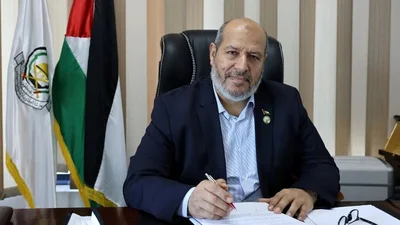
Hamas has elected Khalil Al Hayya as the new head of its political bureau, placing one of the movement’s most experienced negotiators at the centre of its leadership during a period where Gaza is still facing Israeli genocide and the region faces a renewed war.
The movement announced the result on Monday after an internal ballot of the leadership in which Hayya secured 35 votes, narrowly defeating Khaled Meshaal, the head of Hamas abroad and a former political bureau chief, who received 34, according to Al Jazeera Arabic Palestine bureau chief, Walid Al Omari.
The vote completed a leadership process that began in May after Hamas failed to settle the contest in its first round.
Hayya, who is based in Qatar, succeeds Yahya Sinwar, who took charge after Israel assassinated Ismail Haniyeh in Tehran in July 2024. Israeli forces killed Sinwar during fighting in Rafah three months later.
In the months that followed, Hamas relied on a five-member interim council led by Mohammed Darwish, the head of its Shura Council, to manage its political affairs and oversee negotiations.
New MEE newsletter: Jerusalem Dispatch
Sign up to get the latest insights and analysis on Israel-Palestine, alongside Turkey Unpacked and other MEE newsletters
Hayya’s election now restores a single figure to the top post and underlines the movement’s ability to reorganise despite Israel’s sustained campaign to assassinate its senior leadership.
In an effort to scupper ceasefire talks, Israel attempted to assassinate Hayya along with the rest of the Palestinian negotiating team in Qatar in September of 2025.
The attack drew international condemnation, with critics describing it as “gangster behaviour”.
Prominent negotiating figure
Hayya became one of Hamas’s most recognisable political representatives during Israel’s genocide on Gaza.
For more than two years, he led the movement’s negotiating team through talks over ceasefires, prisoner exchanges and the future of Gaza.
That role placed him at the centre of diplomatic efforts involving Qatar, Egypt, Turkey and other regional powers.
Born in Gaza City on 5 November 1960, Hayya grew up under the shadow of Israel’s occupation after the 1967 war.
He pursued Islamic studies and later earned a doctorate in Hadith sciences after graduating from the now destoryed Faculty of Islamic Theology at the Islamic University of Gaza.
His political journey began after he met Hamas founder Sheikh Ahmed Yassin in 1980.
Over the following decades, Hayya rose steadily through the movement. He joined its political bureau, served as deputy leader in Gaza and took responsibility for relations with Arab and Muslim countries.
Women and children watch from a window the funeral of Azzam Khalil Al Hayya, son of the then deputy chairman of Hamas' Political Bureau Khalil Al Hayya, after the former was killed the previous day by Israeli bombardment, in Gaza City on May 7, 2026. (Omar Al Qattaa/AFP)
Palestinians elected him to the Palestinian Legislative Council in 2006, where he led Hamas’s parliamentary bloc following the first elections held in Palestine.
Israeli forces detained him several times, including during a lengthy period of imprisonment in 1991. He also survived repeated assassination attempts.
Family members and sons killed
Hayya’s family has also paid a significant price over the decades following Israel’s attacks on Gaza and Hamas officials abroad.
Hamas decision to dissolve Gaza government is a nod to Trump, expert says
Israel has killed four of his sons: Osama, Hamza, Hammam and Azzam.
Hamza, a member of Hamas’s armed wing, was killed in an Israeli missile strike east of Gaza City. Israel killed Osama, his wife and three of their children when it bombed their home during the 2014 war.
In September 2025, an Israeli strike targeting Hamas negotiators in Doha killed Hammam. And in May 2026, Israel also killed Azzam in Gaza in an attack that left at least one other person dead and nine wounded.
His surviving son, Ezzedine, suffered wounds in an Israeli attack on Gaza City’s Tuffah neighbourhood in April 2025.
Hayya himself survived an Israeli assassination attempt in 2007. The attack killed seven members of his extended family, including two brothers, four nephews and a cousin.
Israel also killed one of his grandchildren in an attack on a school in Gaza City in April 2025.
Hayya now takes command of Hamas at a time when the movement, Gaza and the wider Palestinian cause stand at a crossroads.
Gaza lies in ruins and faces almost daily Israeli attacks despite a ceasefire agreement that Hamas accepted and Israel has repeatedly violated, with more than 60 percent of the strip under occupation by Israeli forces.
Israel has also made no secret of its intention to ethnically cleanse the besieged enclave and expand its campaign across the occupied West Bank.
Palestinians will now be watching to see where Hayya leads the movement – and what his leadership will mean for their wider struggle.