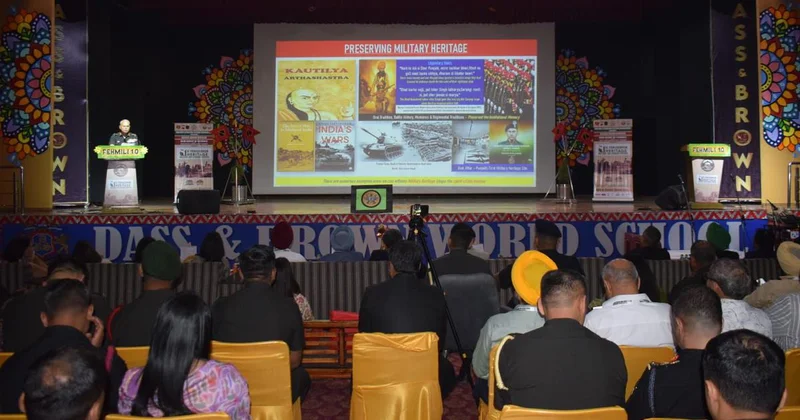
Ferozepur, a garrison border town in Punjab abutting the present-day India-Pakistan border, hosted the first edition of the Ferozepur Heritage, Military, and Literary Festival earlier this year – the result of a collaboration between The Military Literature Festival Association, Chandigarh, the Golden Arrow Division and the Ferozepur Literati Association. The Festival aimed to raise awareness about the rich heritage of the region, promote tourism, and showcase the glorious legacy of the Indian Armed Forces. The festival successfully transformed its primary venues – Dass and Brown World School and Sunder Singh Stadium, Ferozepur Cantt – into hubs of intellectual discourse and military pride, bringing together gallantry award winners, literary scholars, and thousands of residents.
Time travel through history
Ferozepur district was the first to be formed in Punjab and is steeped in cultural and martial history, heroic valour, and sacrifice in pre- and post-independence eras. Owing to its strategic position – near the northwestern border, its involvement in many of the geopolitical conflicts down the ages has been inevitable. As a resident of Ferozepur and a heritage enthusiast of the region’s heritage and historical legacy, the force behind the organising initiative, Anirudh Gupta, CEO of the DCM Group of Schools and President, Ferozepur Literati said, “Our family was one of the first to have migrated from across the border and being the son of the soil, I had harboured this idea for a long time. As an educationist and the largest employment generator for the region, I had three concerns: how to bring the region into the national consciousness as a heritage outpost, to boost tourism, and thereby the economy of the border town.”
As someone who has written extensively on Ferozepur heritage – including a coffee table book on this theme – Gupta explained how the spadework done over many years resulted in the realisation of a literature festival starting with the setting up of the Indian National Trust for Art and Cultural Heritage (INTACH) chapter in Ferozepur.
Even to a tourist on a cursory stroll, the many memorials and museums dotting the town are unmissable. At the National Martyrs’ Memorial at Hussainiwala precincts that commemorates the sacrifice of revolutionaries Bhagat Singh, Sukhdev, and Rajguru, one finds the remains of the Kaiser-i-Hind bridge, built in 1885-87. This fort-like engineering marvel was once a broad-gauge railway lifeline from Lahore, across the river Sutlej to Ferozepur. It bears the hallmark of time travel with preserved railway tracks with a bridge that finishes midway, going nowhere. Interestingly, it is in Ferorozepur Turi Bazaar where Bhagat Singh was hiding during his exile.
The land of martyrs is home to many military expeditions and memorials. The historic Saragarhi Memorial Gurudwara, which was built to commemorate the sacrifice of 21 Sikh soldiers who perished at Saragarhi in Baluchistan in 1897, finds a place in the garrison precincts, along with the Barki Memorial in the same compound. On September 12 every year, people gather here to pay tribute to the heroic soldiers and celebrate Saragarhi Day. The Barki Memorial was constructed in 1969 to commemorate the sacrifice of the soldiers of the 7th Infantry Division in the Battle of Barki. The memorial stands as a proud witness to the martial history of the Indian Army. It has a pillar in the centre, a captured Pakistani M47 Patton tank with a Barki milestone on the south, and a water fountain on the north. It was, then, only befitting that the inaugural edition of the festival began with a wreath-laying ceremony at the Barki War Memorial.
Highlighting frontier history
Topographically strategic, Ferozepur is located on the banks of the river Sutlej, its rich waters contributing to making it a trade hub. The convenience of country-made boats on it to carry out trade, and later the intricate railway network, made the town a transit point for trade and commerce. The Ferozepore Fort is yet another lesser-known gem found in the annals of history. Much of its history dates back to the 1830s when the East India Company set up a military installation in a mud-and-brick frontier magazine that was later converted into an arsenal, the biggest, even at the time of the Second World War.
It is a star fort, also called a bastion fort or trace italienne, “which is a fortification in a style that evolved during the age of gunpowder when the cannon came to dominate the battlefield,” such as Fort Bourtange in the Netherlands. In 1839, Sir Henry Lawrence, who was stationed at Ferozepur as the assistant political agent to the NW Frontier during the early years of British occupation, along with his wife Honoria, used to stay in the fort’s two rooms. The guided tour of the Fort was another attraction at the festival, as it is now open to the public and is a shining example of civil-military collaboration.
The festival, in its sessions on the Anglo-Sikh wars, women’s empowerment and the army, small-town built heritage conservation, and the significance of Punjab in national and global history, was a feast for history buffs. The two-day event had a wide range of activities, from a painting exhibition highlighting the region’s history, movie screenings, author interactions, engaging panel discussions, book signings, a military equipment display, and interaction sessions with gallantry award winners. Major General Ranjeet Singh Manral shared that ”This event will go a long way in highlighting the valour, sacrifice, and commitment towards the Armed Forces,” and added, “At the same time, it will motivate the local youth drawn from schools and colleges to join the Armed Forces.”
For the organisers, rural, military and heritage were the three tourist tracks that were looked at while realising the roadmap of the festival and highlighting frontier history with an aim to view Ferozepur beyond an agro-based economy. There are plans in place now for making it an annual affair, as it is set to transform the border city into a hub of tourism and a vibrant intellectual, cultural space – a shot in the arm for the local economy. Gupta shares, “We plan to keep up our efforts to foreground frontier heritage and start an educursion called, ‘Along the Zero Line’ that will have students from across the country witnessing built heritage in the region, commemorate the sacrifice of Bhagat Singh, Rajguru and Sukhdev at the National Martyrs Memorial that stands as a testimony to the valour of the Bravehearts, along with a getting view of the life of people in border towns.” And to chart the journey thus far on this historic endeavour he shares Majrooh’s verse:
मैं अकेला ही चला था जानिब-ए-मंज़िल मगर
लोग साथ आते गए और कारवाँ बनता गया
I walked alone towards the destinationPeople joined me, and it became a caravan.
We welcome your comments at letters@scroll.in.