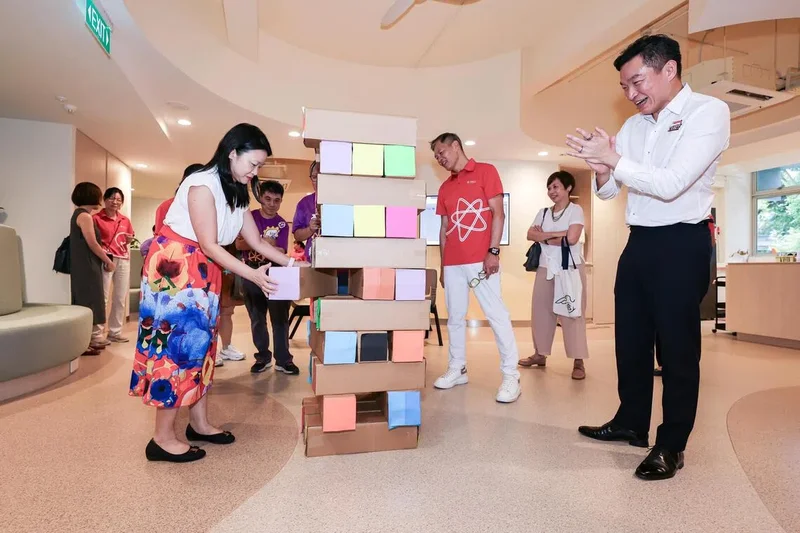
Bigger space, new activities: TOUCH Centre for Independent Living moves to Enabling Village
SINGAPORE – Teo Shui Shan, 30, learnt to brush her teeth properly only in 2025, after she started attending a day activity centre (DAC) in 2025.
She was diagnosed with global developmental delay at one year old.
Her father William Teo, 66, accompanies her to the centre every Wednesday and Thursday from their home in Yishun.
“Now the DAC is a lot more convenient because it’s a five-minute walk away from Redhill MRT and (the path is) entirely sheltered,” he said.
Previously located in Bukit Merah Central building, the TOUCH Centre for Independent Living moved to the Enabling Village in Lengkok Bahru and officially opened on July 31. It offers competency-based training programmes for persons with mild to moderate intellectual disabilities.
Now wheelchair accessible, the centre is a quarter larger than before, taking up about 662 sq m on the second floor of the Playground Block, next to Fei Yue Community Services.
The centre has four classrooms and five zones including Learning Zone, Social Zone and Vocational Zone. It also has a kitchen area and an oasis with cushioned seating.
Operated by Touch Community Services, a voluntary welfare organisation, the new premises can serve a maximum of 52 people, up from 42 at its former location. There are currently 40 clients, including four with hearing losses.
The larger space allows for more activities, such as cleaning and home upkeep. While the previous space only required one or two people to sweep the floor, the new premises can accommodate up to five people doing the task.
Mr James Tan, CEO of Touch Community Services, said that the integrated environment at the Enabling Village also allows them to curate innovative programs that strengthen pathways for persons with disabilities after they turn 18, and enhance support for their caregivers.
One such programme involves checking the quality and packing art products, such as umbrellas and tote bags, to be sold under Journey, a brand by Touch Community Services.
The centre will build four progression pathways: employment, visual art, performing arts and sports.
Speaking at the official opening, Senior Parliamentary Secretary for Law and Social and Family Development Eric Chua said that inclusion is a long-term commitment that people in Singapore must build together and intentionally.
Chua, who is also a member of the Taskforce on Assurance for Families with Persons with Disabilities, wore a pin designed by Thaddino, an artist with autism.
“In Singapore, persons with disabilities want more than simply to be looked after. Like all of us, they want to make choices, build relationships, contribute, and also take part meaningfully in the community,” he said.
“We are taking a more holistic life course approach – one that recognises each person’s strengths and aspirations.”
Established in 2015, the Enabling Village is Singapore’s first inclusive community space. It was developed by SG Enable, a focal agency for disability, and the Ministry of Social and Family Development.
SG Enable facilitates gathering for tenants several times a year, providing a platform for them to connect and plan programmes. There are currently 36 other tenants.
The TOUCH Centre for Independent Living is exploring collaborations with Mad Roaster’s Slow Bar and EatTalk. These may include weekly lunch at Eat Talk for clients.
Noorjannah Abdul Wahab, 46, has been with the centre since 2024. She travels there by a chartered bus service.
Noorjannah, who has intellectual disability, enjoys drawing and her artwork has been printed onto cushion covers.
She told The Straits Times that she loves the new location and does not miss anything about the old place.
As for Teo Shui Shan, she has made many friends at the centre and even developed an interest in basketball.
Her parents observed that she has improved her communication skills and now throws fewer tantrums.
“We want to prepare her to be more independent because we are getting old. She needs to be able to take care of herself, do her own chores and buy her own food,” said her mother Emily Chua, 65.