Sign in. It’s quick, free and it’s up to you.
An account is an optional way to support the work we do. Find out more.
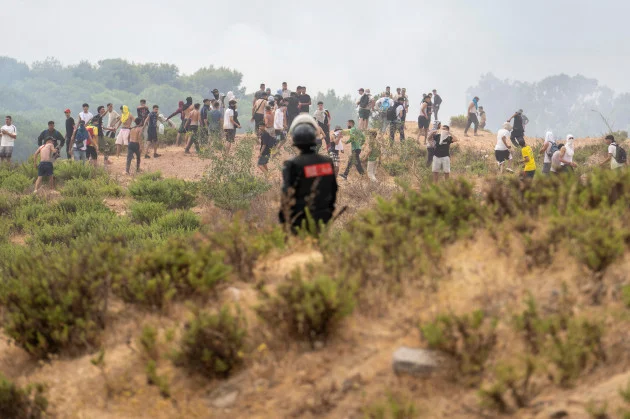
AS TENS OF thousands of migrants crossed into the Spanish enclave of Ceuta in the past days, misinformation about the events has spread.
About 60,000 migrants have entered the Spanish territory in North Africa which had a population of about 83,600.
At least 43 people died while making the crossing.
It is not immediately clear what has prompted so many migrants to cross to Ceuta.
As of today, tens of thousands of those migrants who reached Ceuta have already returned to Morocco, according to Spanish media citing the interior ministry.
However, conflicting false statements, largely pushed by far-right activists, have exaggerated narratives about the Spanish government’s response.
Some have falsely said that authorities aren’t doing anything or were encouraging the migrants to come. Others said that the migrants were prisoners who had been pardoned and let out of prison to celebrate the anniversary of the Moroccan king’s coronation.
Many of the posts seem to simply misunderstand where Ceuta is.
“Thousands of migrants breaking into Spain through the southern border,” Michael McCarthy said in a 30 July video shared more than 111,000 times on Facebook and 12,100 times on Instagram.
“This is happening in the south of Spain now.”
His geographic blunder was far from the only one. “The whole coast was just covered in migrants, and now they’re spreading across the country,” an account called Daz News said on Instagram the same day.
However, while it is under Spanish rule, Ceuta is not geographically a part of Spain.
Rather, Ceuta is an 18.5 square kilometre peninsular area on the north coast of Africa, directly south of the British territory of Gibraltar.
While it has been controlled by Spain in some form since the 1600s. It now considered an “autonomous city”, as well as a “special territory of members of the European Economic Area” — meaning different rules apply to it. For example, it is considered part of the EU, but not part of the customs union.
Ceuta is nominally also part of the Schengen area for visa purposes, but checks are carried out on all passengers travelling between the territory and the rest of Europe.
Given that the city is not geographically connected to Spain, it is misleading to refer to it either as the south of Spain, or Spain’s southern border. And claims that migrants were “spreading across the country” are also incorrect.
Ceuta is less than a fortieth the size of Louth, and travellers must cross the Mediterranean Sea if they wish to reach the Spanish mainland.
Those same accounts also gave misleading descriptions of Spain’s response to the crisis — though in opposite forms.
“Spain has just declared a state of emergency,” DazNews says in his video. Meanwhile, McCarthy said that the Spanish government had opened the border.
“Can you believe this is allowed?” the description of McCarthy’s video reads.
The Spanish government has neither opened the borders nor declared a state of emergency.
Spain has only declared states of emergency three times since transitioning into a democracy following the death of dictator Francisco Franco in the 1970s.
Two of these states of emergency had been issued during the Covid pandemic and were later found to be unconstitutional.
But while Spain has not declared a state of emergency over the crisis in Ceuta, neither is it allowing it to continue unchecked.
Spain deployed its military to Ceuta, and the Spanish prime minister and interior minister visited the city this morning, as it was announced that 25,000 of the migrants had already returned to Morocco.
“What has happened is an attack on Spain’s territorial integrity and deserves our most resounding and energetic condemnation,” Spain’s president Pedro Sánchez said.
Other European leaders have echoed this language, with proposals being suggested to strengthen Spain’s borders with both Morocco and with the rest of the EU.
Another claim spread by Irish social media users was that the migrants entering Ceuta en masse were prisoners freed by the King.
“Morocco’s King, while celebrating his birthday, opened his prison gates,” reads a 30 July post on the Facebook group called Ireland – Rising from the Ashes. “Tens of thousands of convicted criminal males stormed the EU land and sea border in Africa as a result.”
This is, very loosely, based on a real event.
The Moroccan king does have a tradition of freeing prisoners to celebrate the anniversary of his coronation — which is sometimes referred to as his birthday. This occurs on 30 July.
However, there is at least one solid reason to doubt that the scenes in Ceuta were the result of this tradition.
The king remitted or pardoned the sentences of 1,679 prisoners this year, far less than the “tens of thousands” mentioned in the Facebook post, and nowhere near the estimated 60,000 migrants in Ceuta.
Ceuta authorities have linked the event to a Spanish Supreme Court ruling earlier this month that prevents authorities from immediately returning migrants who arrive at Ceuta by sea without due process.
However, the ruling does not apply to migrants who enter by land, including by climbing over the border fence.
In an address today, the Spanish president Pedro Sánchez said that a “self-serving” interpretation of the ruling has “spread like wildfire” within human trafficking networks, leading to a subsequent “surge” in attempted crossings.
Additional reporting by Ottoline Spearman, PA and AFP
The Journal’s FactCheck is a signatory to the International Fact-Checking Network’s Code of Principles. You can read it here. For information on how FactCheck works, what the verdicts mean, and how you can take part, check out our Reader’s Guide here. You can read about the team of editors and reporters who work on the factchecks here.
To embed this post, copy the code below on your site