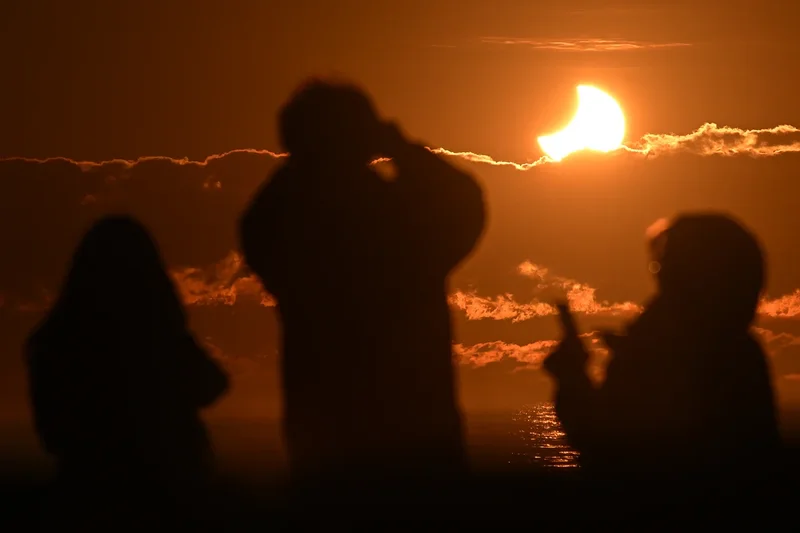
On 12 August, the world will be able to watch a solar eclipse, as the Moon moves in front of the Sun and blocks out its light. As well as making for a stunning show in the sky, viewers will be treated to the eerie effect as the sky goes dark and the air cools.
Here’s everything you need to know about the event, and making sure you see a sight that has not been visible in some parts of the world for decades.
Where to see the solar eclipse
The rare nature of a solar eclipse is a result of the precise alignment required between the Sun and the relatively small Moon. That means both that they are only visible in very specific parts of the world.
This time around, people in the UK and Ireland will see a partial solar eclipse, with as much as 96 per cent of the Sun being covered by the Moon. The best place to see it will be in the south-west, though something should be visible across the two countries.
It is the closest to a total solar eclipse that the UK will have seen since 1999. That was total in much of Devon and Cornwall.
It will also be visible across large parts of Europe, including France, Belgium, Switzerland and the north of Italy. In those areas, viewers could get as much as 95 per cent coverage.
The eclipse will be total in other parts of the world. People in Greenland, Iceland and Northern Spain will be able to see the Sun fully blocked out by the Moon.
It will extend to the Americas, though only slightly. A partial solar eclipse should be visible from the north east of the US and Canada.
When to see the eclipse? All the timings you need to know
Through the late afternoon of 12 August, the Sun and the Moon will gradually move together. Because it will be a new Moon, it will not actually be visible with the naked eye through the day.
At 6.17pm in London, the two will make “first contact”, where the Moon moves across the Sun and appears to start eating into it. It will then continue to move over it until it reaches its maximum, at 7.12pm.
The timings will change slightly depending on where in the country it is watched from, but only by a matter of a few minutes.
How to watch a solar eclipse
Solar eclipses may be stunning – but they are also dangerous. Watching one can potentially cause lasting damage to the eyes.
The dimming of the Sun can mean that it feels easier and potentially safer to look at directly. But even at its dimmest, the Sun can cause lasting damage to the eyes – and experts note that it might not be obvious until after the harm is done.
Instead, eclipse viewers are advised to buy devoted eclipse glasses, which should have markings on them to make clear they comply with safety certifications. They should be available relatively cheaply.
Normal sunglasses do not block out enough of the light to make them safe, experts advise. And even old eclipse glasses should not be used, since their protection might have been compromised.
The eclipse can also be safely seen through a pinhole viewer, or by projecting the Sun onto a sheet of paper with a pinhole projector. Government experts have also advised using a colander or leaves to look at the shadow cast by the Sun.
Of course, for people who are unable to see the eclipse – either because of the weather, or because they are outside the right area, or for any other reason – the whole show will be streamed online by observatories across the world.