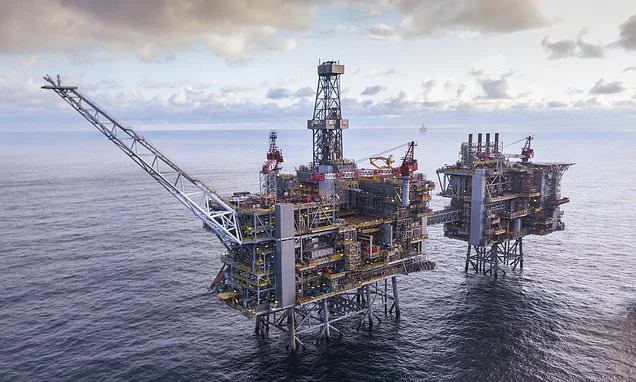
BP has hung the for-sale sign over its North Sea business as it seeks to end six decades of oil and gas production in the region.
The move forms part of a wider strategy at BP to slim down its sprawling global operations. In recent months, the oil firm has doubled down on fossil fuels while prices have spiked following the outbreak of the Iran war, leading to 'exceptional' performance for its share price.
As one of the most widely held stocks, the decision to offload its North Sea operation may raise questions among UK investors over the direction of its business.
The share price inched higher on Friday following the sale announcement but has been immune to large swings.
This is in part because while the firm’s potential withdrawal from the North Sea has been met with fury by politicians, it is perhaps less surprising for investors familiar with BP’s ongoing efforts to overhaul its business.
Earlier this year, BP held talks with Ithaca Energy over a near £2billion deal for the North Sea business, but no agreement was reached.
BP chief executive Meg O’Neill, who took over in April, said on Friday that while the North Sea remained integral to Britain’s energy system, she believed the business would be ‘better positioned as part of another company.’ The sale process ‘reflects its disciplined approach to capital allocation’.
It comes just months after she said she saw ‘untapped potential’ in the region. So, why the sudden change of heart and what will it mean for BP’s share price? Market analysts tell us whether they think investors should, buy, sell or hold onto shares.
As one of the most widely held stocks, the decision to offload its North Sea operation may raise questions among UK investors over the direction of its business
Why is BP selling its North Sea operations?
BP has said its withdrawal from the North Sea forms part of its ongoing portfolio review, as it reorganises the business to become ‘a simpler, stronger and more valuable company.’
BP operates five hubs in the region - two in the central North Sea and three west of Shetland - employing 1,100 people. Last year, it produced over 100,000 barrels of oil a day there, a fraction of the overall 2.3million barrels BP produced worldwide.
Since O’Neill took over in April, BP has pivoted back towards fossil fuels after a foray into renewable energy. It has reorganised the business into two segments, upstream and downstream, and recently announced plans to cut 700 ‘non-frontline’ jobs, warning of ‘potential oversupply and lower oil and gas prices.’
The shake-up hasn’t gone without incident, though. In May, chair Albert Manifold was abruptly sacked over claims of ‘bullying’ behaviour, which analysts predicted could blow BP’s recovery off course.
BP is one of the last oil majors to have a significant operation in the North Sea. It will soon follow the likes of ExxonMobil, Chevron, ConocoPhillips, Shell, TotalEnergies and Eni, which have all sold, merged or reduced their operations in the region.
It comes after a sharp drop in production, driven by a depleting basin and ageing infrastructure, exacerbated by Labour’s ban on new oil and gas drilling, and a windfall tax on energy firms.
In her first Budget in 2024, Rachel Reeves increased the windfall tax on North Sea oil and gas producers to 38 per cent from 35 per cent and extended the levy by one year.
This, combined with the Ring Fence corporation tax charged at 30 per cent and a supplementary charge of 10 per cent, brings their headline tax rate to 78 per cent.
Richard Hunter, head of markets at Interactive Investor, said: ‘Big oil is big business and BP is a major global player. As such, it scrutinises its return on capital and offloads what it considers to be non-core assets.
‘The lack of action in the North Sea and the possibility of windfall taxes may well have prompted the decision, which is understandable from a business perspective but a bitter pill to swallow for those affected in the region.’
Of the 24 fields that BP operates in the region, half are producing and half have begun abandonment.
What will it mean for BP’s share price?
BP has been in the spotlight in recent months and has received renewed attention from investors, as rising oil prices coincide with a major overhaul of its operations.
The oil company is already one of the most widely-held and well-loved stocks among British investors, having paid out generous dividends for over 50 years. Its current annual dividend yield is 4.55 per cent.
The UK government has in the past held major stakes in BP and its interests were for years seen as being entwined with foreign policy. It sold off its last remaining shares in BP in 1987.
An investor who put £1,000 into BP ten years ago would have seen their investment grow to around £1,289 today.
If they had reinvested the dividends, their holding would have risen to as much as £2,288 today.
But it has underperformed the FTSE 100, which has seen its price increase by over 62 per cent over ten years.
BP shares have gained further popularity in recent months after reporting an ‘exceptional’ performance as oil prices surged following the outbreak of the Middle East conflict.
The share price is up 35 per cent over the past year and has gained 14 per cent since the outbreak of the Iran war at the end of February. An investor who bought £1,000 worth of BP shares at the start of the conflict will have seen their portfolio grow to £1,145 in just five months, outperforming the FTSE 100, which has gained 9 per cent this year.
BP shares are forecast to yield 4.68 per cent in 2026, rising to 4.9 per cent in 2027, but the board has paused its share buyback scheme.
The reaction to BP’s plans to offload its North Sea business has been largely muted, with shares rising just 0.59 per cent to 546p by Friday lunchtime.
That is, in part, because the North Sea operation is not a major contributor as it used to be, and was responsible for just 5 per cent of production last year.
‘A sale would be meaningful without fundamentally changing the group,’ said Sam North, market analyst at eToro. ‘It would simplify the business, release capital and allow BP to focus on higher-return projects in markets such as the US and Brazil.’
Analysts do not anticipate an immediate impact on the share price. They will instead wait for clarity on the price and terms of a deal. A strong valuation would help reduce debt and improve returns for investors and, in turn, boost its share price. A discounted sale would raise questions over whether BP is receiving a fair deal.
Duncan Ferris, an analyst at investment group Freetrade, said: ‘Investors may welcome BP’s ruthless focus on larger and higher-return opportunities, but they will want the business to avoid letting a still-reliable asset go at cut price.
'Today's modest uptick in share price suggests investors cautiously approve of pruning lower-priority assets in favour of BP's big beasts. The rise is hardly meteoric, however, and many investors are likely reserving judgment until a willing buyer and a firm price tag are lined up.'
North, of eToro, added: ‘A strong valuation, with proceeds used to reduce debt or fund higher-return projects, would be positive, while a discounted deal or significant retained decommissioning liabilities could weigh on the shares.’
The disposal is a sign of BP’s turnaround gathering pace, which will be welcomed by investors looking for further growth in its core fossil fuel production business.
It also avoids a war of words between one of Britain’s big oil firms and the Labour government, which has been non-committal in its plans for the North Sea.
Burnham hinted at a shift in Labour's ban on new oil and gas drilling, which is part of the party's 2024 manifesto, saying that at a time of tight public finances the North Sea was a resource 'we can't ignore'.
The biggest driver of growth at BP will instead come from a surge in oil prices, which shows no sign of stopping as the US and Iran fail to agree to a meaningful ceasefire.
Brent crude oil is currently trading at $89 a barrel – almost $20 up on pre-war levels of around $72.
BP’s most recent quarterly trading update indicated further strength in its trading business, which remains based in the UK and drives performance in periods of volatility. US oil majors, while bigger, primarily focus on production and asset ownership.
The firm expects oil trading to be marginally higher in the second quarter than in the first, when it flagged an ‘exceptional’ performance, reporting profits of $3.2billion between January and March - more than double the previous quarter.
Investment house Berenberg raised its price target from 590p to 600p following the update with a recommendation to buy.
What next for BP shares?
A prolonged closure of the Strait of Hormuz will push oil prices higher and therefore likely benefit BP's share price.
Analyst consensus rates BP as a moderate buy or hold with an average 12-month analyst price target for BP of around 603p, nearly 10 per cent higher than its current level.
Now BP plans to exit the North Sea its fortunes will not be dictated by Andy Burnham and his plans for the region, but more likely by President Donald Trump and Iran.
Investors looking to capitalise on volatility in oil markets can gain further exposure through investments in BP's rival Shell, and the FTSE 250-listed independent explorer Harbour Energy.
A bolder bet could be placed on North Sea producers, who may benefit from consolidation and joint ventures in the region.
Ithaca Energy, which is in the FTSE 250 and was reportedly in talks to buy BP's North Sea business, has seen its shares rocket nearly 50 per cent this year.
The company generates all of its revenues from the North Sea and could stand to benefit from any change in tone from the Government. However, it remains heavily exposed to windfall taxes.
DIY INVESTING PLATFORMS
Compare the best investing account for you