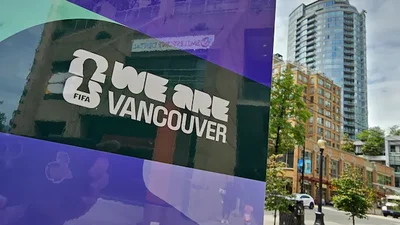
For five weeks, Vancouver felt different.
The FIFA Men's World Cup brought packed fan zones, busy transit and a jolt of public energy to Vancouver — a place often dubbed “No Fun City.”
From the stands to the streets, fans were loud and visible.
But the legacy of a major event is measured by more than crowds and noise. Observers say it also depends on the public cost, the effect on businesses and residents, and whether the excitement around soccer can turn into something more permanent.
Now that Vancouver’s time as a host city is over, the city is starting to weigh what the event meant — and what, if anything, will last.
Vancouver showed up
The city hosted seven matches at B.C. Place during the tournament from June 13 to July 7. Despite concerns over ticket prices, FIFA said each game was a full house, with 52,497 fans in attendance — more than 367,000 spectators in total.
Team Canada fans cheer during a group stage match between Canada and Qatar during the FIFA Men's World Cup in Vancouver on Thursday, June 18, 2026. (Maggie MacPherson/CBC)
Outside B.C. Place, fans gathered at public viewing sites across the region. The Vancouver host committee reported more than half a million visits at the FIFA Fan Festival at Hastings Park. In North Vancouver, the city said more than 340,000 people attended Canada House at the Shipyards.
TransLink said Vancouver’s seven match days added an average of 87,000 extra transit boardings per day across the region. The busiest day came June 24, when Canada played Switzerland at B.C. Place. That day, the system recorded nearly 1.4 million boardings, with TransLink calling this its highest ridership day in more than six years.
In an interview on the CBC’s The Early Edition, Vancouver Deputy Mayor Sarah Kirby-Yung said the crowds were about more than soccer enthusiasm.
“Everybody became so Canadian… It was like Canada Day every day," she said. “That pride in our city was something that I can’t remember feeling anything exactly like before."
Fans watch as Canada plays Bosnia and Herzegovina during the FIFA World Cup at Canada Soccer House in North Vancouver, B.C., on Friday June 12, 2026. (Ethan Cairns/CBC)
Vancouver’s setup also earned outside praise. In June, Sports Illustrated ranked Vancouver first among the 16 World Cup host cities, citing its transit, walkability, mild weather and B.C. Place’s downtown location.
Can Granville Street keep the energy?
At a special council meeting on July 2, Vancouver Mayor Ken Sim said the city needed to build on what he called the “outstanding success” of Granville Street’s pedestrian pilot during the World Cup.
During the tournament, five blocks of Granville Street were turned into a pedestrian zone between West Georgia and Davie streets. It was created for the World Cup, but city council has voted to extend the closure until Sept. 7.
Canada soccer fans on Granville Street, Vancouver, before the FIFA World Cup match between Canada and Qatar at B.C. Place on June 18, 2026. (Jan Zeschky/CBC)
The Downtown Vancouver Business Improvement Association (DVBIA) has been given up to $1.25 million to help program and animate the street, with any unspent money returned to the city. The extension is expected to cost up to $4.75 million, including the cost of sanitation, traffic management and policing.
Kirby-Yung said this move gives the city a chance to see what works after the World Cup.
“Think of something like Gastown,” she said. “You’ve got buskers, you’ve got patios, you’ve got restaurants, you’ve got cafes and you’ve got something for people to do.”
But the area faces a deeper challenge. A planning document from the DVBIA says approximately one-in-four storefronts on the street is vacant, with “longstanding social challenges affecting the corridor.”
The document says “simply removing vehicles is not enough.” It says the extension needs programming that gives people a reason to visit, stay longer and support local businesses.
Canada soccer fans on Granville Street, Vancouver, before the the FIFA World Cup match between Canada and Qatar at B.C. Place on June 18, 2026. (Jan Zeschky/CBC)
Programming is expected to evolve week to week during the extension, with live music, interactive games, pop-up markets and patios showing sports. Some activations will also be tied to special dates and community celebrations, including a National Day of the Cowboy event with country music on July 25.
Beyond Granville Street, city officials said the tournament’s legacy will be reflected in improvements at B.C. Place, modern infrastructure and field lighting at Killarney Park, and exposure for the PNE’s new 10,000-capacity amphitheatre.
Legacy for who?
Before the World Cup, some advocates warned about the impact the event could have on Vancouver’s unhoused population.
Fears about displacement were raised as governments anticipated spending heavily on security for the tournament. In figures updated in June, the province estimated combined local and provincial safety and security costs for Vancouver’s World Cup at about $242 million, partially offset by $100 million in federal funding.
Fiona York, a local advocate for unhoused individuals, said she noticed a stronger police presence downtown and more pressure on people to move their belongings.
“People were being asked… not only to just put their tents down flat, but to pack them up and take them away,” she said. “So it's a little bit more dramatic, a little more severe.”
York also questioned whether the tournament would leave any lasting benefits for vulnerable people.
“We've got Granville continuing this pedestrian zone, all those millions going into that. Was there not something that could be done for the Downtown Eastside if there was money to be spared?”
York said any discussion of legacy should include funding for basic needs in the Downtown Eastside, including washrooms, facilities and housing.
In May, the City of Vancouver released its final human rights action plan for the World Cup. The city also said homelessness services and outreach programs would continue throughout the tournament.
Can World Cup excitement grow the game?
B.C. Soccer CEO Gabriel Assis said the World Cup created a rare opportunity to grow the sport in the province.
“Our focus is to ensure that the momentum of the FIFA World Cup 2026 becomes more than a moment,” Assis said. “We want it to become a movement.”
He said the province already has more than 150,000 soccer participants and more than 100 soccer organizations. And while the tournament has helped “accelerate interest” in the game, he said B.C. will need more investment in fields, coaches and match officials to keep up with demand.
Assis pointed to several projects already underway, including Canada’s first FIFA Arena in Langley, a FIFA26 50/50 funding program, 20 mini-pitches planned across B.C. and a new provincial field inventory to track supply and demand.
Going forward, Assis said the goal is to create a “legacy of improved facilities, stronger programs, and increased access to the game.”
Kids are pictured playing soccer at the Cloverdale Athletic Park in Surrey. Soccer clubs in both Surrey and North Vancouver are calling on their cities to build more turf fields. (CBC)
Jeff Clarke, a former Canadian national team player and senior technical director for Surrey United Soccer Club, said he hopes the tournament helps attract more young players and keep teens in the sport longer. But he added Canada needs more playing opportunities and lower costs for families.
“If you lean too heavily on the participant, then the entry fees are too high and that's a barrier,” Clarke said.
According to Clarke, entry-level programs at Surrey United cost about $100 a month, while higher-level teams can cost families several times that, plus travel and transportation.
What remains after the crowds?
The Parliamentary Budget Officer estimated public spending tied to Vancouver’s host-city costs at $578 million.
The province, meanwhile, has projected the tournament would generate long-term economic benefits, including about $1 billion in GDP for B.C. during the World Cup and in the five years that follow.
While the final accounting is still to come, the legacy of Vancouver’s experience as a host city will be measured by more than numbers. It will depend on what happens next: on Granville Street, in the Downtown Eastside, and on the fields where the next generation of soccer athletes will play.