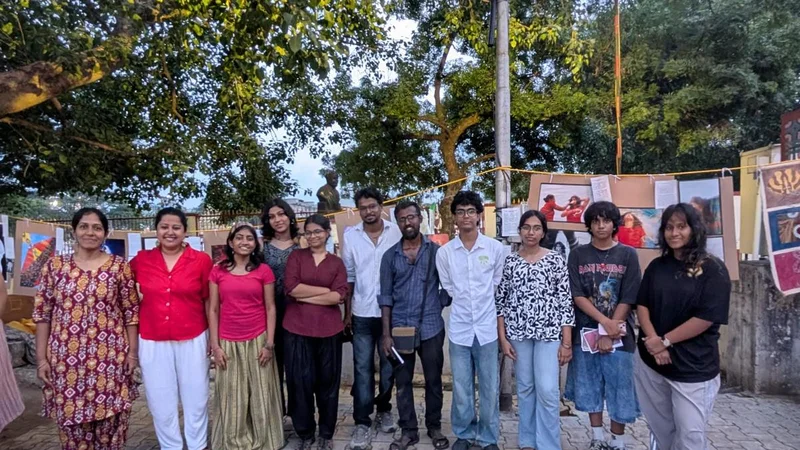
On July 25, when those supporting the protest launched by Cockroach Janata Party in New Delhi were rejoicing over the resignation of Dharmendra Pradhan as education minister, a teenager from Chennai was quietly assembling 11 aspiring artists whose craft is a commentary on systemic injustices.
Eighteen-year-old Samrutha SB is a student of BA Social Science at Azim Premji University in Bengaluru. In Chennai for her semester break, Samrutha decided to bring these artists with their works that open up avenues for conversations on fractures in social structures.
The trigger to do something to create a democratic space for dialogue and collective art stemmed from an experience she encountered in college.
In February 2026, Azim Premji University was vandalised by ABVP members over an event organised by SPARK, an informal reading circle constituted by students of the University. Many students including Samrutha were witness to that chaos on campus.
Samrutha points out the University did not get the support of the student community when it filed an FIR against the students behind the event and later suspended them.
“To resist these harsh actions we protested on the campus. This event frustrated me on many fronts, but what disheartened me the most: one, many of the students were either fearful, apathetic or had extreme opinions which fractured any momentum we tried to mobilise, and two, the institution acted harshly against the wellbeing of its students,” says the resident of Neelankarai.
The University did have meetings but only a small section of the students turned up. “I felt like I needed to act on the frustration if I wanted to see change, and art has always been my best companion at such times,” says the alumna of Chettinad Hari Shree Vidyalayam.
The public art exhibition showcased at Pagir on July 25 and Mada Square on July 26, both in Thiruvanmiyur, blended magic realism with themes of social justice.
Over four weeks, the artists, a majority of them students, engaged in discussions on art and political resistance, reflecting on their own social locations, questioning what distinguishes a system from a community, and grappling with the understanding that the personal is political.
These sessions were facilitated by resource persons which included Poorani C, founder, The Penn Collective; Venkataraghavan, author; and Anjana, a narrative art therapist.
The exhibition was timely. Like the protesters at Jantar Mantar that demanded accountability, the platform served to express dissent against social and political systems of power and reimagine a more just world.
“I was happy to see people from the kuppams coming to see the works. Art should be accessible for both visitors to view and for artists to exhibit, it should be relatable and most importantly it should come from a collective process,” she says. “My main aim was to politicise one another and ignite empathy for each other at this political moment through the discussion sessions as well as for the visitors. I wanted our artworks to be a response to everything we discussed and a seed for conversation that went beyond passive viewership. Conversations around caste, class, gender and the self grew in pockets next to each of the artworks throughout the two days of the exhibition.”
Published - July 31, 2026 10:38 pm IST