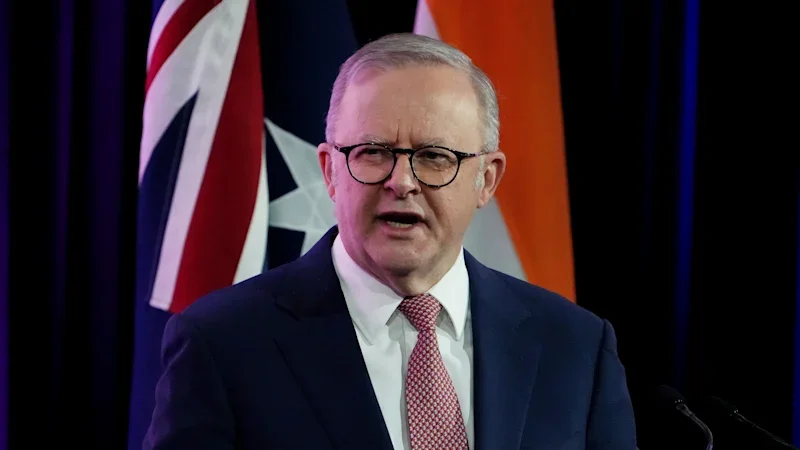
Prime Minister Anthony Albanese’s government is in intense negotiations with the White House to secure access for Australia’s critical infrastructure to AI models so powerful they have been restricted by the US over safety fears.
The talks, confirmed by three government officials, could give the government and critical businesses susceptible to hacking, like banks and telcos, privileged access to top-tier AI models, such as Anthropic’s Fable and Mythos.
A big part of Labor’s data centre rush, and the attempt to make Australia a second home for Anthropic, is to make Australia indispensable to the US computing ecosystem – some in the security world compare it to Pine Gap.
The Trump administration abruptly restricted foreign access to these models last month over national security concerns and the discovery that they could be used to discover software vulnerabilities. The ban was lifted weeks later.
The US has since created a voluntary review system for new models, and Australia is keen to be at the front of the queue for the broader release of these models and future models that may be made available.
Australia is competing for access to the most powerful AI tools as Anthropic’s chief executive Dario Amodei warns that his models “pose very real risks to cybersecurity, creating the potential for disruption of the financial sector, critical infrastructure, and national security.”
“AI models are now tools of global and national strategic consequence,” he said in an essay published in June. “The cyber risks that Mythos-class models present will not be the last that we must face. I believe that biological risks may soon follow, and that serious AI autonomy risks may not be far behind.”
Labor has moved to put AI at the centre of its industry and security policy, with Industry Minister Tim Ayres brushing off suggestion that Labor’s recently announced rules for data centres were interventionist.
In an interview with this masthead, he instead flagged investment in critical metals for AI chips and local AI models to make Australia “indispensable to our partners and embed us in a set of technologies that are going to really matter for future global security”.
Ayres, the lead minister on AI and the Future Made in Australia industry blueprint, didn’t comment on the tightly guarded US talks but told this masthead that Labor saw huge opportunities to build resilience and leverage for Australia, at a time when the US and China are competing in an AI arms race.
“This is about Australian agency and making sure that Australia isn’t just a cork bobbing on the ocean in this technological contest,” Ayres said, arguing the AI boom went beyond the economics of data centre investment.
“Everyone’s focused on the big AI frontier models. But, of course, we’ve got extraordinary capability and data sets in narrower AI applications in mining, in agriculture, in geospatial technology. These all matter for our future resilience. I want Australia to be the indispensable country in the region and to our partners, and that means leaning in now.
“Our future security depends upon not making everything here in Australia, but intervening in the technology stack for artificial intelligence and quantum in a way that makes us indispensable.”
As the opposition argues Labor has been slow to invest in AI products, unlike Asian and European nations, top government officials have for months been in high-stakes negotiations with US counterparts about access to the latest AI.
This masthead first revealed the conversations on July 18, which centred on giving Australia first access to the best new models from AI labs such as Anthropic and OpenAI.
Three government sources, not granted permission to divulge the negotiations, have since confirmed that Australia is seeking access not just for itself but for critical infrastructure firms.
After initially taking a hands-off approach, the White House in June suspended access to Anthropic’s Mythos and Fable models, creating what some analysts described as a quasi-licensing scheme.
Five Eyes partners had been discussing first-use rights for US allies, strengthening Australia’s position, the sources said. Australia is also discussing local investments from AI firms worth tens of billions of dollars, including a mooted deal to make Australia the second training home for Anthropic and its leading models such as Claude.
Public understanding of the power of the latest models is shifting rapidly. On Friday, Anthropic said its Claude AI model had hacked three external organisations during a test. The announcement occurred days after its rival OpenAI disclosed that a rogue agent had hacked another AI firm called Hugging Face.
David Wroe, an AI expert at the Australian Strategic Policy Institute who formerly worked for this masthead, said the push to build data centres in Australia might give Australia leverage with the US.
“That will mean they actually need us. It has to be done smartly and carefully so that we’re not just warehousing American tech for their benefit,” he said. “Pine Gap is a useful analogy. The US doesn’t rank us as a first-tier ally and intel partner purely out of sentimentality. AI training can be a tech industry equivalent. Same as Pine Gap, our geography and reliability are huge strengths.”
Government sources said Albanese’s tougher language about AI’s social licence was designed to send a signal that the government was controlling the computing revolution so that the public would accept data centres, countering growing public backlash.
Albanese government officials believe that by making Australia a leader in computing power, it could allow the creation of local AI products at a time when China is distributing low-cost models to counter Western tech dominance.
Ayres said investment would “strengthen” existing investments in AI from the National Reconstruction Fund and Future Made in Australia scheme.
“We want every part of the stack here in Australia,” Ayres said, referring to the full suite of technologies and components that go beyond mere computing warehouses.
“That goes to our future resilience and where Australia’s got future competitive advantage. That is critical metals, our capacity to make AI chip hardware here in Australia, building our sovereign AI models here.
“Of course, there’s an economic rationale: investment, jobs, capability in Australia. But the Future Made in Australia rationale for building Australia’s future resilience in critical technologies like artificial intelligence is overwhelmingly strong.”
Coalition spokesman for science and technology Aaron Violi said the government should use the technology-focused pillar in the AUKUS pact to “strengthen our cyber resilience and keep Australians safe”.