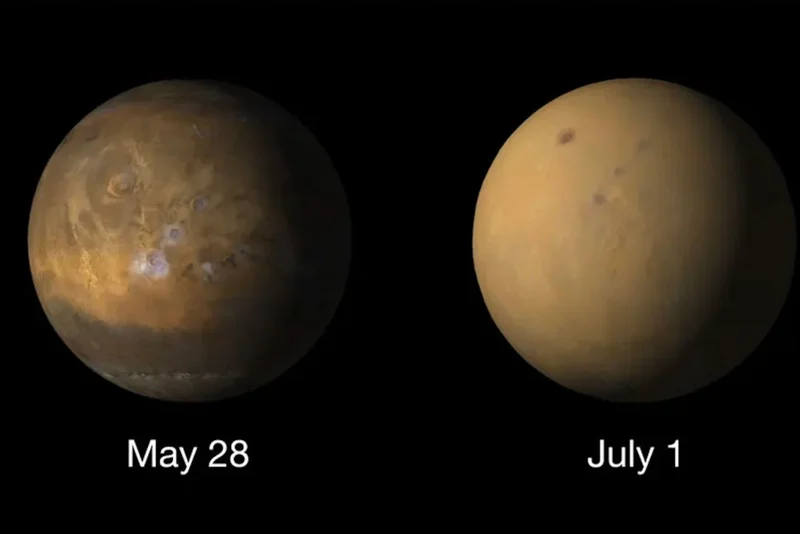
It took seven months to confirm that NASAâs Opportunity rover was dead. The U.S. space agencyâs little robotic probe had stopped communicating with Earth back on June 10, 2018âafter being engulfed by a severe Martian dust storm then blanketing the entire Red Planet. Itâs taken years, but physicists now have some idea about why exactly that storm became so dangerous.
New research presented this month at the Royal Astronomical Societyâs National Astronomy Meeting has uncovered compelling evidence that radiation from solar storms is capable of magnifying weather events on Mars after penetrating the planetâs weak magnetosphere. The new study scrutinized data from NASAâs orbital MAVEN spacecraft and the European Space Agency’s Trace Gas Orbiter to determine just how much solar energetic particle (SEP) events heat up Marsâ lower atmosphere. The researchersâ results surprised them: When compared to expected global temperatures estimated from the Mars Climate Database, it looks like intense solar flares and other stellar radiation can act on Martian dust storms synergistically, increasing their severity and roiling Marsâ lower atmosphere.
âDust storms were not originally part of our investigation, so finding one happening at the same time as the heating was unexpected,â Lancaster University physicist Lana Williams, who studies Martian space and atmospheric plasma dynamics, said in a statement. âIt suggests that Marsâ atmosphere and weather may respond to several events acting together, rather than each source of heating operating independently,â according to Williams, who led the new study.
Kicking up a storm
Williams and her colleagues had originally intended to examine five SEP events to ascertain whether or not radiation from solar storms had any effect closer to the Martian surface, where actual weather patterns emerge. Past research had already documented cases where solar eruptions, like solar flares or coronal mass ejections, generated measurable effects in Marsâ upper atmosphereâincluding aurorae like Earthâs own Northern Lights and additional leakage of Marsâ atmospheric gases into space.
âWe expected that these highly energetic particles might have some effect on temperatures in Marsâ lower atmosphere, but in four of the five events we studied we found no clear evidence of heating,â Williams said. âThe one exception occurred while a global dust storm was expanding across the planet.â
During this June 2018 SEP event, ESAâs Trace Gas Orbiter recorded an increase of about 90 degrees Fahrenheit (50 degrees Celsius) at roughly 47 and 78 miles (75 and 125 kilometers) of altitude, as Williams told IFLScience. For context, Marsâ exobase, the altitude at which its gases start to bleed into space, begins around 87 miles (140 km) up and its most turbulent atmosphere, or homopause altitude, rests around 56 and 84 miles (90 and 135 km) high.
Clouded by uncertainty
Williams and her collaboratorsâastronomers at the UKâs University of Leicester and Spainâs Instituto de Astrofisica de Andalucia-CSIC in Granadaâalso found a July 2021 SEP event that appeared to produce a similar, albeit smaller, increase in Martian temperatures. But the team noted that these two episodes are far from enough corroborating evidence to confirm that this phenomenon is real.
â[A] clear heating effect is observed, but further research is required to attribute atmospheric temperature variations as a result of the global dust storms and SEP events where the two occur simultaneously,â the researchers stated in their new study.
One aspect obscuring the picture is the weaker signal from the July 2021 event, which only increased temperatures somewhere between one tenth and one fifth of what the June 2018 SEP blast accomplished. Nevertheless, Williams hopes further analysis of data taken by ESAâs Trace Gas Orbiter from 2022 to present might settle the issue.
She said she was particularly curious about a May 2024 solar storm so strong that NASAâs Curiosity rover captured evidence of the stormâs charged particles sailing toward the Martian surface on video.
âIt is a case of we just donât have the data at the minute to look further into it,â as Williams told IFLScience, âbut it would be interesting to look at the 2024 solar storm.â