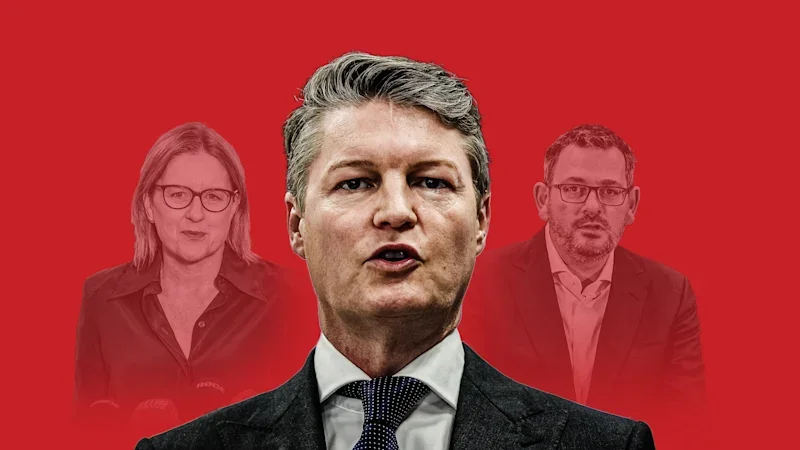
Bill Shorten spent much of his political life doing numbers. And the polling numbers coming out of Victoria’s Trades Hall a fortnight ago were scary.
Translated to the looming November election, the result would be a ruin deeper than that inflicted on Joan Kirner’s Labor government in 1992.
“Labor was heading off a cliff,” Shorten says. “In 1992, Joan Kirner got 27 seats and [Jeff] Kennett got 61. It [the 2026 election] was going to be worse than that.”
Shorten, a long-term powerbroker and former federal leader, argues the hostility confronting state Labor reflects a post-COVID frustration with all political parties, but especially Labor.
“In some ways, Ben’s two biggest rivals are not on the ballot paper: Dan Andrews is not on the ballot paper, and Pauline Hanson isn’t on the ballot paper, but that’s what people are voting on.”
That internal alarm explains why the Labor caucus executed its late-term change of leader, dumping Jacinta Allan after nearly three years in office to install her deputy, Ben Carroll.
Retiring Sydenham MP Natalie Hutchins makes no attempt to disguise the unsentimental calculation behind the move.
“Labor is in real danger in its seats in the west, and it’s time to have a premier willing to take on the hard issues affecting our residents,” she said.
Her outer-western electorate shares a boundary with Carroll’s seat of Niddrie. During four weeks of door-knocking, Hutchins encountered anger unprecedented in her political career.
Voters in the established estates of Taylors Lakes and Hillside cited crime, government inaction on CFMEU corruption, bad roads, and a sense that Melbourne’s east receives lavish infrastructure while the west misses out. For the first time, a disturbing number told her they intended to vote for One Nation.
“A lot of people, particularly in the outer west and newer suburbs, are pretty rattled about community safety,” Hutchins says. “And it’s not just the youth crime; it’s also the organised crime, the drug dealing, and also family violence that is all connected.”
Hutchins says Carroll has a strong sense of social justice and an understanding of the issues in Melbourne’s west, which she hopes will improve the party’s prospects.
Faced with $190 billion in state debt, ongoing revelations surrounding the $109 billion Big Build, and an electorate itching for change after 12 years of Labor rule, caucus concluded Allan could never separate herself from the era that created those problems.
Shorten sees Carroll as Labor’s only remaining path to a shifted conversation. “This state election was looming as a referendum on the question: ‘Are you dirty with the state of politics in Victoria?’ His promotion to leader provides a bit of a circuit-breaker to that.”
On his first afternoon as premier, Carroll stood at a media podium inside Parliament House and delivered a declaration explicitly designed to draw that line.
“I am not Daniel Andrews. I am not Jacinta Allan.”
The words were easy. Their political task is hard.
How hard? Don’t take our word for it. Read Carroll’s handwritten notes, captured during his first press conference as premier. “Not Daniel Andrews” was scrawled at the top of his talking points.
It’s easy to see why the 51-year-old Carroll was eager to press this point.
For three years, he served as Allan’s deputy, and for nine years before that, he sat around the cabinet table under Andrews, rising through government while two premiers came to define modern Victoria.
Now, just four months before the state election, Carroll confronts the defining challenge of his political career: can a long-serving Labor insider, groomed by party hard heads, persuade a sceptical electorate that his elevation represents genuine change rather than a cosmetic reshuffle?
Carroll is a more anonymous political figure than the leaders he follows.
Where Andrews centralised power with ruthless discipline, and Allan sought to weather scandal through endurance, Carroll belongs to a tradition of Labor pragmatism. His persona is suburban: a Catholic, straight-laced family man with a lifetime love of the Kangaroos who got a taste for marathon running in middle age.
But it will take more than pragmatism to solve the problems on his desk.
Carroll inherits a state carrying enormous debt and a government battered by two years of revelations surrounding the Big Build. The teachers he was responsible for until a few days ago are threatening to strike again.
The question confronting the ALP is whether the boy from Airport West has the time, the authority, and the independence from his two far better-known predecessors to drag his party back from the brink.
A ‘studious, serious person’
To understand Carroll’s politics, it helps to begin in Melbourne’s north-west.
Carroll lives in tree-lined Aberfeldie with wife Fiona Rothville – a lawyer who serves as director of Workplace Integrity at Deloitte – and their young daughter. Rothville’s father is a director of Nilsen, a major electrical contractor that has worked on state infrastructure projects; Carroll declares it in his register of interest.
Carroll’s roots in his electorate run deep. Raised in Airport West as the eldest of three children, he entered parliament in 2012. In his inaugural speech, he framed his story around the idea of opportunity, tracing his family’s journey from Irish labourer Michael Carroll from Tipperary, who arrived in Victoria in 1840, to his election more than 170 years later.
Opportunity, he told parliament, brought his parents, Greg and Kay Carroll, to Airport West, where they built the family home in 1974 and established a small electrical business. His mother Kay migrated from Texas and worked at Glenroy West Primary School. His father ran the family business until it collapsed during the recession of the early 1990s.
Carroll said his parents had “instilled in me the importance of family and the value of hard work”. As soon as he reached the legal working age of 14 years and nine months, he walked into Airport West Kmart looking for part-time work. “I soon found myself working on the cash registers as a checkout chick.”
He remained at the store for eight years while completing an arts degree with honours at La Trobe University in 2000. He joined the Shop, Distributive and Allied Employees’ Association, later saying it gave him “a good understanding of the importance of unions in helping working people”. At times, he recalled, the union helped pay for his university textbooks.
On Wednesday morning, less than 24 hours after taking the top job, Carroll leaned into that retail origin story for his first public press conference as premier. Standing inside Kmart on Bourke Street in Melbourne’s CBD, he announced legislation for Workplace Protection Orders, giving courts powers to ban violent or abusive customers from retail, hospitality, and public transport workplaces for up to 12 months.
During his years behind a Kmart register, Carroll recalled being intimidated and threatened on the job, describing those checkout shifts as “crucible years”.
From the year 2000, Carroll advised premier Steve Bracks, then planning minister Justin Madden. After a stint as a trainee lawyer at the Victorian Government Solicitor’s Office, he moved to Canberra in 2011 to advise Right-faction powerbroker Stephen Conroy on the National Broadband Network.
Emma Dawson, executive director of Labor Party think tank the Chifley Research Centre, worked alongside Carroll in Conroy’s office, where he managed caucus relations.
She remembers an adviser distinct from typical Canberra political figures: “He’s a very studious, serious person.” Dawson recalls him parsing complex legislation before briefing MPs – a habit of constant note-taking highlighted by several people during the compilation of this story. “Ben is not afraid to ask questions and to listen to people. He takes notes – copious notes.”
Dawson says Carroll values evidence over factional orthodoxy, pointing to his decision as education minister to mandate synthetic phonics despite union pushback. “He’s interested in the evidence behind what works,” she says.
A son of the west rises
When former attorney-general Rob Hulls resigned from Niddrie in 2012, Carroll won the byelection, aged 36.
Standing in Parliament after his victory, Carroll described representing Niddrie as his “greatest honour” because he would be serving “the community I was raised in, the people I am one of”.
Sebastian Agricola is a lawyer who has worked for more than 30 years in St Albans, just outside of Carroll’s electorate. The two met when they faced off as candidates for preselection in Niddrie.
Agricola recalls a younger man with similarly strong ties to the north-western suburbs, who engaged in the hand-to-hand combat of Labor preselection in a respectful and refreshingly down to earth way.
“He was competitive, in the sense of you have to be for that sort of a contest. But he played it straight down the line. He was fair, he never criticised me,” Agricola says. “People can let those preselections become very personal and vitriolic. Ben never did that.”
Agricola, veteran president of the St Albans Business Association, has remained plugged into community and political circles in Melbourne’s west, and says Carroll has been an approachable figure locally, who never gave in to cynicism.
“If people just accept that what you see is actually genuine, I think there’s a good chance that he’ll have a significant impact,” he says of the newly minted premier.
Carroll never hid his ambition. “I was always very keen to rise,” he told reporters at his first press conference after being made deputy premier.
That ambition fuelled years of quiet tension with Andrews who, after Labor’s 2022 election victory, installed Jacinta Allan as deputy, leaving Carroll in the corridor for an hour to receive his portfolio – a spot known as “Dan’s freezer”.
In 2023 when Andrews tried to hand-pick his successors – Allan as premier, treasurer Tim Pallas as deputy – Carroll threatened a membership ballot, which would have left Victoria without a permanent premier for a month. It triggered what colleagues described as a “nuclear meltdown” from Andrews. But Carroll was made deputy premier.
The political scar never healed. Later, Carroll was the only sitting Labor MP to publicly criticise Andrews after the former premier posed in a photograph in Beijing among a group of foreign officials and leaders that included Vladimir Putin and Kim Jong-un.
Shorten contrasts Carroll with his predecessors, pointing to his local focus and willingness to fight cabinet over the Airport Rail Link.
“He’s never been a schemer. He’s never tried to be a factional mini state warlord. He’s very different from someone like Dan Andrews. But he’s capable of being a very good state leader.”
Shorten says both he and Carroll advocated for an Airport Rail Link, putting Carroll at odds with colleagues focused on the Suburban Rail Loop.
“That made him not popular with the SRL zealots in the cabinet. He didn’t get the memo that he shouldn’t speak up about it,” says Shorten, who is now the University of Canberra vice-chancellor and who says he is no longer active in the Labor Party.
Carroll has held 14 separate ministerial portfolios. Danny Pearson, the retiring Labor MP for Essendon, says Carroll’s rise is the result of years of toil and ambition.
“To be the leader of a major political party, you’ve got to really want it, you’ve got to have ability and you’ve got to work hard,” he says. “You can’t be some sort of part-time dilettante who thinks, you know, swanning around in the members’ bar is the pathway to power.”
Former Andrews government minister Philip Dalidakis, a longtime friend who lured Carroll from a short career in law back into politics in Stephen Conroy’s office, describes him as “extraordinarily earnest” in his approach to both public policy and politics.
“He doesn’t yell, he doesn’t scream ‘Look at me!’, he just quietly goes about his policy work.”
Dalidakis sees Carroll’s style setting up a contest of substance against Liberal leader Jess Wilson, while signalling an end to the “command and control” cabinet model of Andrews and Allan.
“He doesn’t use policy to wield power for power’s sake, and I think that’s what we probably want in our leader. I think that’s probably why Jess Wilson has made a really good start in the last six months because she’s focused on good policy.”
Carroll needs to listen, he says, both to voters and to his cabinet colleagues. “The premier has said that he’s going to return to a proper cabinet consultative process … that can only be a good thing for Victoria.”
Carroll’s difficult task now is to speak to the big-spending legacy of the Andrews era without repudiating the government that elevated him.
His first major announcement was a state royal commission into corruption and organised crime infiltration across the Big Build, reversing the position Allan defended for two years.
Carroll promised sweeping terms of reference, a special prosecutor operating alongside the inquiry, and retrospective “follow-the-money” powers for IBAC.
The move illustrated how sharply he intends to distinguish himself from his predecessors.
Tim Read, the Greens MP who chairs parliament’s Integrity and Oversight Committee that monitors and reviews the performance of IBAC, says he’s reserving final judgment until the premier delivers deeper anti-corruption measures. “Without other powers, including removing the requirement that corrupt conduct [for IBAC] constitute a criminal offence, any new powers will be limited,” he says.
Carroll has moved quickly to distance himself from existing cabinet policy. He has put the SRL under review; one of his first phone calls as premier was to Victoria Police Commissioner Mike Bush; and he has previously publicly rejected the government’s push to phase out household gas connections.
Can Carroll outrun the past?
Yet, the greatest obstacle confronting Carroll is not policy. It is credibility among voters.
Carroll is attempting to convince the electorate that someone who has spent years at the centre of power can embody a fresh start.
David Hayward, RMIT emeritus professor and an expert analyst of Victorian politics, says it was evident from his first speech as leader that Carroll is channelling his former boss Steve Bracks.
“I thought he handled it really well by coming out and using a Bracks-like phrasing of integrity, economy, and community safety as the leitmotif of his new government, and immediately saying, ‘I am not my predecessors’,” Hayward says.
Bracks pulled off a surprise heist when he defeated Kennett in 1999. Carroll will need to produce an even bigger upset if he is to deliver Labor a fourth term in government, unseen in Victorian politics since Henry Bolte and Rupert Hamer led the Liberals to nine straight election wins between 1955 and 1979.
To do so, Labor must treat the day that Carroll rolled Allan as day one of the election campaign, Hayward says.
“I think he had to distance himself from the malaise that had come to settle upon the government. It’s not like the Allan leadership was full of ideas and policy innovations. It really appeared to be very flat-footed.”
Anxious though he may be to separate himself from Andrews and Allan, Carroll cannot shrug off the state’s record debt.
Hayward says most voters were once unfazed about debt while it could be justified as delivering infrastructure assets, but that changed when the debt and the Big Build were linked with corruption, which was uncovered by a series of reports in The Age.
“Everything suddenly switched … this suddenly raised questions about the spend, about the infrastructure and [Allan] was never really able to respond.”
Carroll’s move to call a royal commission and establish a special prosecutor alongside it gives Labor one last chance to change the script.
“That’s another point about the change of leader. With somebody appearing to be so different to the previous premier, it gives a new energy,” Hayward says.
Time is working against him. Carroll has 119 days before Victorians go to the polls on the final Saturday in November.
He must also contend with the fatigue that follows 12 years of Labor rule, while confronting a surging One Nation vote, now polling at 22 per cent across Victoria and threatening Labor in outer-suburban seats.
By establishing a royal commission into the Big Build on his first day as premier, Carroll sought to isolate the scandal and cast it as part of Allan’s legacy rather than his own.
Whether voters accept that distinction – or regard Carroll as an equal participant in more than a decade of Labor government – could shape the outcome of November’s election.
Fourteen years after promising parliament he would “strive to work every day with that sort of passion and dedication”, Ben Carroll occupies the office he spent his political life pursuing.
For the marathon runner from Airport West, the final sprint has begun.