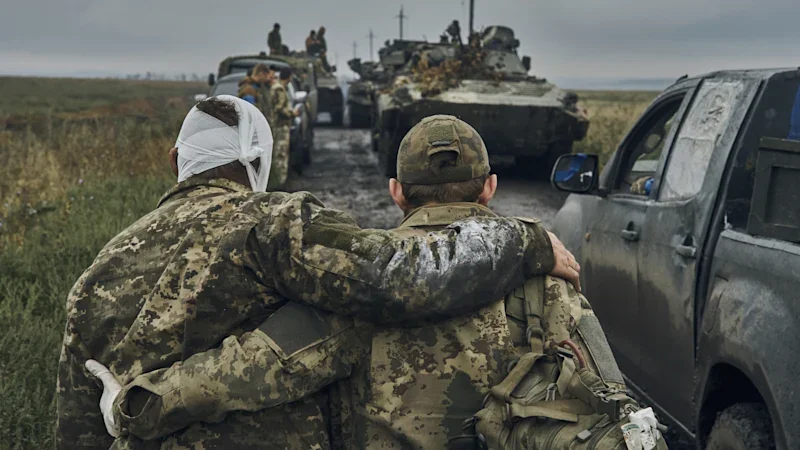
In the kill zone, the old ways of medical care no longer work. That is one of the lessons from Ukraine along the vast front, where Russian drones can make it impossible to rescue a wounded soldier.
Military training is changing to prepare soldiers for the treacherous conditions underneath the drones, says Ukraine’s deputy minister for veterans’ affairs, Oleg Shymanskyi.
Ukraine is working with NATO member states on what this will mean for every army as warfare adapts to the rise of faster, more lethal and more autonomous drones.
“Because of the kill zone, which is the territory where drones fly and nothing else moves, the evacuation scenarios and practices have changed completely,” says Shymanskyi.
“There is no helicopter that’s evacuating you 30 minutes after the injury.
“Under NATO standards, for example, the lowest level of medical training, such as for a private, means the soldier will know the basics – to put a tourniquet on, but not to touch the wound because there’s going to be a medical professional attending somewhere else.
“That is much less available now. And that is why we’re now pushing more medical training down to the lowest level of the military.”
Shymanskyi cites this as one example of the way lessons from Ukraine are being passed on to NATO allies. He has met Australians in Veterans’ Affairs to discuss how war is changing the care for veterans.
“We’d like countries around us, and NATO more broadly, to understand the scale of the challenge,” he says in an interview.
“But we’d also like them to pick up on the experience that we have with veterans because we have acquired this experience at a very steep price.
“It’s not only military experience. Veterans are medics, veterans are engineers, veterans are IT professionals.
“For instance, almost every military unit has an engineering group that adapts drones on the front line. When parts are changed, they’re applying the changes right there in the field, not in the factory.”
Veterans testify to the enormous challenge of getting medical care to wounded soldiers when Russian forces are operating drones overhead.
One soldier, known by his call sign Mario, told this masthead that he was struck by a Russian drone as he drove a small group of soldiers through a forest near the front.
“I was blown out of the car. I lay on the ground, and it took nine hours to evacuate me,” he said in an interview last year. “Three guys tried to evacuate me immediately, but more drones with bombs started appearing, and they had to escape.”
Every hour that passed made it harder to save him. His first surgery was at a government hospital, where his legs were amputated below the knees. He needed multiple operations at a major medical centre, Superhumans.
Shymanskyi says Ukraine has about 1.5 million veterans. They gain this formal status when they enter direct combat, which means many of these troops are still serving in the Ukrainian forces.
Many of those who leave to go home are supported by the state – especially those needing medical care for injuries and mental health.
“Many of them need support from the state to go back to their civilian lives and civilian careers,” says Shymanskyi.
“The longer-term needs are longer-term rehabilitation, recognition, economic stability. Our policy really follows that pattern where we start with physical and mental rehabilitation, immediate support, with the intention to move to economic opportunities.”
At a time when Ukraine is aiming for greater integration with the European Union and, over time, full membership in the bloc, the way veterans are treated will help shape Ukraine’s economic fortunes because those who return from the front will be needed in the country’s reconstruction.
“What it means is that when we win, when the peace comes, whenever this happens, there should be a recovery together with the EU,” he says.
“If the investment companies of the world come and pour billions into Ukraine, there needs to be the population to implement and get the economic engine running.
“We want to move the military population not just back to civilian lives but back to the civilian economy.”
This is especially important in Ukraine, he says, because the veterans include so many volunteers from civilian life, something less common in other countries.
But this comes with significant challenges as many veterans return from the war with physical disabilities. Future employers will have to be aware of this, and perhaps modify workplaces to make it easier for workers who have been through war.
“There’s a lot of demand from employers to get staff,” says Shymanskyi.
“It gets to the point where big companies – in energy generation, construction – are all saying that there is a business case for them to adapt their workplaces to veterans and to people with physical disabilities, or different physical capabilities.
“So there’s much more motivation, even at the political level, to adapt our physical spaces and our businesses and workplaces to the needs of veterans.”