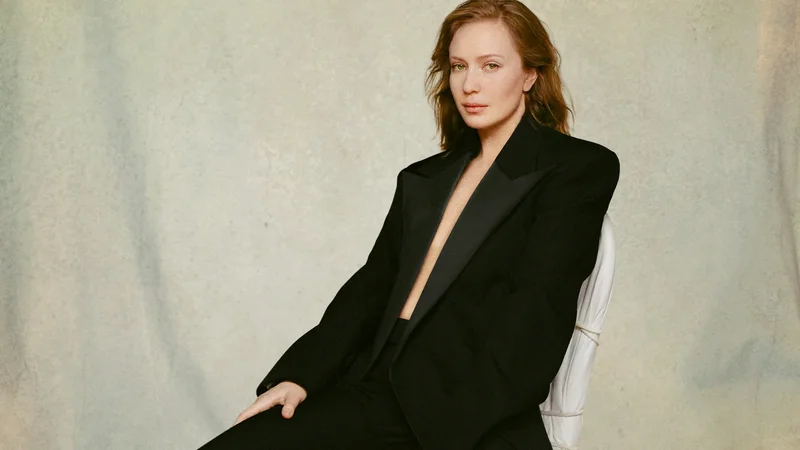
Breaking through Hannah Einbinder’s schedule is a challenge proportional to the remarkable moment the actor and comedian is experiencing. She made her on-screen debut just five years ago in the HBO series Hacks and now appears in her debut feature film, Teenage Sex and Death at Camp Miasma. Einbinder, 31, plays a promising director tasked with relaunching a horror franchise once headlined by a diva originally played by Gillian Anderson. When we finally get to speak, it has been only a month since Hacks ended, and Einbinder has just attended the Cannes Film Festival, where Teenage Sex and Death at Camp Miasma — directed by another rising indie talent, Jane Schoenbrun (I Saw the TV Glow) — opened the Un Certain Regard section.
A few days after this interview was conducted, the Emmy nominations were announced; the ceremony will take place in September. Einbinder has been nominated again and Hacks earned 24 nominations for its fifth season, a record for the comedy category. The actress’s schedule is full of awards, recognition, travel, intense promotion and a sustained commitment to activism. She answers by Zoom from her parked car.
“We just picked up masks,” she explains, holding the evidence up to the camera. “There’s a chemical fire at a food refrigeration plant in Los Angeles called Lineage. It’s in a neighborhood full of people and houses, in Boyle Heights. It’s crazy.”
She had already been sharing information on social media in previous days, helping local organizations. In general, her Instagram is weighted toward social and humanitarian issues, queer visibility and diversity advocacy, and support for Democratic politicians and NGOs, more than promotion of her work or personal curiosities. She reserves her private life for stand-up material.
She started on the stages of Los Angeles comedy clubs at open-mic nights while working days in a coffee shop. She got her break when a producer from the The Late Show with Stephen Colbert saw her and offered a spot on the program. She debuted just days before the Covid-19 pandemic lockdown. During that time, she was also auditioning for Hacks, for the role of Ava Daniels, the egotistical, unstoppable writer hired to rejuvenate the late-night show of comedy legend Deborah Vance, played by Jean Smart.
From the outside, Einbinder’s world has changed completely, but she insists she is much the same. Sitting in her car, drinking iced coffee, without makeup and wearing a vintage sports T-shirt, she sounds believable. She is authentic, fresh, and original. She is Hollywood’s new definition of cool.
Question. Have you had enough time to rest and reflect on what Hacks meant, or on what comes next?
Answer. Yes. I’ve spent a couple of months promoting and I’ve been able to sit down in interviews to talk about the feeling of leaving the work behind and dealing with its ending; it’s nice to process it in real time. I tried to accept the end of Hacks as best I could during filming, but the truth is you only absorb each phase as it arrives. There’s no way to prepare for what comes next. I was probably the first to cry at work over the series ending [laughs].
Q. Is releasing Camp Miasma close to the end of Hacks perfect for coping with the “now what?” anxiety?
A. Yes, sometimes our lives as actors can feel extremely hectic, and then you experience this totally opposite calm. Right now I feel like I have an abundance of opportunities. I’m very grateful these experiences are converging. I try to find ways to create a bit more balance in the polarity of this job.
Q. Despite your still short résumé, do you feel free and liberated to choose what you want to do next?
A. For me it’s important to try, as much as possible, to maintain the standard of quality I’ve been privileged to reach between these two projects. Not just quality, but the depth of collaboration. I worked on Hacks for six years, and the people I made the series with became part of my family. Going from Hacks to making my first film with Jane and connecting with her so deeply are incredibly exceptional experiences, not only for their quality but for the closeness that forms among collaborators. That matters a lot to me. I want to feel there’s a reason to do the work I do. While I seek projects that make me feel good, I also look for people I feel good with.
Q. Working only with people you connect with is a conclusion actors often reach after years of experience. Do you think it’s a generational issue — that earlier generations didn’t even consider it — or is it personal?
A. That’s an interesting point: Paul W. Downs, Jen Statsky, and Lucia Aniello, the creators of Hacks, are the same age. So I think maybe they entered the industry without any ties to the toxic old‑school approach. That could be a factor, but it also depends on the kind of people they are. I feel very lucky to have come across them.
Q. The first audition for Hacks was the day before the pandemic broke out, when you were still 24…
A. Well, I’m having memories now… [she interjects to hold up the masks she’s been carrying around Los Angeles lately].
Q. Thanks to Hacks, you became known publicly… How has your life changed in practical terms?
A. Partly because we started filming during lockdown and premiered in quarantine, I was able to keep my normal life longer. My entry into fame wasn’t conventional. Most of my friends are from college, others are comedians I started with before the series, and my best friend is from high school. But, of course, my life has also broadened in many ways.
Q. For better or worse?
A. On the one hand, I’m in a position where I can do very rewarding creative work, and I value that privilege greatly. But I also think fame is largely a dehumanizing experience.
Q. How do you face that dehumanization?
A. I try to keep my life simple. I’m lucky because most people who approach me are very kind and from my community. People who are queer and women, and often both. People who respect and understand me.
Q. You haven’t built that community solely through your work but also through what you share on social media — a highly engaged profile. In fact, the end of your Emmy acceptance speech went viral: “Go Birds, fuck ICE and free Palestine.”
A. I think our culture gives fame and celebrities too much importance. In my view, people with visibility have a responsibility to draw attention to what really matters: preserving human life. Whether in Palestine or in Boyle Heights here in Los Angeles, when a company like Lineage endangers people, everything is connected. The connecting thread is capitalism. For me, the best use of that visibility is to focus attention on what matters.
Q. Susan Sarandon said this year in Spain that she has been blacklisted and sidelined in Hollywood for her political activism. Javier Bardem was the only one to say something about Gaza at the Oscars… Aren’t you afraid of consequences for your activism? Have you experienced reprisals?
A. I don’t think about whether there are consequences. I have deep respect for Javier, for Susan, and for everyone who spoke before me. She was in fact one of the few who did, and that’s related to the response she received. I’ll also say that, as a Jewish person, I benefit from a certain privilege when speaking specifically about Gaza. No matter what they try, any accusation of antisemitism against me is unfounded. I follow the footsteps of those who spoke before me. Many of those people helped me rethink the belief system I had inherited.
Q. Is that still a brave stance in Hollywood today?
A. I don’t think other people’s cowardice should be the criterion for judging bravery. I don’t believe what I do is brave at all. It’s rational. And the fact that others are cowardly doesn’t make what I do brave. I think the brave ones are Palestinians who speak out, like Mahmoud Khalil, who was detained by ICE for defending his people. And, of course, the people of Gaza are brave. I live with immense privilege. In my view, speaking about Palestine as I do is the least I can do.
Q. Where does your political activism come from?
A. I became politically aware at university when Bernie Sanders emerged and ran for president. I was studying and began to reevaluate my ideology, which I had previously identified as more liberal. That opened doors for me to join the east Los Angeles comedy scene after graduating, which was closely tied to leftist organizing and mutual aid. We did benefit shows and collaborated with local organizations. Since then, it has been intrinsically linked to my art.
Q. Did your activism rub off on Ava, your character in Hacks?
A. Ava was already fully defined when I was cast. Ava reflects Paul, Jen, and Lucia and their belief system. They use that character to communicate much of their ideology, which aligns with mine. It’s a happy coincidence that we come from the same ideological place.
Q. This last season was especially critical… For example, in the episode about the technobro trying to sell them AI to make comedy. How do you see the present and future of art amid these big tech corporations?
A. It doesn’t look good. But I hope we’ll see growing resistance and people opposing the integration of AI in art. This is where boycotts are very effective. Understanding that if something uses AI, we can’t support it. Understanding that if studios take money from those entities, it’s hard to support them. All of us in the industry have some degree of complicity with these systems simply because we work for large corporations. That’s hard to face. Frankly, I don’t have an answer. It’s something that torments me and I think about every day. It drives me crazy. We just have to try to resist as best we can. That’s where I’m at.
Daughter of Laraine Newman, writer and comedian and a member of the founding generation of Saturday Night Live, and of director Chad Einbinder, Hannah defines herself as a comedian, Jewish, bisexual, and left‑wing. In the monologue with which she debuted on Stephen Colbert’s show and later included in part in her special Hannah Einbinder: Go to Hell, she begins by explaining that her mother had her at 42, that her parents didn’t marry because they didn’t want to, and that her mother was the breadwinner. She talks about her grandmother coming out, about medicated ADHD in youth that left her like a zombie until college, comedy, and marijuana arrived, and about how competitive she was as a high school cheerleader… She spares no detail and mines her life for material.
Q. Hacks was born to reflect on the limits of comedy and to explore what it means to be a woman in comedy. Is there any doubt left that women can be funny?
Q. There’s a great line in the series spoken by Deborah Vance. It’s in a press conference when they announce she’s going to be the new late-night host. Everyone asks her about being a woman, about her age, but not about her work. She gets frustrated and says: “I’m not a woman. I’m a comedian.” I get it. I think what Hacks aims to do, in my view, is simply remove the word “woman” from the concept “comedian” because it creates an unnecessary qualifier. And I think that’s how many artists from marginalized groups feel: externally labeled as different when they are simply trying to create, like everyone else. So I don’t think about whether people consider women funny or not.
Q. But in recent years you’ve become a role model for those who follow, inheriting the legacy of those who came before you.
A. Legacy isn’t something I worry about. I try to make choices that make me feel good and to collaborate with people I love. But it is true that representation is very positive and important. The ultimate goal of representation is equality.
Q. Now your first film as a lead is coming out. Camp Miasma deconstructs horror stereotypes, a genre your mother loves.
A. Yes, my mother is a big horror fan, so I’ve seen a lot, though not so much slasher. My tastes have always leaned more toward John Carpenter, Stephen King, something supernatural but comic. I think horror and comedy are closely linked. The reactions to fear and to laughter often go hand in hand, as in this film. But what connected me most to what Jane [Schoenbrun] wanted to tell was the story around dissociation and sexuality in general.
Q. The tagline is: “If the movie gets too real, you can always turn it off.” What does that mean?
A. It’s about being present and having control of yourself in relation to others in a sexual context and more broadly. It’s an allegory of consent. The film is like a Trojan horse. It’s funny and then you realize you’re talking about very deep issues.
Q. Did movies play an important role in your childhood and upbringing?
A. Yes, in my case from a very young age I watched Nickelodeon’s psychedelic cartoons. I have ADHD and had a lot of energy as a child, and I think Jim Carrey channeled that in a way I connected to; I tried to be like him and that became a method to make my parents laugh and boost my self‑esteem.
Q. What about fashion? Your red‑carpet appearances are also original and different.
A. That’s something I get a lot of help with [laughs]. My friends say I dress like Adam Sandler in my everyday life: badly. But comfortable. I’ve learned a lot about fashion as an art form.
Q. And after Camp Miasma… what are your plans?
A. I have a couple of things in the works and I’m planting seeds. I keep doing stand-up. Acting has allowed me to take my time, which is a gift, because I’m very slow at writing. Monologues were my first love and a useful outlet to express many of the things I think. I will never stop doing them.