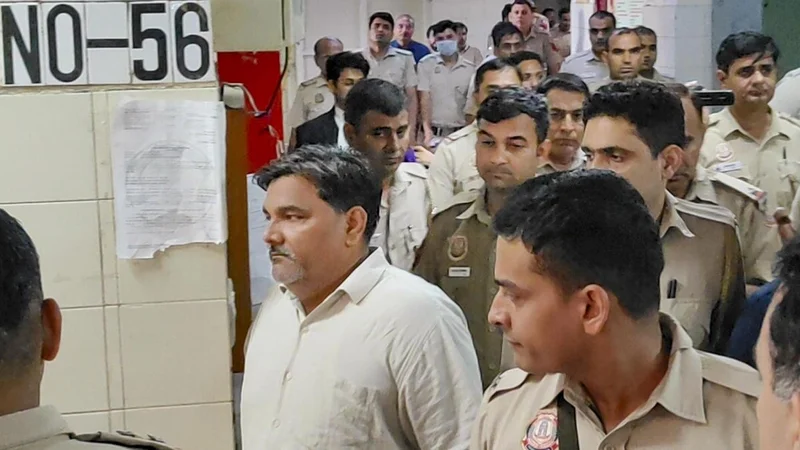
The murder of Intelligence Bureau (IB) officer Ankit Sharma during the 2020 Northeast Delhi riots became one of the most closely watched criminal cases arising from the communal violence that followed protests against the Citizenship (Amendment) Act (CAA). The riots claimed 53 lives, injured hundreds and displaced many families.
More than six years later, on July 12, 2026, a Delhi court convicted former Aam Aadmi Party councillor Tahir Hussain and four others for Sharma’s murder. On July 31, all five were sentenced to life imprisonment. While describing the killing as “exceptionally brutal”, the court held that the case did not satisfy the legal threshold for the death penalty under the “rarest of rare” doctrine.
The case
On February 25, 2020, 26-year-old IB officer Ankit Sharma stepped out of his home in Northeast Delhi during the peak of the riots and never returned. Late that night, his father, Ravinder Kumar, who was in the Delhi Police, lodged a missing person’s complaint at the Dayalpur police station. The following day, Sharma’s body was recovered from a drain near Chand Bagh.
His post-mortem report recorded 51 external injuries, including multiple stab wounds and blunt-force trauma.
Why was Tahir Hussain accused?
In his statement to the police, Ravinder Kumar alleged that his son had been taken by rioters to a building owned by Tahir Hussain, where he was killed.
The Crime Branch investigation recovered petrol bombs, stones, acid packets, slingshots and other projectiles from the crime site. Investigators also relied on CCTV footage, forensic evidence and the testimonies of 91 witnesses.
The prosecution argued that this evidence showed that Tahir Hussain was part of the unlawful assembly, his premises were used during the violence and that he actively encouraged or facilitated the attacking mob. It held that Sharma was intercepted by the same violent unlawful assembly, repeatedly assaulted and stabbed before his body was dumped in the drain.
Based on the investigation, the police charged Hussain and 10 others with offences including murder, kidnapping, rioting with deadly weapons, unlawful assembly and promoting enmity between communities under the Indian Penal Code (IPC).
The defence disputed both the investigation and the prosecution’s case. It alleged that the FIR had been ante-timed and questioned delays in recording the statements of the witnesses. It also contended that several eyewitnesses had altered their versions during trial and some of them did not identify Hussain as part of the mob.
What the court concluded
Additional Sessions Judge Parveen Singh of the Karkardooma Court rejected the defence’s contention that the investigation was flawed.
The court held that, taken together, the evidence established beyond reasonable doubt that the accused, Tahir Hussain, Nazim, Kasim, Javed and Anas, were members of an unlawful assembly which, the court held, had assembled with “animus against Hindus” and a common object of committing rioting, loot, arson and causing damage to the property and persons of the “Hindu community”.
It found that, although the assembly may not have been constituted specifically to murder Ankit Sharma, its members knew that death was a likely consequence of pursuing their common object, attracting liability under Section 149 of the IPC. This IPC section says that every member of an unlawful assembly responsible for offences committed in prosecution of its common object.
This was the reason why even when prosecution did not proved that Hussain personally inflicted the fatal injuries, court held that his participation in the unlawful assembly was sufficient to make him liable for murder.
All the accused were, however, acquitted of the charge of criminal conspiracy, because, the court said that the prosecution had failed to establish beyond reasonable doubt that there was a prior agreement or meeting of minds to commit the offence.
Six co-accused were also acquitted after the court found the evidence against them insufficient.
Why was the death penalty rejected?
After the conviction, the prosecution argued that the brutality of the murder warranted the death penalty.
The court described the murder as “nauseating and sickening”, observing that Ankit Sharma was surrounded by a “murderous mob”, subjected to a “brutal assault” and that his body was treated with extreme indignity before being thrown into a drain yet sentenced the accused to imprisonment for life because the constitutional standard for awarding the death penalty had not been met.
It noted that the prosecution had failed to show that the convicts were beyond the possibility of reform or that they had a history of violent criminal conduct. In the absence of such circumstances, the court concluded that life imprisonment remained an adequate punishment.
Published - August 01, 2026 10:25 am IST