Canada could add billions to its economy by processing more food. Here's what it's trying
Feds pledging major investments to grow Canada's food processing industry
Inside their demonstration plant in Benmiller, Ont., Martin VanderLoo and Graham Markham are working to prove a point: Canada can generate a big economic boost and strengthen its food sovereignty by processing more food at home.
The two men are focused on soybeans, a legume that Canada grows millions of tonnes of each year. Their company, New Protein International, aims to produce soy protein isolate, which is used in products like baby formulas, protein bars and nutrition shakes.
"The demand for plant-based protein just continues to increase dramatically," VanderLoo said.
Indeed, according to the U.S. Foreign Agricultural Service, global production of soybeans has risen from 350.8 million tonnes in 2016 to 429.4 million tonnes in 2025.
The issue, according to VanderLoo and Markham, is that Canada is leaving money on the table by sending a sizable chunk of its agricultural products outside of the country for processing, then importing them back for consumption.
"We will forever become a servant state of the other countries where they will continue to build more manufacturing facilities and buy our stuff and process it there," Markham said.
"Let's make it here."
According to Soy Canada, a national association that represents groups involved in the development, transportation and processing of soybeans, more than 70 per cent of Canada's production is shipped abroad.
The federal government's recently-released national food security strategy notes that "despite its current size, Canada does not process nearly as much of the food that is grown or harvested in Canada as it could."
- Carney's new $3.2B strategy aims to boost access to local, affordable food
- Canada's got a grocery competition problem. Are local food hubs the answer?
"Instead, this food is exported to other countries to be processed. This decreases our food sovereignty, and it also means that we lose out on potential economic gains of processing the food in Canada," the strategy says.
Some groups, like Protein Industries Canada, estimate Canada could unlock $25 billion in annual GDP growth with the right investments, infrastructure and policy support for its plant-based ingredient manufacturing and food processing sector.
VanderLoo and Markham are hoping to seize on that opportunity. Their demonstration plant uses a unique process to extract the protein without using hexane, a petrochemical. Their goal is to create Canada's first large-scale facility in the near future.
According to VanderLoo, the commercial facility would use 70,000 metric tonnes of soybeans, and it's expected to produce 17,500 tonnes of soybean protein isolate — several million large-size protein powder tubs.
Canada in a pickle
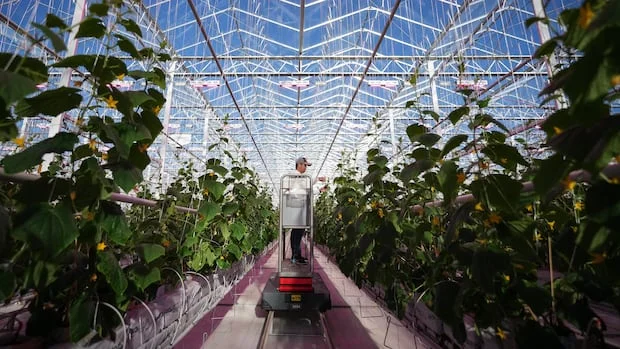
Dan Froese, who works with seven of his siblings on their family farm in Vienna, Ont., to grow pickles and peppers, described how the family used to ship their crops to Canadian plants owned by pickle brands like Bick's and Heinz.
WATCH | Bick’s pickles no longer stocked in some stores due to ‘tariff impacts':Those plants have since closed, Froese said, so his crops are now shipped to the U.S. for processing. The issue is that upon return they're viewed by Canadians as American-made — despite the raw ingredients being fully Canadian.
"It hurt our industry hugely for this year," he said. "The contracts for this year were literally smaller toward the farmers because Canadian people stopped buying Bick's pickles to a large extent."
Henry Voth works for Hartung Brothers, a U.S.-based company that purchases cucumbers from farms, including Froese's, and delivers them to companies for processing.
"Everyone's gone to the U.S.," he said, and companies are enticed to move operations there because regulations are less cumbersome and, accordingly, less expensive.
"Food safety is a great place but can be overdone. ... I'm not saying it's not important, there are definitely important pieces there, but we're overregulated in that."
Froese's brother Jaime concurred.
"The tax burden in Ontario is just astronomical," he said.
"If you want to look for solutions, you're going to have to have tax incentives or reduce taxes. But it seems as long as we have a Liberal government, it's just going to keep skyrocketing."
What Canada's doing, and needs to do
Ottawa's food security strategy pledges hundreds of millions of dollars to strengthen Canada's food processing sector, with a goal of increasing the proportion of domestically-processed food consumed in Canada from 70 to 80 per cent, though there's no specific deadline.
Markham, with New Protein International, said the goal is realistic but requires ambition.
Arlene Dickinson, founder of District Ventures Capital and star of CBC's Dragon's Den, has been vocal about the decline of Canadian food processing. She told The House on Thursday that Canada has long considered itself a commodity-driven nation.
Dickinson also said Canada's food manufacturing and agri-food space employs more people than its auto sector. According to the federal government, in 2024 the food and beverage processing industry employed 318,000 Canadians.
"It is the largest employer of manufacturing in the nation," Dickinson said.
For too long, she said investors have been chasing the high returns of the tech sector, while the food sector is steadier.
"We have to start thinking differently. We have to stop thinking about it in terms of only the profile of the return — which by the way is very good in the food space — but also think about it in terms of food sovereignty."
Dickinson said the federal strategy is "a start to what we need to begin to do here" and Canada must be focused on the last mile of commercialization.
"In order to do that, we have to put capital to work. People have to invest in processing plants, manufacturing plants and finishing plants," Dickinson said. "We need more capital to be deployed against this really important sector."
As for whether the Canadian government can achieve its goal of strengthening its food sector in time to capture more value, Dickinson said she thinks it will.
"I now see growth funds that are putting money towards agriculture. … I'm a big believer in Canada. I know we've got opportunity in front of us. I believe we're gonna make it work."
With files from Derek Vanderwyk