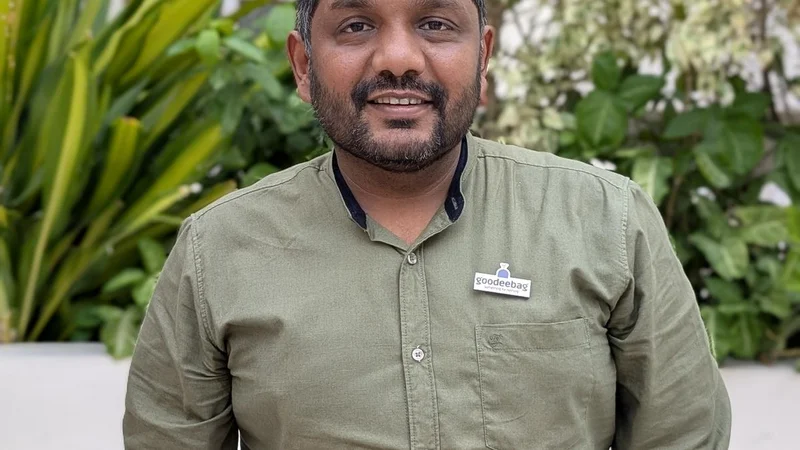
After several years in logistics, Abhishek Agarwal found himself asking a simple question: why is India so good at delivering products to consumers but so poor at collecting them once they are discarded?
Drawing on his logistics experience, he borrowed the logic of home delivery. If a grocery order can reach a customer’s doorstep in 15 minutes, why can’t the same efficiency be applied to collecting recyclable dry waste — paper, plastic bottles, wrappers, medicine blister packs and other household discards?
That idea led him to plan Goodeebag in 2022 a passion project that collects recyclable dry waste from households. “We started operation by end of 2025. From 2022 to 2025 I worked on the system of collection, sorting, understanding the requirement of recycle buyers, our customers and building the app. I didn’t want to collect it and without knowing who to sell it. Everyone talks about avoiding plastic — carry your own bag, refuse a plastic bag at the shop. But what nobody talks about is that every country has a forward logistics system and almost nobody has developed a reverse one,” says Abhishek.
So how does Goodeebag make money? “Goodeebag who worked indepently sells the scrap to recyclers that put it to use to manufacture household products. I sell them by weight. When the recycle materials are collected from homes, customers are paid through points which can be redeemed through the grocery store within the app.”
His point is straightforward. When you order something online, an elaborate network of warehouses, delivery riders and tracking systems ensures it reaches your doorstep. But once a water bottle is emptied or a package is opened, there is no equivalent system to bring those materials back.
“The circle of a product’s life is incomplete,” he explains. “It goes from raw material to manufacturer, retailer and consumer, and then nothing. It disappears into the informal economy of ragpickers and roadside collectors, with no traceability, accountability or way of knowing where it ends up.”
How it works
Goodeebag’s reverse logistics model fills that missing half of the circle. Its team collects recyclable waste from homes, transports it to sorting centres and channels it to authorised recyclers, creating a formal, technology-backed collection system.
The company officially launched its app in late 2022. Abhishek had no background in waste management or materials science. “When I started, I didn’t know HDPE (high density polyethylene) from LDPE (low density polyethylene),” he admits. He had to learn the different categories of recyclable waste, understand where each material needed to go and build an operational system that people would actually use.
Today, Goodeebag handles around 200 to 250 household pickups daily, collecting roughly 800 kilograms of recyclable waste through homes alone. Combined with collections from apartment complexes and institutional partners across 11 to 12 areas like Gachibowli, hitex, Nalagandlla, Narsingi, Kokapet, TSPA, Hafizpet and Begumpet, in Hyderabad, it processes nearly four tonnes of waste every day. The material is sorted at the company’s 8 collection centres before being sent to recycling units, where it is transformed into products such as planters, dustbins and even eyewear frames.
While the Goodeebag app is free for customers, it comes with a request. Customers are asked to do very little. “We only request that they rinse food-contaminated recyclables. Don’t even wash them, just give them a quick rinse,” says Abhishek.
The fleet of 18 company-owned rickshaws are entirely electric, a deliberate decision in a business where logistics is the biggest operating cost and fuel can quickly erode already-thin margins.
Goodeebag initially focused on Hyderabad’s gated communities and high-rise apartments around Gachibowli. But it soon ran into a structural challenge. A typical household generates only four to five kilograms of recyclable waste a week — far too little for recyclers, who need large volumes of material already segregated by type by 80 dedicated employees.
“That’s when I realised every drop makes an ocean,” says Abhishek. The team began going door to door, explaining the model to residents. “Give us your recyclable waste and we’ll reward you with money, groceries or other incentives. We want anything that’s clean, recyclable — plastic or paper.”
Does recycling save resources
Every recycled plastic sheet is one that did not require new petroleum to be drawn out of the ground. Every reused paper cup is one less tree cut down and one less item added to a landfill. You’re closing the other half of that same loop,” he says.
Published - July 22, 2026 01:16 pm IST