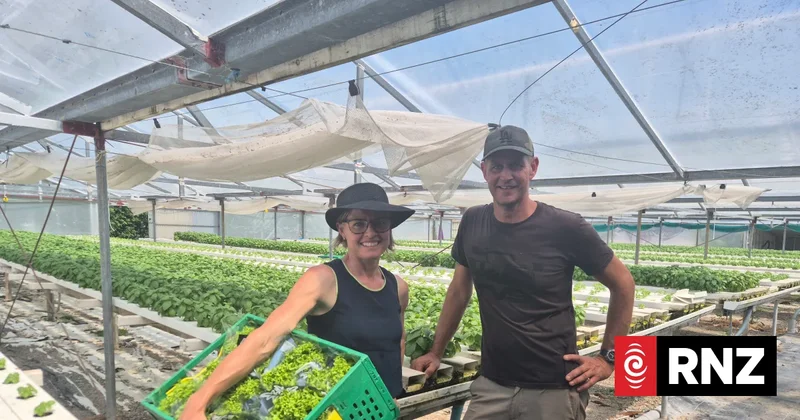
There's no need for extra washing when it comes to these salad greens. The plants from Waikawa fresh are harvested straight from their trays where they're grown hydroponically.
"There's no bugs, there's no soil, there's no dirt. We don't clean these plants with any chemicals or chlorine, so we eat those lettuce straight out of the channels. They're just absolutely crispy clean ... and they haven't been touched by anyone the whole time it's been growing," Tony Dale-Low told Country Life.
He and wife Lisa Dale-Low made the move to growing salad greens and herbs almost a decade ago, trading in city life and corporate jobs for horticulture in Horowhenua.
Hydroponics in Horowhenua: Growing with water
The couple had no growing experience before starting.
They'd spent a couple of years travelling around the country in a bus with their three children before coming up with a checklist of what they wanted for their next chapter.
"We wanted to be doing something productive, rather than something paper or computer-based. We wanted to be rural and we wanted to have a bit more flexibility with the kids. None of that was really sector specific or even location-specific," Lisa said.
After narrowing it down to the North Island they came across an existing hydroponic growing business near Levin - hydroponic systems work by replacing soil with a water-based, nutrient-rich solution.
That was in 2018 and after learning the ropes from the previous owners they've made it their own.
They grow the plants from seedlings themselves, also using hydroponics on a 'flood and drain table'.
"So this is set up on a timer. It runs three times a day and these tables will fill with nutrients or liquid with some fertilizer," Tony explained.
It sits there for a few minutes before draining. Being fully automated means the team don't need to do any manual watering.
He said it helps the plants up well - making them more resistant to diseases and pests.
"[It] all definitely starts here in the propagating house. If we get it wrong here, then we have issues later. If we get it right, then we have so much more success."
Once the seedlings reach about three weeks, they're transferred to larger growing trays called 'gullies'.
"They look like downpipes, which in fact I think they are, actually straight off someone's house," Tony told Country Life.
"They've been drilled with a lot of little round holes and we plant the plant inside the holes. The nutrients get pumped around the greenhouse through these small whiskers."
The system they use only requires liquid to be pumped to the top of the gully before gravity does the rest, drawing it down the channel, through the gutter back to the holding tank which is topped up with the water sourced from the 4500m2 of greenhouse rooves.
The water is reticulated meaning they only need to add more to account for evaporation or absorption by the plants.
In the central tank, a computer system checks to make sure the water has the right balance of nutrients and the right pH level - the acid or alkaline concentration - and runs a dosing system to adjust this when needed.
Sustainability is a key part of Waikawa Fresh' operations.
The recent addition of solar power at the end of last year is also helping cut down on energy bills - it's even used to power an old Nissan 'lettuce' leaf they use on farm to run the maintenance gear around.
About two months after the plants have finished growing they'll be ready to be picked straight from the gullies with no extra washing required - "lovely and crunchy and and fresh".
Learn more: