Taylor Sheridan has become one of the defining screenwriters of the last decade. From the Academy Award-nominated Hell or High Water to one of television's biggest franchises in Yellowstone, few writers have built such a recognizable voice across both movies and TV. Sheridan’s stories are often described as modern Westerns, which is hard to debate given cowboy-adjacent hits like Landman, 1923, and his latest Dutton Ranch. But what truly ties them all together is a fascination with broken institutions, impossible moral choices, and the will to survive in worlds where right and wrong have long since blurred.
Before the Dutton family became a cultural phenomenon, Sheridan was laying the foundations for these fascinations with intense crime thrillers, like Hell or High Water and Wind River. But the clearest expression of everything that would come to define his career first cropped up in his breakthrough screenplay, one of the most harrowing cartel thrillers ever made. Directed by Denis Villeneuve (Dune, Arrival), Sicario is a gripping nosedive into America's morally compromised war on drugs along the U.S.-Mexico border, and it's available to watch right now on HBO Max.
Like much of Sheridan’s body of work, Sicario is less interested in heroes than in systems that have stopped functioning as intended. Emily Blunt's FBI agent Kate Macer enters the story believing she already understands the rules of law enforcement, only to discover that the war on drugs operates according to an entirely different code. Every mission reveals another compromise in the system until the distinction between law and vengeance becomes almost impossible to ignore.
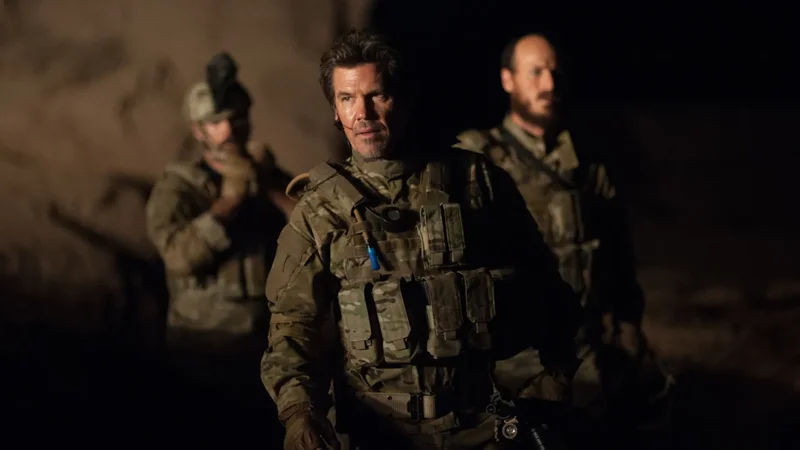
That moral ambiguity is what elevates Sicario above countless other crime thrillers. Rather than building toward a triumph over evil, Sheridan's screenplay gradually strips away the illusion that there are any clean victories to be had — or heroes at all. Characters like Josh Brolin’s “spook” CIA agent Matt Graver and Benicio del Toro’s shadowy Alejandro Gillick frequently withhold information from Kate (and the audience), creating a constant sense of unease that makes every convoy, border crossing, and raid feel like it could erupt into violence at any moment.
Take, for instance, the border crossing scene itself. In the process of extraditing a high-ranking member of the Sonora Cartel, the squad of agents, including Gillick, Graver, and Kate, is ambushed while stuck in traffic just after leaving Mexico. The film's blistering shootout, staged amid the claustrophobia of packed three-lane border traffic, plays like a modern homage to Heat. But its purpose isn't simply to thrill; it's also the moment Sheridan lays bare the film's moral divide. While Alejandro and the rest of Graver’s team move through the chaos with chilling efficiency, Kate freezes, horrified by how quickly due process has given way to execution. In a single sequence, Sicario reveals that its greatest conflict isn't between law enforcement and the cartel, but between those willing to abandon their principles and the last person still trying to hold onto hers.
Of course, Sheridan's screenplay found the perfect collaborators. Villeneuve directs with remarkable restraint, allowing tension to build through silence instead of spectacle. Roger Deakins' breathtaking cinematography transforms the U.S.-Mexico border into a landscape that's both beautiful and foreboding, while Johann Johannsson's haunting score provides a sense of looming inevitability. And then there's del Toro, whose quietly devastating performance becomes the film's emotional core as his true motivations come into focus.
Sicario's success inevitably led to 2018's Sicario: Day of the Soldado. Sheridan returned to write the screenplay, with del Toro and Brolin reprising their roles, but Villeneuve and Blunt did not. While the sequel has its defenders and digs even deeper into the moral compromises of America's border policy, it never reached the critical or cultural heights of its predecessor. Without Villeneuve's meticulous direction or Kate Macer's outsider perspective anchoring the story, Soldado often feels more like an extension of Sheridan's worldview than the careful interrogation of it that made Sicario so compelling.
If you've only come to Taylor Sheridan through Yellowstone or its many offshoots, Sicario is the reason why Hollywood took notice in the first place. Just over a decade later, it's still his leanest, sharpest screenplay — a thriller that established the themes he'd revisit for years to come while remaining arguably the finest encapsulation of them all. Even after several incredible thrillers and an ever-expanding filmography, nothing Sheridan has written has quite matched the precision, tension, and moral complexity of the film that first announced his arrival.
Sicario is streaming on HBO Max* *