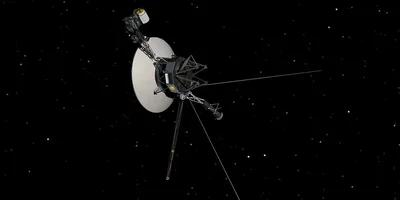
NASA has revealed it’s working on a plan called “The Big Bang” that it hopes will extend the working lives of the Voyager probes.
A few details about the plan appear in an April 17 NASA announcement which revealed that during a planned roll maneuver on February 27, “Voyager 1’s power levels fell unexpectedly.”
“Mission engineers knew any additional drop in power could trigger the spacecraft’s undervoltage fault protection system, which would shut down components on its own to safeguard the probe, requiring recovery by the flight team – a lengthy process that carries its own risks,” the announcement explains.
To avoid that scenario, the Voyager team decided to shut off the craft’s Low-energy Charged Particles experiment (LECP), because they hope doing so will give Voyager 1 “about a year of breathing room.”
“While shutting down a science instrument is not anybody’s preference, it is the best option available,” states a canned quote from Kareem Badaruddin, Voyager mission manager at JPL.
NASA left LECP in a state that means it can’t do its job but didn’t turn off a small motor that consumes just 0.5 watts because the aerospace agency says doing so “gives the team the best chance of being able to turn the instrument back on someday if they find extra power.”
Readers will doubtless remember that Voyager 1 is over 25 billion kilometres from Earth and therefore unserviceable, while its radioisotope thermoelectric generator will one day cease emitting sufficient energy to keep the craft alive. Voyager 2 has the same problems.
NASA’s announcement reveals that engineers think they can find power for LECP by developing “a more ambitious energy-saving fix for both Voyagers they call “the Big Bang,” which is designed to further extend Voyager operations.
“The idea is to swap out a group of powered devices all at once – hence the nickname – turning some things off and replacing them with lower-power alternatives to keep the spacecraft warm enough to continue gathering science data,” the announcement states.
Work on Big Bang is sufficiently advanced that NASA plans to test it on Voyager 2 in May and June. If that effort succeeds, NASA will try it on Voyager 1 no sooner than July.
“If it works, there is even a chance that Voyager 1’s LECP could be switched back on,” NASA says.
If that’s possible, it would be yet another remarkable achievement in the 48-year history of the Voyager missions, which NASA expected would last the four years they took to reach Jupiter and Saturn. Both craft carried ten instruments, but now operate just three apiece. ®