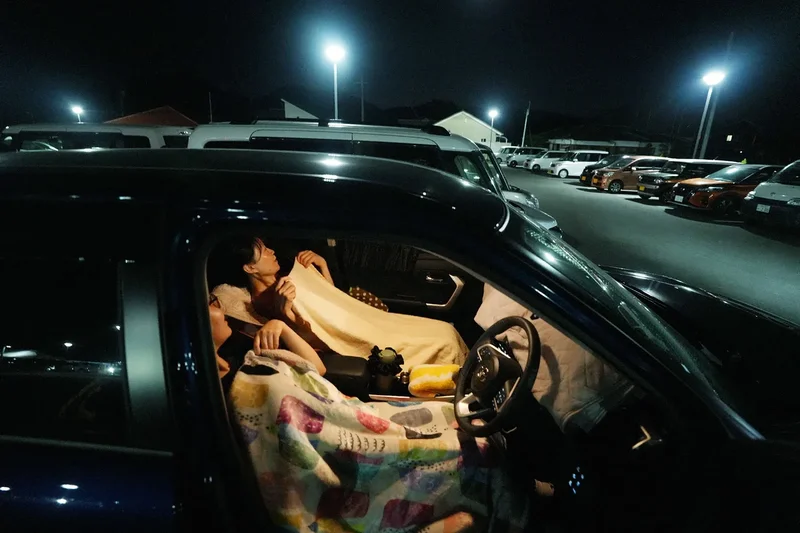
Thousands of survivors of Japan's powerful 6.8-magnitude earthquake have been forced to sleep in cars and crowded makeshift shelters as an intense heatwave grips the country, compounding misery for communities already devastated by the disaster.
The death toll from the earthquake that shook Kumamoto Prefecture in southwestern Japan has risen to 36, while six others remain in serious condition, according to prefectural authorities.
The earthquake and nearly 100 subsequent aftershocks flattened homes, snapped bridges, crumbled roads and triggered an explosion at a shopping mall, sparking a massive search-and-rescue operation.
More than 1,500 buildings were damaged, including 179 that were destroyed, according to preliminary assessments by Kumamoto officials.
The earthquake forced more than 9,000 people to seek refuge in evacuation shelters, where authorities are working to restore running water and electricity to power air conditioning.
Japan is reeling under punishing summer temperatures, with highs reaching 36C (97F). Japan's weather agency and the ministry of the environment issued an extreme heat alert for Kumamoto City on Friday, raising fears of heatstroke among people left homeless by the quake.
Temperatures are expected to hit 40C on Monday, according to the Japan Meteorological Agency, which has urged people to take precautions.
Fuel has become scarce after power outages knocked petrol stations offline and earthquake damage disrupted deliveries from other regions.
Many evacuees have resorted to sleeping in their cars for privacy, but the shortage has made it difficult to keep the air conditioning running in the scorching heat.
Hirokazu Sato, who lost his home in the earthquake, said he, his wife and their three children would remain in their car until they could move into temporary housing.
"I don't know how soon I'd be able to move in," Sato said. "We need to have the air conditioning on throughout the day and night, which uses up gas."
Japanese prime minister Sanae Takaichi stressed that authorities must secure water supplies by doing "whatever it takes" and called for close coordination with the military and other relevant agencies.
Along with fuel, water services have been cut off for 72,000 households in the prefecture, according to Japan Times, with a timeline for restoring service unknown.
Authorities have said they are working to step up efforts to strengthen water supply support, including the dispatch of water trucks to priority locations.
Among those forced to cram into a car was Tomoko Takaoka, a 31-year-old factory worker who was unable to stay at an evacuation shelter with her two dogs.
Faced with the choice of sheltering without her Chihuahua and Chihuahua-poodle mix, Ms Takaoka instead turned to her car to protect herself and her pets from the heat.
After coming across social media posts about a veterinary hospital that has converted into a shelter for owners of cats and dogs, she moved to Ryunosuke Animal Hospital in downtown Kumamoto.
The facility is providing separate rooms for canines and felines after learning from the 2016 earthquake in Kumamoto that left almost 280 people dead.
"During disasters, it's only natural for dogs and cats to stay together with their families. But people who don't own pets don't necessarily want to be with them," hospital director Ryunosuke Tokuda said.
"They worry about fleas, odours, allergies and noise. Pets are often viewed negatively, which is why many evacuation shelters don't allow people and pets to stay together," he added.
Ms Takaoka was among 26 evacuees and their pets sheltering at the hospital in tents.
"They're just like family to me. I'd like to stay with them as much as possible," she said.
The search entered its fifth day on Saturday after the critical 72 hour window – when there is the best chance to reach people alive – ended. Authorities said they are making efforts to locate every unaccounted person and identify those who have been found.
Of the 36 deaths, 27 victims have been identified.
Rescue workers continued to look through the rubble at the Aeon Mall in Kashima town, one of the hardest-hit sites. The complex had some 3,000 shoppers and hundreds of members of staff inside when the earthquake struck. About an hour later an explosion ripped through a part of the mall where some staff members were working, causing the second floor to collapse.
Rescuers pulled 12 people out of the mall with seven confirmed dead and five others injured. Officials did not say if more people were missing at the site.
A search operation has now ended at a Nippon Paper Industries factory in Yatsushiro city where a chimney collapsed in the quake, officials said. Of the 11 people dug out there, nine were confirmed dead.