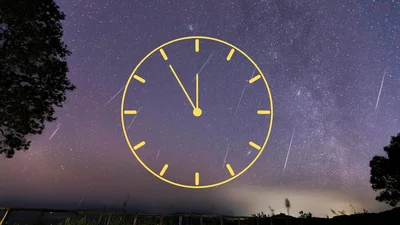
The Lyrid meteor shower is nearing peak activity! Here's the best time to hunt for shooting stars as well as a guide on where to find them in the spring sky so you can maximize your chances of spotting these fast-moving meteors.
When are the Lyrids most active?
In 2026, the Lyrid meteor shower is active from April 16-25 and reaches peak activity around 4 p.m. EDT (2000 GMT) on April 22 during the day for viewers in the U.S., according to the American Meteor Society (AMS).
If you're watching from the U.S., your best time for spotting Lyrid shooting stars is during the hours preceding dawn on April 22, when up to 18 meteors may be seen each hour blazing away from an apparent point of origin, or radiant, located close to the bright star Vega in the constellation Lyra.
The radiant rises to its highest point — when the most meteors will be visible — in the hours before sunrise.
As a bonus, the 27%-lit waxing moon will set below the horizon around 2 a.m. local time. That should provide a beautifully dark night sky upon which the natural light show can stand out. The shower will also spawn a decent number of meteors on the three nights surrounding the peak, so there's no need to despair if you miss the show on April 22!
Where to find Lyrid meteors
We see Lyrid meteors as Earth passes through the debris stream left behind by the wandering comet C/1861 G1 Thatcher. The shower's radiant indicates the direction from which the meteors strike Earth's atmosphere. So, if you stare directly at the radiant, you won't get to see the shooting stars with the longest trains.
To find the best Lyrids, locate the blue-white light of Vega — and with it the approximate position of the radiant — shining high above the eastern horizon after the moon has set on April 22. Be sure to use a handy smartphone astronomy app to help point the way if you're not used to navigating the night sky. Many of these apps actually use augmented reality technology to pinpoint specific stars and deep sky objects, which makes the sometimes daunting prospect of finding your way about the starry sky a breeze.
Breaking space news, the latest updates on rocket launches, skywatching events and more!
Next, search for a clear patch of sky about 40 degrees away from the radiant — 40 degrees being roughly the width of four clenched fists held at arm's length. This is where the most spectacular shooting stars and fireballs can appear.
How to maximize your chances
The moon won't get in the way of your predawn meteor hunting, but city lights most certainly will! Head away from artificial lights and allow 20-30 minutes for your vision to adjust to the dark. Make sure you're using a red light to protect your night vision and that you've switched your astronomy app to "night mode" (or the equivalent setting).
Don't be tempted to use binoculars, as this will limit your field of view. Instead, lay back — ideally on a deckchair or blanket — and take in as much of the sky as possible. And if you're heading somewhere remote, be sure to let a friend or loved one know where you're watching the show from.
Editor's Note: If you snap a photo of a Lyrid meteor and want to share it with Space.com's readers, then please send your photo(s), comments, and your name and location to spacephotos@space.com.