From the tangle in your computer cord to the mess your cat made of your knitting basket, knots are everywhere in daily life. They also pervade science, showing up in loops of DNA, intertwined polymer strands, and swirling water currents. And within pure mathematics, knots are the key to many central questions in topology.
Yet knot theorists still struggle with the most basic of questions: how to tell two knots apart.
It’s hard to decide whether two complicated knots have the same structure just by looking at them. Even if they appear completely different, you might be able to turn one into the other by moving some strands around. (To a mathematician, the ends of a knot are always fastened together so that such motions won’t untie it.)
Over the past century, knot theorists have developed a set of clear, if imperfect, tools for distinguishing knots. Called knot invariants, these tools each measure some aspect of a knot — a pattern formed by its interwoven strands, perhaps, or the topology of the space surrounding it. If you use an invariant to measure two knots and you get two different results, you’ve proved the knots are different. But the reverse isn’t always true: If the invariant gives you identical results, the knots may be the same, or they may be different.
Some invariants are better at telling knots apart than others, but there’s a trade-off: These stronger invariants tend to be hard to calculate. “Most invariants are either very strong but impossible to compute, or easy to compute but very weak,” said Daniel Tubbenhauer of the University of Sydney.
By the time you’re up to knots whose strands cross each other 15 or 20 times, many invariants start to falter — either they fail to distinguish between many knots, or they’re getting too hard to compute. For most knot invariants, said Dror Bar-Natan of the University of Toronto, “if you say ‘300 crossings’ and then you say the word ‘compute,’ you are in science fiction.”
A page from an 1885 paper by Peter Guthrie Tait, in which he distinguishes different knots with 10 crossings.
But now, Bar-Natan and Roland van der Veen of the University of Groningen in the Netherlands have come up with a knot invariant that does not require mathematicians to choose between two evils: It is both strong and easy to compute. “It seems to be right in the sweet spot where exciting things happen,” said Tubbenhauer, who was not involved in the work.
This combination of strength and speed means that mathematicians can probe knots that were previously far out of reach. It’s easy to calculate the new invariant for knots with as many as 300 crossings, and Bar-Natan and van der Veen have even calculated some aspects of the invariant for knots with more than 600 crossings.
We in some sense just winged it.
Roland van der Veen, University of Groningen
“This breakthrough is comparable to a new kind of telescope: one that not only provides much sharper resolution over familiar ranges, but also extends our reach by a factor of 10,” said Gil Kalai of the Hebrew University of Jerusalem.
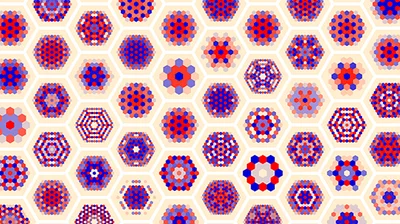
For each knot, the invariant outputs a colorful hexagonal “QR code,” as symmetric and delicately detailed as a snowflake. “The output is phenomenally beautiful and unbelievably varied,” said Liam Watson of the University of British Columbia. “It just seems to come from another world.”
Mathematicians hope that these intricate motifs will point them toward deeper topological features of individual knots. “You immediately start to wonder,” Watson said, “what was it about this given knot that produced this particular pattern?”
Buckets of Knots
Consider a game in which you draw a knot and try to color each of its strands red, yellow, or blue. The rules are that you must use each color at least once, and that at every crossing, either all three colors appear or only one does. This is possible for some knots, but not others — for example, you can color a trefoil knot, but not a figure-eight knot.
Mark Belan/Quanta Magazine
No matter how you further tangle any given knot, if it starts out “three-colorable” then it will remain so. Likewise, knots that aren’t three-colorable stay that way. That makes three-coloring a knot invariant.
It’s not so hard to calculate whether a knot is three-colorable, but this invariant is not very good at distinguishing between knots. It separates knots into just two buckets: three-colorable and not three-colorable. If the knots you’re trying to distinguish happen to be in the same bucket, you’re out of luck. You could improve your invariant by using more colors and rules, and by measuring how many colorings a knot has instead of just whether it can be colored. These refinements create stronger invariants, but they also get harder to calculate.
This breakthrough is comparable to a new kind of telescope.
Gil Kalai, Hebrew University of Jerusalem
Over the past century, knot theorists have come up with hundreds of invariants. Using these tools, they’ve managed to catalog the more than 2 billion knots with 20 or fewer crossings — a heroic effort, considering the shortage of invariants that are both computable and strong. When it comes to identifying knots, “the tools we have in 100 years of knot theory are not particularly great,” Tubbenhauer said.
This is partly because the strongest knot invariants tend to emerge from the study of profound topological structures within knots. But few knot theorists are versed in both these theoretical ideas and the computational considerations that go into devising invariants that are easy to calculate.
Bar-Natan and van der Veen, two theoreticians who are also adept programmers, are exceptions to this rule. Their new invariant grew out of deep topological ideas, but for now they’ve mainly focused on creating a fast, strong invariant. Making computability the priority in this way is “something culturally new” in knot theory, Watson said.
A Knotted Highway
Bar-Natan’s path to the new invariant started two decades ago when he was trying to understand ribbon knots — knots that run along the boundary of a ribbon that passes through itself. The work led him to revisit a particularly powerful invariant called the Kontsevich integral, which contains many other knot invariants rolled up inside it. Mathematicians have conjectured that this invariant is so strong that it can distinguish between all knots.
“For about five minutes I was happy,” Bar-Natan said. Then he reminded himself that for all practical purposes, the Kontsevich integral is impossible to compute. “It exists as an abstract thing, but you cannot actually deduce anything about any real-life knot from it.”