Sign in. It’s quick, free and it’s up to you.
An account is an optional way to support the work we do. Find out more.
ALMOST ALL OF the tens of thousands of migrants who entered Spain’s enclave of Ceuta in North Africa had left by Saturday, officials said, as some EU countries bolstered their border controls over the sudden influx.
An estimated 60,000 migrants entered Ceuta over just a few days from neighbouring Morocco, the enclave’s regional president Juan Jesus Vivas told reporters, but by today, Spain’s interior minister said almost all had left.
“The situation has been almost entirely reversed,” Fernando Grande-Marlaska told reporters.
Under the watch of Spanish soldiers and police on Saturday morning, the remaining young migrants continued crossing back over the border to Morocco, AFP journalists saw.
Any who lingered too long on the coastal path were immediately ushered back out by the soldiers.
To cross into Ceuta, many swam around a small border barrier that juts out into the Mediterranean.
At least 67 people died in the attempt, said Grande-Marlaska, providing updated figures today.
“We hope to go to Europe to work and earn a living. That’s it,” Souleye Bodian (19), a Senegalese migrant told AFP outside a migrant centre in Ceuta where dozens of other sub-Saharan African migrants waited for officials.
“We all know that in Africa there isn’t much opportunity,” he said.
The sudden influx of migrants had sparked political panic in Europe.
Twenty-two EU countries issued a joint open letter today calling for a video meeting of the bloc’s interior ministers “as a matter of urgency” to agree a speedy coordinated response, and to “prevent further uncontrolled crossings”.
Italian Prime Minister Giorgia Meloni then wrote on X: “Defending the external borders of the Union is not the interest of a single Nation. It is a shared responsibility of Europe.”
Italy suspended its Schengen agreement with Spain allowing for visa-free movement between borders as of Saturday for one month.
Several European countries also suggested Spain’s membership in the Schengen free movement zone should be suspended, though the move is virtually impossible in practice.
Spanish Prime Minister Pedro Sanchez, in a letter to the heads of the European Commission and European Council, blasted the “selfish” reaction by some EU countries. He backed a video meeting of interior ministers.
EU chief Ursula von der Leyen said on X that the bloc needed “a lessons learned process to improve our European resilience,” while pointing out that “not a single person reached mainland Spain or the rest of the EU” during the influx.
I held a conference call with Commissioners @magnusbrunner and @dubravkasuica for an update on the situation in Ceuta.
— Ursula von der Leyen (@vonderleyen) August 1, 2026
The good news is that the vast majority of those who arrived illegally have returned to Morocco, due to the effective work of Spanish and Moroccan law…
Madrid had rushed security personnel and equipment to the North African outpost that it has run for centuries.
After a night of wandering the beaches and streets of Ceuta or sleeping on the sand, AFP journalists observed Saturday, some young people turned back to say “adios” or “goodbye” to officers before crossing back to Morocco.
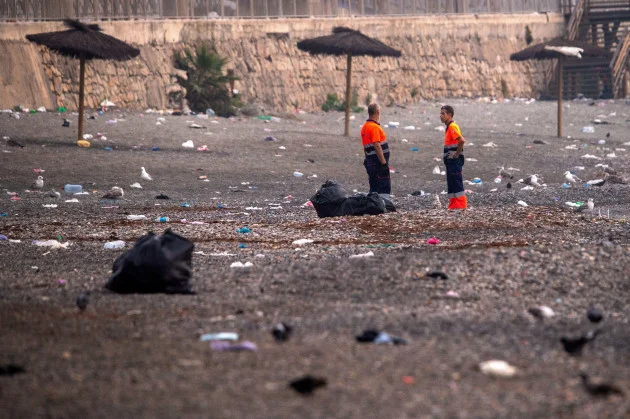
More soldiers stood guard on the small beach next to the border fence, positioned under parasols in the morning.
Buoys and flippers still littered the ground along the fence, while others floated in the water.
Spain’s interior ministry said a new pneumatic barrier 500 metres in length was installed near the border post to reinforce security.
In Morocco, Soufian (42) told AFP that he had been planning to make a swim from his coastal town of Martil, located less than 40 kilometres from Ceuta, when a friend told him that the border was open.
“It didn’t take long – just five minutes or less, maybe three – since it was right at the border.”
He explained he was motivated by the potential to visit his mother, who is ill and lives in Madrid.
“Even though there’s no food, nothing at all, I’ll endure anything to see my mother,” Soufian said, adding he makes just €10 a day working 12-hour shifts as a security guard.
As for the others who crossed, he said, “everyone wants to move up, wants a good future – something that doesn’t exist in Morocco”.
What sparked the sudden massive flow of migrants remains unclear.
Morocco’s authorities have not yet issued an official statement on the development.
A Moroccan source close to the border operations told AFP on condition of anonymity Saturday that those being returned by Spain were being transported home directly by bus or via the railway station in Tangier, 70 kilometres away.
The Fnideq border crossing is now “completely secure”, the source added, as are the hills overlooking it, from which hundreds of people, mostly young men, had thrown stones at security forces on Friday.
Ceuta, a territory of 18.5 square kilometres, and the nearby enclave of Melilla are Europe’s only two land borders with Africa.
Previous migrant surges have occurred during tensions between Spain and Morocco, including in 2021 which led more than 10,000 migrants to enter Ceuta in just two days.
To embed this post, copy the code below on your site