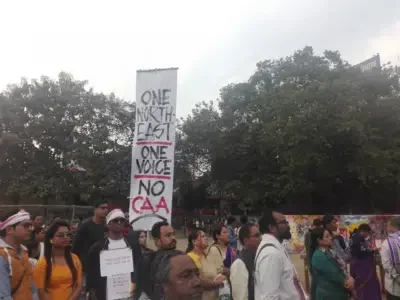
This post is part of Global Voices’ July 2026 Spotlight series, “Statelessness.” This series offers insight into the issue of statelessness and how it hinders people’s freedom of movement, educational opportunities, political access, and more. You can support this coverage by donating here.
Over one year ago, the Assam government shifted its policy to encourage applications under the Citizenship (Amendment) Act (CAA), helping eligible people apply instead of facing proceedings before Foreigners Tribunals. Since then, only six people have received citizenship under the law, while tens of thousands of cases before the Foreigners Tribunals remained pending.
A large pool of exclusion
The Citizenship (Amendment) Act (CAA) of 2019 was promoted by the leaders of India’s ruling Bharatiya Janata Party (BJP) as a pathway to Indian citizenship for eligible Bengali Hindus caught in Assam’s citizenship verification process.
In March 2024, Assam Chief Minister Himanta Biswa Sarma mentioned that around 500,000 Bengali Hindus were among the 1.9 million people excluded from the National Register of Citizens (NRC). Yet, more than a year after the Assam government introduced a new approach to help eligible people obtain citizenship under the law, official figures showed that only six people had received citizenship.
A long legal battle
One of those six people was Dipali Das. In March 2026, Dipali Das became one of the first people in Assam to receive Indian citizenship under the Citizenship (Amendment) Act (CAA). Seven years earlier, a Foreigners Tribunal in the northeastern Indian state had declared her a foreigner, sending her to a detention center in Silchar, where she spent nearly two years while she and her family fought to prove that she was an Indian citizen.
For Das, receiving her citizenship certificate ended a years-long legal battle. Her case also reflected a broader shift in Assam’s approach to disputed citizenship claims. The Citizenship (Amendment) Act (CAA), which finally came into force in 2024, provided a fast-track pathway to Indian citizenship for Hindus, Sikhs, Buddhists, Jains, Parsis and Christians from Bangladesh, Pakistan and Afghanistan who entered India on or before December 31, 2014. Rather than relying solely on Foreigners Tribunals, Assam had begun using the CAA as an alternative route for some eligible people.
Foreigners Tribunals were established in Assam under the Foreigners Tribunals Order, 1964, to determine whether people suspected of being foreigners are Indian citizens. Cases are referred by the police or district authorities, while the Election Commission can also flag “D” (Doubtful) voters whose citizenship is then verified by a tribunal.
The impact of the shift to CAA
That policy shift became clearer in July 2025. According to Scroll news, which reviewed the minutes of a July 2025 meeting held by Assam’s Home and Political Department, district commissioners and senior police officials were instructed not to continue pursuing certain Foreigners Tribunal cases involving people eligible under the CAA. Instead, they were directed to identify eligible individuals, assist them in applying for citizenship under the law, and submit periodic progress reports.
The directive marked a departure from Assam’s long-standing reliance on Foreigners Tribunals. Many people eligible under the CAA had already become entangled in the state’s citizenship verification process after being excluded from the National Register of Citizens (NRC), which required residents to prove that they or their ancestors lived in Assam before March 25, 1971, the cut-off date established by the Assam Accord. Instead of continuing tribunal proceedings in selected CAA-eligible cases, the government sought to move eligible applicants toward the new citizenship process.
This directive has also created a dual-track system where non-Muslims are shielded from Foreigners Tribunal scrutiny while Muslims continue to face proceedings with the risk of detention and deportation. Having won the May 2026 Assam elections with a solo majority partly by consolidating Hindu votes through this polarizing narrative, the BJP now has no political incentive to reverse course.
In July 2026, the first official figures released after the initiative showed that only 70 people had applied under the CAA and just six had received citizenship. During the same Assam Legislative Assembly session in July 2026, the government disclosed that 73,759 cases remained pending before Foreigners Tribunals, while 172,673 people had been declared foreigners since the tribunals were established.
The CAA vs Foreigners Tribunals
Although Parliament passed The Citizenship (Amendment) Act (CAA) in 2019, it only came into operation after the Union government notified its Rules in March 2024. In Assam, implementation proved particularly complex because many people who could benefit from the law were already contesting their citizenship before Foreigners Tribunals.
The low number of applications was not entirely unexpected. Reporting by Maktoob Media and The Quint found that many eligible Bengali Hindu families feared applying under the CAA could undermine the citizenship claims they were already pursuing before Foreigners Tribunals or through the NRC.
Lawyers and rights groups echoed those concerns, arguing that the application process could require applicants to identify themselves as migrants from Bangladesh, potentially weakening the legal position they were already defending.
Among them was Montu Das, a resident of Cachar district, whose wife Nisharani Das had been excluded from the NRC. Speaking to Maktoob Media, Das said he had no intention of applying under the CAA because he feared applying under the CAA with new documents would damage his family's existing citizenship claim. “Hum fas jayega (We will be trapped). I will never apply, come what may,” he said.
Anjali Roy, who had successfully challenged her “doubtful voter” designation years earlier, voiced similar concerns in The Quint. “My father and grandfather were born in India… So why should I declare myself as a migrant?” she said.
Roy's concerns were shared by organizations such as the Citizens’ Rights Preservation Committee (CRPC), which has represented families involved in citizenship-related cases across Assam. Its president, Sadhan Purkayastha, told Maktoob Media that many eligible Bengali Hindus were already trying to establish that they were Indian citizens before Foreigners Tribunals. Applying under the CAA, he argued, could require them to identify themselves as migrants from Bangladesh, potentially weakening the position they were already defending before the tribunals.
Legal scholars have also questioned whether the tribunals provide adequate safeguards in cases carrying the risk of statelessness. Dr. Mohsin Alam Bhat, Assistant Professor of Law at Queen Mary University of London, mentioned in a July 2025 report that citizenship adjudication carries “profound consequences, including the risk of statelessness,” and therefore requires bodies that are “legally constituted, independent, impartial, and composed of competent legal officers.” His report concludes that Assam’s Foreigners Tribunals fall short of those standards.
Unanswered questions
The government has recently released CAA application and citizenship figures, but has not disclosed how many people were identified under the initiative, how many pending Foreigners Tribunal cases were reviewed, or whether district officials submitted the required progress reports. Those unanswered questions remain significant because Foreigners Tribunals continue to decide citizenship disputes in Assam.
On July 13, 2026, the Supreme Court of India set aside Foreigners Tribunal and Gauhati High Court decisions declaring 27 people as foreigners after finding procedural deficiencies and ordered fresh hearings. Although the judgment did not concern the CAA, it showed that the tribunal system continues to determine the legal status of thousands of people in Assam.
Against that backdrop, the government's own figures reveal only part of the picture. Six people have received citizenship under the CAA, while tens of thousands of tribunal cases remain pending. They do not show whether the initiative identified and helped eligible people move out of prolonged tribunal proceedings and obtain citizenship under the CAA. So it is impossible to assess whether the July 2025 initiative expanded access to citizenship or merely altered the administrative process. For thousands of people whose legal status remains unresolved, that distinction carries profound consequences.