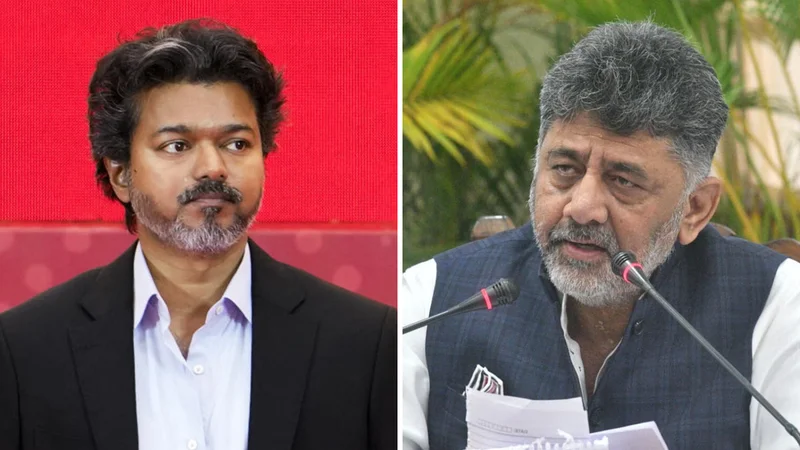
Chief Minister D.K. Shivakumar appears to have entered a politically challenging phase, with his leadership being tested simultaneously on multiple fronts — the Cauvery water-sharing issue, the long-pending expansion of the State Cabinet, the proposed Bidadi township project and the government’s drive to clear encroachments on footpaths.
The Chief Minister has increasingly found himself on the defensive. His appeal to his Tamil Nadu counterpart, C. Joseph Vijay, to postpone his proposed visit to Bengaluru in the wake of the Cauvery Water Management Authority’s (CWMA) direction on the release of water reflected the political sensitivity surrounding the inter-State river dispute.
Many visits to Delhi
The delay in the Cabinet expansion has emerged as perhaps the major political challenge before Mr. Shivakumar. Despite repeated visits to New Delhi, he has so far been unable to secure the Congress high command’s approval to fill the 20 vacant ministerial berths. His return from the national capital without a finalised list of new Ministers has fuelled speculation that the State leadership enjoys limited autonomy in political appointments. Unlike his predecessor Siddaramaiah, who expanded his Cabinet to its full strength within days of assuming office, Mr. Shivakumar has had to wait for the party leadership’s clearance.
The Cauvery dispute presents a different set of political constraints. Any decision to release water to Tamil Nadu invites criticism from Kannada organisations, farmers and the Opposition, while disregarding the CWMA’s directions could expose the government to legal consequences. With little room for political manoeuvre, the government has struggled to strike a balance between protecting Karnataka’s interests and complying with statutory obligations. The BJP and the JD(S) have sought to portray the government as “weak” in defending the State’s interests. However, with copious rains on Saturday (August 1), the situation, at least for the time-being, seems to be easing.
Similarly, the proposed integrated township near Bidadi has exposed the tension between Bengaluru’s urban expansion and the concerns of farmers facing land acquisition. Although the government initially defended the project, sustained protests by farmers and Opposition parties compelled it to constitute a committee to examine its merits and demerits. While the move helped defuse immediate tensions, it also created the perception that the government had retreated from its original position under public pressure.
Footpath vs. livelihood
The government’s campaign to reclaim footpaths by removing encroachments, abandoned vehicles and other obstructions presents another political challenge. While the middle-class urban residents favour sanitised and more accessible public spaces, street vendors and small traders constitute an important political constituency. Any large-scale eviction without adequate rehabilitation risks generating political backlash, making the enforcement drive a delicate balancing act between urban governance and livelihood concerns.
None of these issues is likely to threaten Mr. Shivakumar’s leadership. However, they reinforce the perception that his government is spending considerable political capital on managing controversies and competing interests rather than advancing its governance agenda.
Published - August 01, 2026 07:09 pm IST