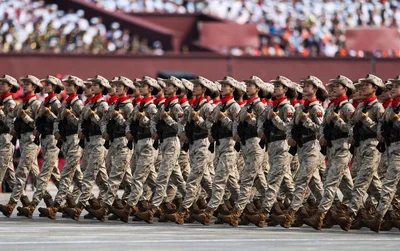
The militia formation attends a military parade in Beijing, China, Sept. 3, 2025. Xinhua-Yonhap
Military spending in the Asia-Pacific rose at the fastest pace for 16 years in 2025 as U.S. allies felt “growing uncertainty” over whether Washington would honour its security commitments, according to a new report.
Total global spending reached $2.89 trillion, an increase of 2.9 percent from 2024, the Stockholm International Peace Research Institute (SIPRI) think tank said in its annual report on military expenditure published Monday.
That marked the 11th consecutive year of increases and brought the global military burden to 2.5 percent of gross domestic product (GDP), the highest since 2009.
The top three military spenders — the United States, mainland China and Russia — spent a combined total of $1.48 trillion, just over half of the global total.
However, the global expansion in 2025 was slower than the 9.7 percent figure recorded the year before, mostly due to a decline in U.S. spending.
SIPRI said the 7.5 percent drop to $954 billion was caused by Washington not approving any new military aid for Ukraine.
“In 2025, the U.S. continued to prioritise investment in its nuclear modernisation and advanced conventional weapon programmes in order to maintain U.S. military dominance in the western hemisphere and deter China,” the SIPRI report said.
In the world outside the U.S., spending grew by 9.2 percent.
Military expenditure in Asia and Oceania — from which SIPRI excludes the Middle East — totalled $681 billion and rose 8.1 percent, the largest year-on-year rise since 2009.
Mainland China spent $336 billion, 7.4 percent more than in the previous year and marking the 31st consecutive year-on-year increase.
“China’s spending supports the [People’s Liberation Army’s] goal of completing a comprehensive modernisation of its forces across all military domains by 2035,” the report said.
But Beijing was outpaced by other militaries in the region, with Japan recording a 9.7 percent increase, reaching a total of $62.2 billion. That was equivalent to 1.4 percent of GDP — the highest share since 1958.
HMAS Canberra leads Japan's Kumano and other military vessels into Sydney Harbour as they gather ahead of the Kakadu International Fleet Review, a biennial maritime exercise marking 125 years of the Australian Navy, in Sydney, Australia, March 21. Reuters-Yonhap
According to SIPRI, Tokyo is implementing a military build-up plan it launched in 2022 that is driven by “perceived security concerns related to China and North Korea.”
Taiwan’s military spending rose by 14 percent to $18.2 billion in 2025, the largest year-on-year increase since at least 1988. The report said this reflected an “intensification in the operational complexity and scope of [Chinese] military drills around the island in 2025.”
Beijing sees Taiwan as part of China to be reunited by force if necessary. Most countries, including the U.S., do not recognise Taiwan as an independent state, but Washington is opposed to any attempt to take the self-ruled island by force and is committed to supplying it with weapons.
“U.S. allies in Asia and Oceania such as Australia, Japan and the Philippines are spending more on their militaries, not only due to long-standing regional tensions but also due to growing uncertainty over U.S. support,” said Diego Lopes da Silva, senior researcher with the SIPRI Military Expenditure and Arms Production Programme.
“As in Europe, US allies in Asia and Oceania are also under pressure from the [U.S. President Donald] Trump administration to spend more on their militaries.”
The Trump administration’s new National Security Strategy, released in December, urged Washington’s allies in East and Southeast Asia to spend more on collective defence to deter “aggression” in the first island chain and to build up capacity to “deny any attempt to seize Taiwan.”
Europe was the main contributor to the global increase in military spending in 2025, with a 14 percent rise to $864 billion — the highest level of European spending ever recorded by SIPRI.
Spending by Russia and Ukraine — the third and seventh largest spenders in the world — continued to grow in the fourth year of their war, with the foes chalking up 5.9 and 20 percent increases, respectively.
Spending in central and western Europe expanded at the fastest rate since the end of the Cold War, as Trump pushed his Nato allies to share more of the burden of collective defence. The region’s expenditure hit $559 billion in 2025, with 22 of the European member states hitting at least 2 percent of GDP.
Read the article at SCMP.