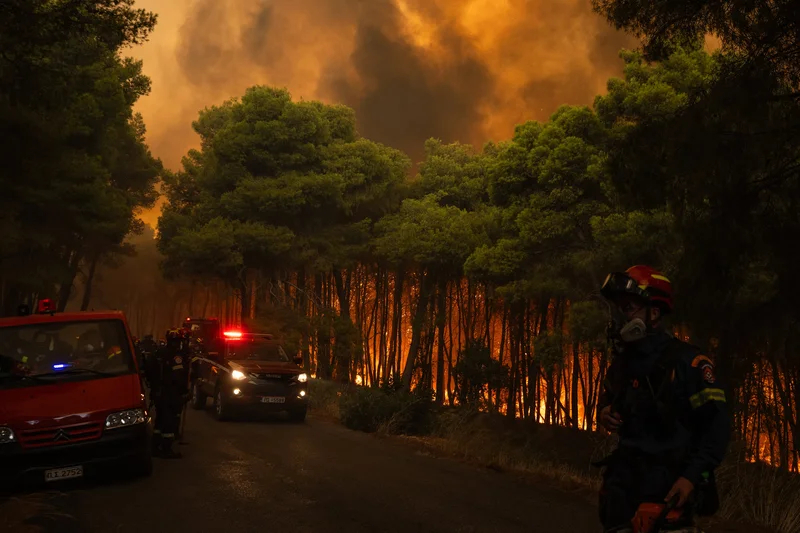
Wildfires fanned by heavy winds burned across multiple areas of Greece on Saturday, including near Athens, with large-scale firefighting operations and emergency evacuations underway, while conditions worsened again in parts of Spain and France.
Europe has been ravaged by wildfires this summer after a period of successive record-breaking heatwaves and little rain. Villages in France and Spain have been destroyed, and hundreds of thousands of people have been forced to flee their homes and holiday accommodation.
Blazes fed by gale-force winds flared up across Greece, which until recent days had experienced fewer heatwaves and a relatively quiet fire season.
A Reuters live video feed showed firefighters, police and ambulances slowly withdrawing before a wall of fire and smoke that engulfed forests and shrub in the mountainous terrain of Agia Paraskevi, near Porto Germeno, about 60 kilometers (40 miles) northwest of the capital Athens.
Authorities said strong winds were hampering firefighting efforts, making them impossible in places.
In France, a fire in the mountainous southeastern Var department, which had been brought under control three days ago, flared up again on Friday, sweeping across more than 1,000 hectares in six hours.
French interior minister Laurent Nunez told reporters the situation in the Var was "very serious" and that fires have affected 119,000 hectares in France so far this year.
"It's not at all under control," said Eric Grohin, director of the Var department's fire and rescue service, adding that the situation remained "very complicated," with temperatures at 40 degrees Celsius (104 degrees Fahrenheit) and winds set to pick up.
Local prefect Simon Babre also said several flare-ups had been dealt with on Saturday by firefighting aircraft and more than 1,500 personnel on the ground.
Nearly 2,500 people were evacuated overnight, with firefighters bringing in reinforcements on Saturday when winds were expected to strengthen and complicate efforts to control the blaze.
In southwestern France, the South Gironde animal sanctuary was treating deer that had escaped a massive fire near Bordeaux that burned for more than a week but suffered burns or accidents due to panic, such as collisions with cars or fences, said manager Patrick Meng.
"There are hundreds of thousands of (animal) deaths; it's a catastrophe," he said.
Spain continued battling several wildfire hot spots on Saturday, two days after the government declared the end of a national emergency caused by huge fires in the country's central provinces.
Conditions worsened in the northern province of Leon, where a new blaze broke out overnight, another remained active, and a third was evolving favorably, according to authorities. In neighboring Zamora province, a fire that ravaged about 11,000 hectares improved enough for 14 evacuated towns to reopen and restrictions to be lifted.
In the eastern province of Castellon, the Vall d'Uixo fire was stabilized on its seventh day after burning nearly 10,000 hectares, allowing all evacuated residents to return. Police said they suspected arson after finding two separate ignition points.
Major fires in the central regions of Madrid and Avila, which burned more than 70,000 hectares, were stabilized. A new outbreak near the San Juan reservoir, west of the capital, was extinguished on Friday.
Greek authorities issued emergency alerts for several areas for Saturday and warned of extreme wildfire risk in the regions of Attica and Evia.
More than 300 firefighters, 92 firefighting trucks, heavy machinery and aircraft have continued to battle a conflagration in the region of Boeotia, where more than 200 people from the town of Agios Vasileios, about 80 km northwest of Athens, had to be evacuated by sea.
Another 12 people, fleeing the same blaze, were evacuated from the beach in Porto Germeno by Greek Coast Guard patrol boats and a Fire Service vessel.
The fire in Porto Germeno split into three fronts and many houses caught fire in the area, the Protothema newspaper reported. Authorities told people from the nearby towns of Agia Paraskevi, Kryo Pigadi and Agios Nektarios to evacuate.
EU countries are having an above-average season for wildfires, already overtaking 2025's record-breaking year.
Across parts of western and southern Europe, a relatively wet winter fed forests and scrubland before successive heatwaves baked new growth into tinder, leaving abundant fuel for fires.
And the toll of extreme weather has extended well beyond the widespread devastation caused by fires.
In Austria, the country's Agency for Health and Food Safety reported a record 395 heat-related deaths for the month of June.
Earlier this week, Britain said an estimated 2,877 people had died from heat-related causes so far this year, while France reported 5,764 excess deaths in the country between June 17 and July 2, and Germany's RKI health body estimated 9,800 people had died so far this year linked to the high temperatures.