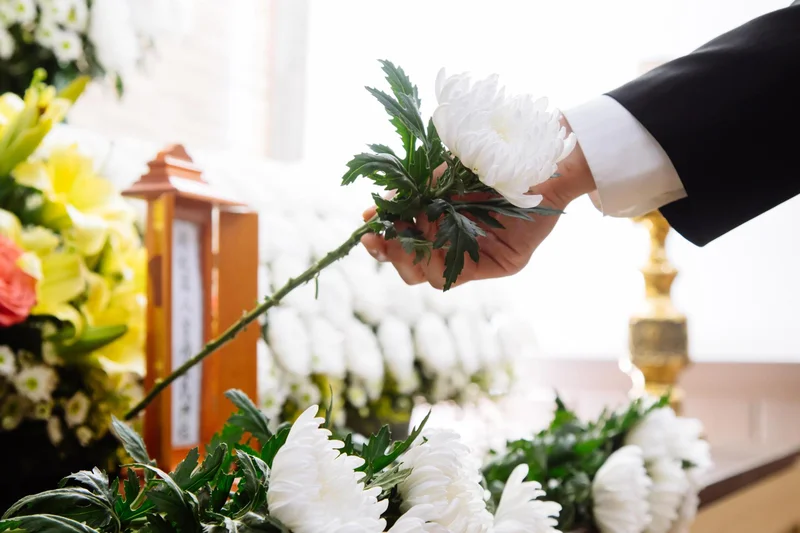
The funeral that Ryu Jae-jun, 57, held for his father on June 23 broke entirely from Korean tradition. His family dispensed with a formal funeral hall — a traditional three-day reception and catering space where bereaved relatives host a continuous stream of visitors — and omitted the customary receiving line.
Rather than contact a prepaid funeral service or a commercial funeral home, Ryu called the Catholic church his family attended. He scheduled a funeral Mass and brought his father’s body to the church. Instead of dressing the deceased in a traditional burial shroud, the family dressed him in his favorite everyday clothes, while family members wore suits instead of traditional mourning robes. About 200 acquaintances attended the Mass, held three days after the death, and the family declined all cash gifts traditionally offered to the bereaved.
"Because we did not receive mourners, I was able to organize my father's belongings during the funeral period and fully reflect on his life and our memories together," Ryu said.
His mother's funeral, held the previous year, heavily influenced his decision to forgo a reception hall.
"When we set up a funeral hall for my mother, we received more than 1,000 visitors," Ryu said. "I was grateful that they came, but after greeting a blur of mourners, I had no time to think about my mother or grieve. The whole process felt like an assembly line. I think my father felt much the same way. He told me, 'When my time comes, let's not do it this way.'"
Across Korea, a rapidly growing number of bereaved families are following Ryu's example by choosing simplified funerals, where relatives skip the public reception to hold small, intimate services. Society once perceived such arrangements as a last resort for the destitute or those with no known relatives, but shifting public values have transformed the practice into a deliberate choice to grieve without distraction.
1 in 5 services skip reception rooms
"Based on the various accounts we hear from people working in the field, it is clear that simplified funerals are increasing," said an official at the Ministry of Health and Welfare.
Although the ministry lacks formal statistics to track the trend, funeral industry estimates suggest that roughly one in five services now skip traditional reception halls. Park Seung-hyeon, head of prepaid funeral service Thechoomo, pointed out the trend away from conventional funerals to streamlined ceremonies.
"Demand for simplified funerals has surged since last year and has overtaken demand for funerals that include them." Park said. "We handle about 30 simplified funerals per month."
Public opinion overwhelmingly favors private services for the future. An Embrain Trend Monitor survey conducted in May among 1,000 adults aged 19 to 69 found that 71.8 percent of respondents hope to have their own funerals conducted without a funeral hall.
The rising preference reflects a broader cultural rejection of excessive formality in favor of practicality. When the same survey asked respondents to define a "good funeral," 56.7 percent prioritized a simplified process, 55.4 percent emphasized minimizing the financial burden on the bereaved family and 47.5 percent highlighted reflecting the wishes of the deceased.
To accommodate this shift, Nakwon Memorial Park in Gimhae, South Gyeongsang Province, began offering services this year to help bereaved families establish home memorial spaces to honor the deceased in daily life.
The COVID-19 pandemic also accelerated the transition. Before the pandemic, Korean etiquette required acquaintances to visit funeral halls in person to pay respects, but social distancing rules normalized remote condolences and electronic transfers for condolence money.
According to the health ministry’s 2023 report on its comprehensive plan for funeral facility supply and demand, 55.9 percent of respondents said their funeral visits declined after the pandemic. Families have also narrowed the scope of death announcements, restricting notices primarily to immediate relatives (24.1 percent) and close personal acquaintances (52 percent).
The shift toward smaller nuclear families drives the trend further. Kim Geun-tae, a professor of public sociology at Korea University, attributes it to financial burdens and reduced family interactions.
"As the number of children declines, funeral costs that were once divided among five people now have to be paid by one or two, increasing the burden," Kim said. "Reduced interaction among family members and relatives is also a major factor."
A funeral director who spent five years working for a prepaid funeral service echoed Kim's assessment.
"In the past, 90 percent of simplified funerals involved people experiencing financial hardship," the director said. "Now they are preferred by people who do not have many family members available to receive visitors."
The aging population also contributes to the change, as bereaved family members are increasingly older themselves.
"My mother was 97, so all her siblings had already passed away. I am also at an age when I am preparing for retirement, so we held a small funeral," an office worker in his 50s who held his mother’s funeral four months ago said.
Widespread resistance to excessive formality has reshaped funeral culture, mirroring the popular rise of small weddings and simplified ancestral memorial rites. Lee Hun-cheol, 31, recently received a text notification for a family-only funeral.
"Times have changed. Small weddings are popular now, and traditional ancestral rites are getting simplified too," Lee said. "A new culture is taking hold where people honor the deceased without getting tied down by formality."
Streamlined rituals leave ample time for grief
Skipping a funeral hall does not mean abandoning all traditional funeral rites. Bereaved families simply omit renting a reception room and serving catered meals to visitors, while retaining core procedures. Families still hire transport vehicles to move the deceased to a mortuary holding room, conduct a casket ceremony with relatives and hold a formal send-off before cremation. When crematories have immediate availability, families often shorten the entire process to a one- or two-day service.
Financially, omitting the reception hall yields substantial savings. Although specific costs vary depending on family selections, simplified funerals generally cost between 2 million won ($1,364) and 3 million won. This range represents a fraction of the Korea Consumer Agency’s estimated national average funeral cost of 13.8 million won.
In exceptional cases, families reduce costs even further. A 26-year-old identified only by his surname, Park, spent about 500,000 won on his father’s funeral in April by dispensing with a funeral hall, transportation of the body, a casket ceremony, and a formal send-off. Because his father pledged his body for medical research during his lifetime, the hospital absorbed the transportation and administrative procedures, significantly easing the family's financial burden.
"While my father was being treated for a stroke, he repeatedly told me to hold a simple funeral, so I followed his wishes," Park said
Although some critics voice concerns that eliminating funeral halls leaves families without a physical space for collective mourning, intermediate options exist, such as receiving visitors only during designated hours or holding standalone farewell ceremonies.
"It is important to change perceptions so that funeral homes can become places for farewells rather than places primarily devoted to receiving visitors," said Lee Jeong-seon, a mortuary science professor at Eulji University.
This article from the Hankook Ilbo, the sister publication of The Korea Times, is translated by a generative AI system and edited by The Korea Times.