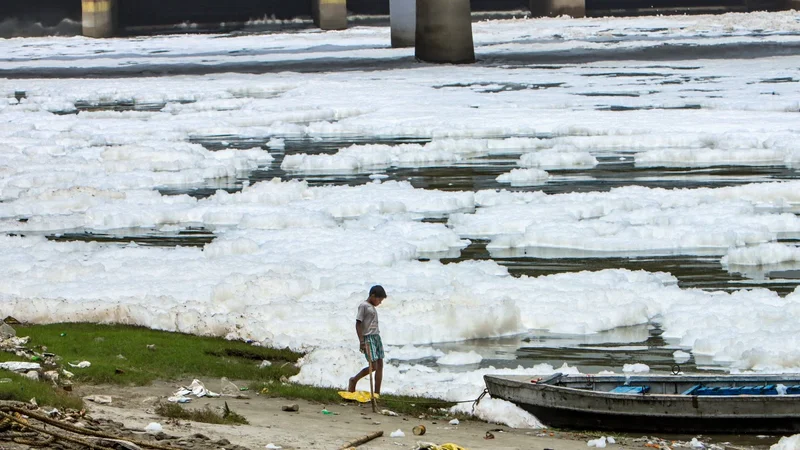
Despite fresh promises by the Delhi government to revive the Yamuna, the capital's most polluted river appears to be in even worse shape than it was a year ago.
A comparison of Delhi Pollution Control Committee (DPCC) water quality reports from May 2025 and May 2026, published this month, shows that while pollution indicators have improved marginally at a few locations, the river remains biologically dead across much of Delhi.
The dissolved oxygen (DO) levels have collapsed to zero at several stretches, and fecal contamination remains alarmingly high.
The findings underline the enormous challenge facing the Rekha Gupta-led government, which has pledged to scientifically restore the river by modernising sewage treatment plants (STPs), expanding Delhi's sewer network and intercepting untreated drains before they discharge into the Yamuna.
POLLUTION WORSENS DOWNSTREAM
The Yamuna enters Delhi at Palla in relatively healthy condition. In May 2026, dissolved oxygen stood at 5.9 mg/l, comfortably above the minimum standard of 5 mg/l required for aquatic life. Biological Oxygen Demand (BOD), a measure of organic pollution, was 2 mg/l, within acceptable limits.
But just a few kilometres downstream, the river rapidly deteriorates.
At Wazirabad, DO dropped from 6.8 mg/l in 2025 to 3.1 mg/l in 2026, indicating that the river is already struggling to sustain aquatic life before entering central Delhi.
From ISBT Bridge onwards, the picture becomes alarming.
At ISBT, ITO Bridge, Nizamuddin Bridge, Okhla Barrage and Asgarpur, dissolved oxygen remained zero (NIL) across most locations, effectively rendering the river incapable of supporting fish or other aquatic organisms. At Hindon Cut, the only slight improvement was a DO level of 0.7 mg/l, still far below the prescribed standard.
While infrastructure projects are underway, untreated sewage continues to overwhelm the river. (Photo: PTI)
FECAL CONTAMINATION REMAINS SEVERE
One of the most worrying indicators is the fecal coliform bacteria, which signal contamination from untreated sewage.
The desirable limit is 500 MPN per 100 ml, while 2,500 MPN is considered the maximum permissible level.
The 2026 report paints a grim picture.
At Palla, fecal coliform increased from 1,700 in 2025 to 2,200 MPN, pushing it close to the permissible limit. At Wazirabad, levels rose from 3,300 to 3,500 MPN, remaining above safe standards.
Further downstream, contamination remains catastrophic. ISBT Bridge recorded 130,000 MPN, ITO Bridge 120,000, Nizamuddin Bridge 110,000, Okhla Barrage 140,000, while Asgarpur registered 330,000 MPN, over 130 times the maximum permissible limit.
Although some downstream locations show lower fecal counts than last year, the numbers remain so high that the river continues to function largely as a sewage channel rather than a living river.
Susmita Sengupta, Senior Programme Manager, Centre for Science and Environment, said that the increase in fecal coliform levels indicates that untreated sewage is entering the river. At the same time, reduced river flow means the contaminants are not getting diluted, making pollution even more concentrated.
"There are two likely reasons for this. First, more raw sewage may be flowing directly into the Yamuna through Delhi's drains, especially from non-sewered areas such as unauthorised colonies and informal settlements that are not connected to the sewer network," Susmita added.
Delhi Chief Minister Rekha Gupta participates in a Yamuna cleaning drive, in New Delhi. (Photo: PTI)
GOVERNMENT PROMISES VERSUS REALITY
The deterioration comes weeks after Chief Minister Rekha Gupta launched the 'Clean Delhi with CM' campaign at Chilla village, calling the Yamuna a river revered by millions and promising its scientific and sustainable rejuvenation.
The government has announced plans to modernise sewage treatment plants, expand sewer networks and tap drains carrying untreated wastewater into the river in a phased manner.
Yet the latest DPCC data suggests these measures have not yet translated into meaningful improvements in water quality.
The Delhi stretch of the Yamuna has remained among the country's most polluted river stretches despite repeated interventions by the Supreme Court, the National Green Tribunal and successive governments over the past three decades.
The latest figures highlight that while infrastructure projects are underway, untreated sewage continues to overwhelm the river.
"Once the river enters Delhi's ISBT area, it is essentially biologically dead because there is no dissolved oxygen left to support aquatic life," Sushmita told IndiaToday.in.
Until every major drain is intercepted and sewage treatment systems operate at full capacity, experts say the Yamuna is likely to remain biologically stressed, its oxygen depleted and its waters carrying dangerous levels of human waste through the heart of the national capital.
- Ends
Published By:
Sibu Kumar Tripathi
Published On:
Jul 22, 2026 13:30 IST