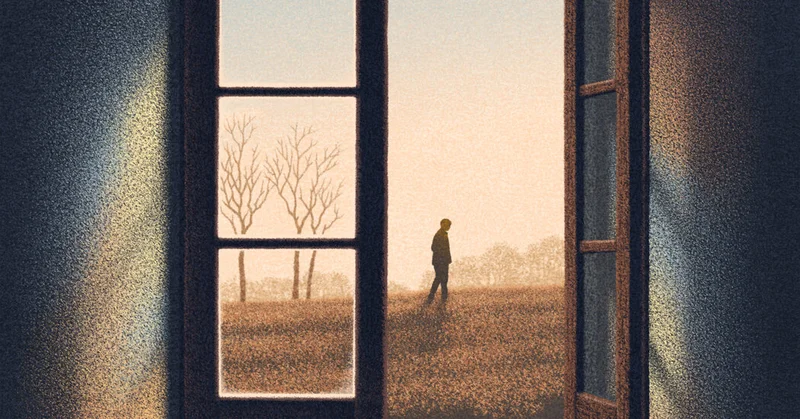
As happens for many people, my 30s were a decade of belated culminations: marriage, children, professional achievement (for me, the publication of novels and a teaching job). However, it all refused to settle into place. My wife and I struggled to get along. Parenthood was sometimes “all joy and no fun.” The novels received critical praise but sold modestly, and the teaching job was 1,500 miles from where my wife wanted, and continued, to live.
I didn’t know what would help, but I knew what wouldn’t: talking about it.
I had spent two decades in and out of therapy, to some insight but little transformation. Ditto for the couples therapy my wife and I had undertaken. I also felt like I’d been talking nonstop since immigrating as a child from the Soviet Union. In America, English became a dangerous tool to persuade elite institutions to give me the things that my elders had said mattered: approval, access, funding, employment. My Soviet-child shyness turned into garrulousness, then logorrhea. I chattered, people clapped, the doors to opportunity opened. I rarely felt at home on the inside but I enjoyed a superficial sense of arrival.
Then there was the noise of just being American. (There was virtually no commercial advertising in the Soviet Union. Think about that for a minute.) Social media exists to terrify us of quiet and solitude. My phone had become a postmodern crack pipe: I knew it was killing me, yet I couldn’t put it down. I felt ill from talking and noise. But that’s all I knew how to do.
So when, two years ago, an acquaintance mentioned to me an annual visit she made to a silent retreat, I cautiously probed for details. Was it a wellness-type thing? Was there yoga? It was the antithesis of luxury, she said: an ecumenical contemplative Christian community in the middle of Georgia, with monastic quarters, silent meals and daily prayer, for $60 a night. It didn’t even have a website.
I’m not a Christian, but I was desperate. I wrote to Oliver Ferrari, a monastic brother in the community, and we settled on several days that December. As the date approached, my thrill at the prospect of unspecified liberation turned to terror. I had never been alone with myself for that long.
The retreat had been started in 1987 by two friends: Fay Key, a civil-rights advocate who longed to enact Jesus’ command to “come away to a lonely place and pray,” and Steve Bullington, a Methodist pastor. I arrived to find a chapel and several modest residences bordered by fields for soybeans and hay. It’s the kind of place where the shower doesn’t shoot straight and the communal jar of almond butter has marks from every spoon that has used it, a sanctuary as plain as its setting. “No majestic mountains, no roaring sea,” as Fay once wrote in a memoir. “I sometimes say there is nothing here but God.”