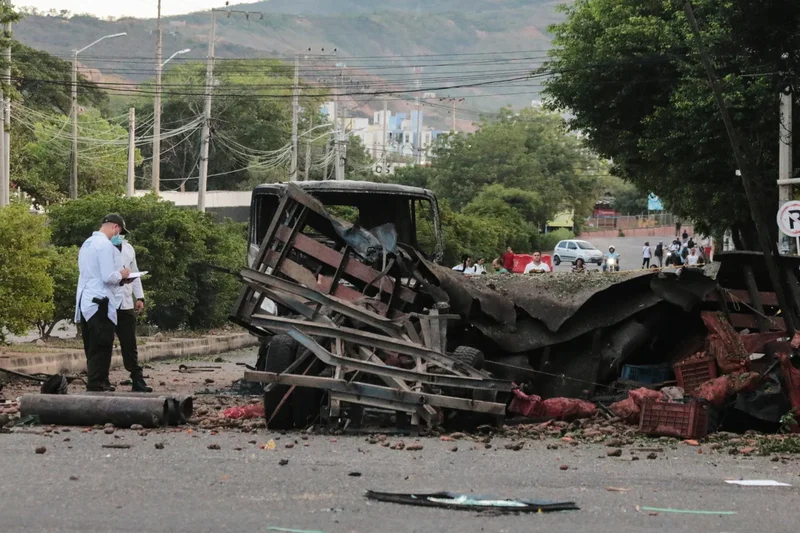
Colombia’s government has attributed a truck bomb explosion outside a police base, which injured 11 officers and killed a police dog, to the nation’s largest remaining rebel group.
The attack occurred early Saturday in Cucuta, a city on Colombia’s border with Venezuela, a region frequently contested by drug gangs and insurgent groups vying for control of lucrative smuggling routes.
Gen. William Rincon, director of Colombia’s police, confirmed the blast originated from a truck parked outside the headquarters for police in Norte de Santander Province.
The pre-dawn detonation caused significant damage to the building’s roofing and shattered its windows.
"This was a vile terrorist attack," Rincon stated. "We will not rest until we find those who are responsible and have them prosecuted." Colombian Defense Minister Pedro Sanchez later blamed the National Liberation Army (ELN) for the assault, offering a $60,000 reward for information leading to the perpetrators.
The bombing comes just days before Abelardo de la Espriella, an ultra-conservative who has pledged to cancel peace talks with the country’s remaining rebel factions, is set to be sworn in as Colombia’s new president next Friday in Cali.
The ELN has been engaged in conflict with the Colombian government for decades, with an estimated 6,000 fighters operating across Colombia and neighboring Venezuela.
Founded in the 1960s by union leaders, students, and peasants advocating for social justice, the group has largely evolved into a criminal enterprise, profiting from illegal gold mining and drug trafficking, according to Colombian authorities.
Outgoing President Gustavo Petro frequently accused its leaders of acting as "drug lords dressed up as guerrilla fighters."
Under President Petro, who took office in 2022, peace negotiations with the ELN were initiated but collapsed early last year after the group launched attacks in the rural area north of Cucuta, resulting in an estimated 78 deaths and displacing at least 56,000 people.
Incoming President de la Espriella has vowed to confront the ELN and other criminal organizations with increased military force and to reinstate the aerial fumigation of coca crops, the primary ingredient for cocaine.
Petro’s broader "Total Peace" strategy, aimed at engaging various armed groups in dialogue, faced criticism, with detractors arguing that many groups exploited government-granted ceasefires to regroup, rearm, and solidify their control over rural communities.
A 2016 peace deal with the Revolutionary Armed Forces of Colombia (FARC) led to the disarmament of over 13,000 guerrilla fighters, creating a power vacuum in some rural areas that smaller groups like the ELN have since sought to fill.