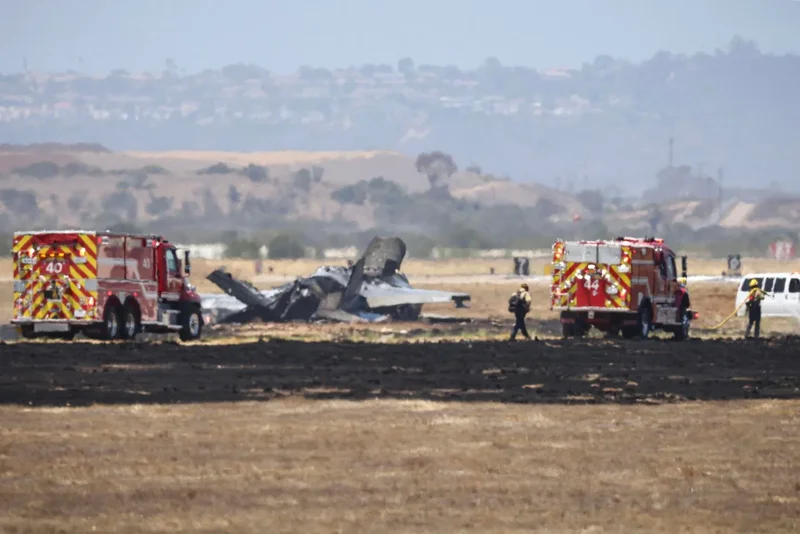
The crash of a United States Marine Corps Lockheed Martin F-35B Lightning II at Marine Corps Air Station Miramar, San Diego, California, on Friday is just the latest mishap involving the fifth-generation fighter.
“Emergency personnel responded this morning to an aircraft mishap on the flightline of Marine Corps Air Station Miramar at approximately 10:00 a.m. local time today, involving an F-35B assigned to Marine Aircraft Group 11, 3d Marine Aircraft Wing,” MCASM confirmed in a statement to the media.
“The pilot ejected, was transported to a local medical facility in stable condition for evaluation and treatment of non-life-threatening injuries.”
The service said more information would be released when available.
Fightertown USA’s Latest Crash
This latest mishap is also just the latest aviation accident to occur at the San Diego facility, but that shouldn’t be surprising given that for more than 50 years, it hosted the United States Navy pilot training school depicted in the original Top Gun film, earning the nickname “Fightertown USA.”
In 1996, the school was relocated to Naval Air Station Fallon, Nevada, and the base transferred to the United States Marine Corps, where it serves as the West Coast headquarters for the service’s aviation units.
Pilots regularly utilize nearby restricted military airspace over the Pacific Ocean, including the W-291 range, for tactical combat and interception training.
The most recent previous accident at the base prior to Friday’s F-35 crash occurred in late August 2023, when an F/A-18 Hornet crashed east of the base near Interstate 15. The sole pilot was killed after ejecting from the aircraft.
The Latest Crash Of An F-35
The United States Marine Corps identified the crash on Friday as a “Class A Mishap,” the most severe category, indicating that the damage was greater than $2 million, or that the aircraft was destroyed or a service member killed.
It is the latest Class A mishap involving an F-35 aircraft since 2000.
The Lightning II aircraft was an F-35B, a short takeoff and vertical landing variant that is operated by the United States Marine Corps and several partner nations. Unlike the U.S. Air Force’s F-35A, the conventional takeoff and landing model, or the U.S. Navy’s F-35C, which is the version designed for carrier operations, the F-35B can be deployed from the U.S. Navy’s amphibious assault ships and operate from austere forward bases with limited runway capabilities.
The USMC also operates the F-35C alongside the U.S. Navy from the Nimitz-class and Gerald R. Ford-class nuclear-powered supercarriers.
The cost of a single F-35B is approximately $109 million.
A Safe Service Record, Despite High-Profile Crashes’
With Friday’s mishap, there have now been at least a dozen major hull-loss crashes involving the Lockheed Martin stealth fighter. This incident also comes just four months after a U.S. Air Force F-35A crashed at the Nevada Test and Training Range in Southern Nevada during a training flight from Nellis Air Force Base. The pilot was able to eject and sustained only minor injuries.
Just days earlier, another F-35 was forced to make an emergency landing at an undisclosed air base in the Middle East after taking ground fire during a sortie over Iran as part of Operation Urgent Fury.
Although two F-35s – including a U.S. Air Force A variant and a USMC B model – suffered extensive fire damage that even resulted in the F-35B being damaged beyond repair in 2016, the first crash of an F-35 occurred on September 28, 2018. That Marine Corps F-35 crashed near Marine Corps Air Station Beaufort, South Carolina. The pilot ejected safely.
A Japanese Air Self-Defense Force pilot has the unfortunate distinction of being the first aviator killed in an F-35 mishap after his conventional takeoff and landing model crashed during a training flight from Misawa Air Base. That accident has been attributed to the pilot’s spatial disorientation.
Another USMC F-35B was lost after the pilot safely ejected following a malfunction over North Charleston, South Carolina, during a training flight from MCAS Beaufort. In that mishap, the U.S. military was unable to locate the jet fighter for more than 30 hours as the aircraft flew for 11 minutes before crashing in Williamsburg County.
Such incidents might put in question the safety record of the F-35.
Yet, there have been far fewer crashes involving the Lockheed Martin fifth-generation fighters compared to other combat aircraft at the same stage of their respective service history. There are only around 15 mishaps that resulted in a complete loss or destruction of an F-35 out of more than 1,340 aircraft built.
By comparison, there have been more than 750 crashes of the F-16 Fighting Falcon. In its early service during the late 1970s and 1980s, the F-16 suffered significantly higher mishap rates. Its single-engine configuration even earned it the nickname “lawn dart” because an engine flameout could immediately cause the jet to plunge. Still, the total crashes involving the F-16 are across the millions of flight hours the aircraft has amassed.
At least two Russian Sukhoi Su-57 (NATO reporting name “Felon”) fifth-generation multirole fighters have also been lost in crashes since the first mishap in December 2019. Given that only around 30 of the Kremlin’s most advanced combat aircraft are now in service, the ratio of losses of the Su-57 is vastly higher than that of the F-35.
However, given the cost of the Lightning II, no crash should ever be taken lightly!