Marching towards inclusion: How S’pore’s first contingent of persons with disabilities train for NDP 2026
AI generated
SINGAPORE – A chipped front tooth is a harrowing reminder to Hazel Koh of the day a schoolmate deliberately tripped her, sending her tumbling down two flights of stairs.
Koh, 35, has Charcot-Marie-Tooth disease, a genetic condition that affects muscle strength in her limbs. So does her 11-year-old son, Keith Pah. Both of them wear leg braces.
More than two decades after Koh was bullied for her disability, Keith will be part of the first persons with disabilities (PWDs) contingent at the 2026 National Day Parade.
Although the attention they sometimes receive in public is unwanted, Koh is glad that all eyes will now be on Keith – for a different reason.
“I feel proud to see him (Keith) being included and encouraged, to feel like a part of everyone,” said Koh, who works part-time in administration.
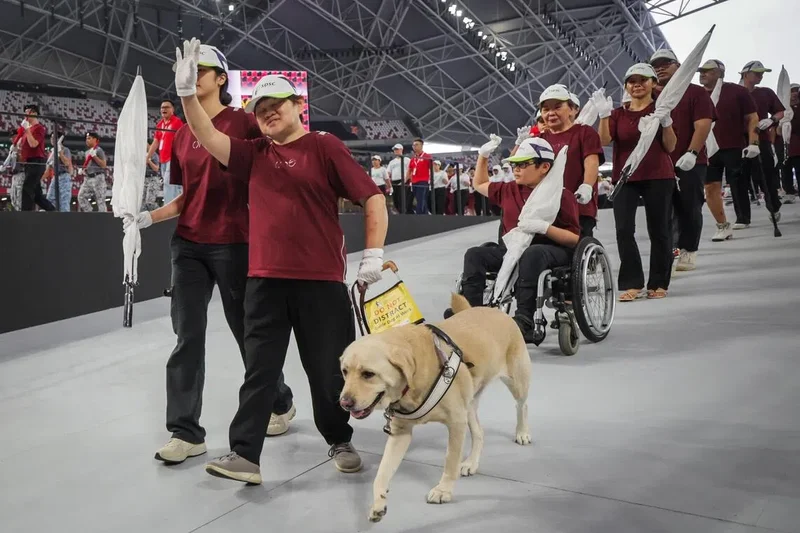
Keith, a Primary 6 pupil from Seng Kang Primary School, is part of a 21-member contingent from the Singapore Disability Sports Council that will be joining other civilian contingents at NDP 2026.
The contingent is led by former para-athlete Yap Qian Yin, who won gold for Singapore in para-sailing at the 2014 Asian Para Games and the 2015 ASEAN Para Games. It includes people with physical and intellectual disabilities, as well as autism.
The contingent spends about 12 hours on Saturdays, from 8am to 8pm, at the National Stadium for rehearsals and preview shows.
Some participants initially had reservations about the new experience.
Lim Lee Lee, 58, who has visual disability, was unsure how her guide dog, Hesta, would react to loud noises, and whether sufficient accommodation of PWDs would be made during rehearsals.
But Hesta adapted well. The blond labrador retriever now leads Lim by following other participants, stays calm amid loud commands and the feu de joie – French for “fire of joy”, a ceremonial rifle salute – and even stands at attention when she hears Majulah Singapura.
Holding areas and quiet rooms have been designated at the stadium for those who need a calmer environment, as part of measures to support PWD participants.
During rehearsal breaks, Lim and Hesta head to the rooms to play fetch. Hesta also gets her favourite cucumber and carrot sticks to help her stay hydrated.
“It’s really a surprise to know that even PWDs can be included. It is time society knows we can contribute,” said Lim, who is the co-founder of a social enterprise that helps PWDs find employment.
Rehearsals are hard work, as Keith knows.
Cheekily, he said he sweated “swimming pools” at the first practice session because he had to stand for long periods while wearing his leg braces. He later switched to using a wheelchair.
His grandmother, Tan Kim Choo, 63, will push his wheelchair during the parade. She is one of five assistants who will accompany the contingent members on stage.
Though Koh will not be participating in the march, she attends every practice session with him.
Also in the contingent is 12-year-old Aniq Syazwi Mohd Fauzi, a pupil at Grace Orchard School who has mild intellectual disability.
His mother, Nur Umairah, 35, a staff member at Singapore Aquatics, said Aniq practises marching with the correct posture while walking to the bus stop on his commute each day.
She cried the first time she saw him on stage during rehearsals.
“I’m very happy to see that there’s so much inclusivity nowadays,” she said.
At an earlier rehearsal, Aniq received an award given to the best participant in each contingent.
“I feel nervous, but when I go up on stage, my fears are gone,” he said with a smile.
The avid sports player, who swims, bowls and plays basketball, shares the same birth month as Singapore. His birthday wish is to become a Paralympian.
Most of the contingent members arrived early for rehearsal on July 25, chatting over coffee and adjusting their attire. Hesta rested under a table before a hard day’s work began.
On cue, the contingent marched steadily onto the stage via ramps and practised waving to the 42,000-strong crowd that will greet them on Aug 9.
Lim, the social enterprise co-founder, has been blind since birth. She cannot see the maroon T-shirts and white caps worn by her fellow contingent members, or the national flag that will soar over the Kallang Basin.
But as a familiar NDP song says, her senses tell her this is surely home. “I know that in this stadium, audience members are everywhere,” said Lim. “Because when we’re walking up, we can hear people cheering for us.”