- See more Daily Mail on Google - save us as a Preferred Source
Many people across Europe will be able to witness their first solar eclipse this month in nearly three decades.
The UK will be plunged into brief darkness during the rare celestial event on the afternoon of Wednesday, August 12, as the moon passes directly between the Earth and the sun.
Unlike other countries, the UK will experience a partial solar eclipse, as the bulk – or around 90 per cent – of the sun will be covered.
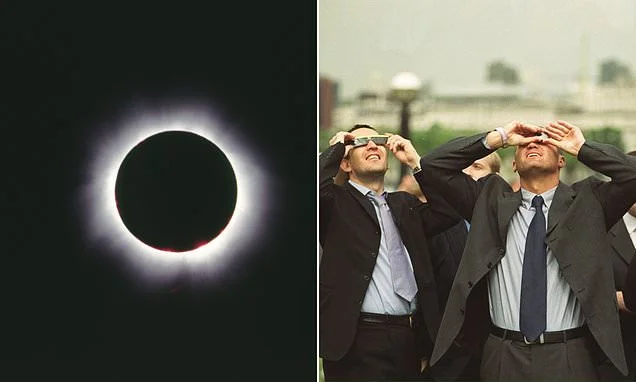
It is the biggest of its kind the UK has seen since 1999, when a total solar eclipse was visible from the majority of Cornwall and Devon.
People living in Cornwall are expected to be among those who will get the best view, with around 95 per cent of the sun obscured by the moon.
Meanwhile, 98 per cent of the sun above the southwestern tip of Ireland will be covered, according to the Royal Observatory Greenwich.
Differing from a total eclipse when it is complete darkness, the sky will rather seem like a cloudy day or similar to dusk or dawn.
The 'first contact' will take place at 6.17pm in London, Bristol and Cardiff. It will last until 8.06pm, with a peak at 7.12pm.
City workers in London took time to view the eclipse in London in 1999
The UK will be plunged into brief darkness during the rare celestial event on the afternoon of Wednesday August 12, as the moon passes directly between the Earth and the sun
For those watching from Edinburgh and Glasgow, the eclipse will begin at 6.08pm and end at 8pm – peaking at 7.05pm.
Manchester and Liverpool will start to lose sight of the sun at 6.13pm, running until 8.03pm to 8.04pm, with the pinnacle point at 7.10pm.
In Norwich, the moon will start to move in front of the sun from 6.15pm with the eclipse ending at 8.04pm. The maximum eclipse is at around 7.11pm.
Meanwhile, the celestial even will start in Truro, Cornwall, from 6.18pm and end at 8.10pm, with a peak at 7.16pm.
It is recommended to find a high point with a clear view of the horizon, such as a hill, to watch the eclipse.
Greenland will experience a total eclipse from the late afternoon or early evening, which will stretch across to Iceland and into northern Spain and the Balearic Islands.
A small section of northern Russia will experience total darkness at midday, NASA said.
Those in Spain and the northwestern tip of Portugal will not experience a full eclipse until the late evening, shortly before sunset.
There are two safe ways to see a solar eclipse, according to the UK Health Security Agency, with the use of specialist eclipse viewers or indirect viewing methods.
The UK will have to wait until 2090 for the next full solar eclipse.