- See more Daily Mail on Google - save us as a Preferred Source
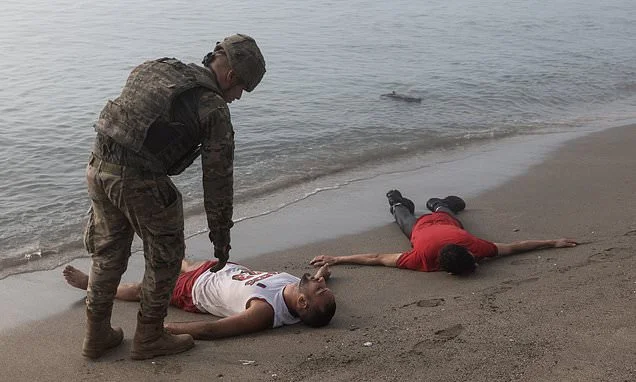
A young man in a basketball vest staggers from the sea and collapses at the feet of a Spanish soldier, next to the prone body of another exhausted soul who had been equally desperate to make it to European soil.
First light had just broken over Ceuta's Playa El Tarajal and, until now, all had been quiet, save for the gentle hiss of lapping waves. Nobody was expecting any more migrants. It turns out Sid Ahmed Dib, 23, from the Algerian port city of Skikda, and his unknown companion, were the last.
As Sid lies flat on his back in the sand, having finally made it to this Spanish enclave, most of the thousands of young men who arrived before him were going the other way, returning back over the border to Morocco like tired and hungry children who'd run away from home then quickly thought better of it.
One of the soldiers gives Sid a bottle of water and he throws his head back, the cords of his throat pulsing as he gulps it down. He's a lucky man. Many of the 67 who died trying to enter Ceuta either drowned or were crushed while trying to climb the breakwater stones that hold the border fence.
Suddenly he begins sobbing uncontrollably into the crook of his arm. Whether through overwhelming relief or exhaustion or something else besides, it isn't clear. Composing himself, he tells me he's been swimming for at least four hours to get here, this odd little Spanish dot of Spanish territory on Morocco's Mediterranean coast. He produces a blue plastic bag containing his passport, which he'd tucked into his shorts while swimming.
'My Algerian passport,' he says proudly, flicking through its damp pages. 'Algeria is so bad, worse than Morocco. I tried to get into Tunisia, then went to Casablanca and then came here when I heard thousands were coming. I want to get to Europe. Madrid or Paris maybe.'
The Spanish mainland is just 15 miles across the Strait of Gibraltar, so it's easy to see why Sid and the other migrants consider Ceuta the gateway to a new life. Behind him, stands an empty wooden beach bar, the aptly named Cafe Europe.
A migrant in a basketball top gasps for life as Ceuta is gripped by fear following a mass crossing of refugees from Morocco
Dozens of migrants are pictured in the Ceuta Temporary Immigrant Stay Centre (CETI), which is experiencing extreme tension and severe overcrowding
Spanish soldiers question a migrant, following mass crossings of migrants on foot and by sea from Morocco into the Spanish territory
Spanish troops sit in a military vehicle as the authorities escort a big group of migrants to the border to take them out of Spain
Migrants pass through a broken fence as they leave Spain's North African enclave of Ceuta towards the Moroccan town of Fnideq, on the Morocco-Spain border
As Sid told his story, Ceuta's fearful Spanish residents were panic-buying in supermarkets then scurrying back to their homes. Left shell-shocked by the previous two days, which saw more than 60,000 migrants overwhelm their small city, many feel abandoned.
'The migrants have caused our population to almost double in size and we don't know what the future holds,' said 26-year-old graphic designer Belen Picazo. 'We're going home and we'll lock ourselves in.'
As more mayhem unfolds before me, I would challenge any liberal progressive to witness such troubling scenes and still advocate for open borders.
With migrants lurking with listless boredom on every street corner, in squares, avenues and bridge underpasses, forcing locals to cower in their homes, Ceuta today does not look like anyone's idea of a utopia.
Tearful Sid didn't seem much of a threat. But you don't need to travel far to sense disquiet here.
Some migrants queue outside the small number of shops prepared to serve them. Most don't want their custom.
Normally on a Saturday the city parks and beaches are alive with families and the sounds of children playing. Apart from the police, the military and a few hardy Spanish souls, the only people visible in Ceuta yesterday were migrants, seemingly from across Africa. For sure, some were friendly, but the locals' deep unease was understandable.
'They've taken over the city,' said a police officer. 'Look around you. It may as well be Morocco because all the Spaniards are indoors.'
Spanish soldiers come to help the migrant gasping for air on the beach as thousands cross over the border
Paramedics put the man on a stretcher and give him first aid as they take him off the beach
A Spanish soldier escorts a migrant away from the area as the unprecedented humanitarian response ensues
It was true. The numbers were overwhelming. And so was the litter. Cans, bottles, wrappers seemed to carpet every patch of grass.
The only place where local voices were heard was at the Mercadona supermarket. It felt like a Spanish-only enclave within an enclave. Three armoured personnel carriers were parked outside it all day, preventing migrants from entering.
One Moroccan boy, no older than 16, taunted police with a 'Heil Hitler' salute as he was shooed away. Inside, the queue for each till was 50-deep. Having shut its doors because of the crisis for the previous two days, the supermarket braced itself for wave after wave of panic-buying customers.
Ms Picazo was with her parents and their overflowing trolley in one of the long queues. She lives in Madrid now but came back to Ceuta after the first influx of migrants poured across the border because she was 'worried sick' about her mother, a nurse, and her engineer father, who live in the centre of the city.
She says: 'I was genuinely frightened for my parents. I am sorry for the immigrants who died trying to get here but we are all worried about what will happen next. There is fear everywhere. Who can blame us? This is not a normal situation. Even with soldiers everywhere people are scared.
'This cannot be allowed to carry on. Like everyone else, we are buying water, oil, everything in bulk, just in case.'
Nearby, an elderly man queuing with his grandson was criticising the Spanish government for 'abandoning us'.
'It all went wrong when Sanchez started that amnesty,' he says, referring to Spain's socialist prime minister Pedro Sanchez and his controversial policy giving more than a million migrants illegally living in Spain the chance to apply for residency status.
Migrants pose for a picture while being escorted to the Ceuta-Morocco border in the Spanish North African enclave of Ceuta
A woman drinks water outside the CETI short-stay migrant centre in Ceuta on August 1
Sanchez insisted it would make Spain a happy place to live for everyone, whatever their ethnicity. But his critics say that the scheme – launched in April but since halted – helped entice the Moroccan migrants.
Further up the hill from the supermarket, we see a migrant dart across the street clutching a bag of groceries he's apparently stolen. A police officer holding a baton aloft gives chase. Both disappear from view.
We drive further along Avenida de Africa. Dozens of young Moroccans appear to be laying siege to the Coviran grocery store. This time it is a soldier who does the chasing. As the men scatter, he goes after three of them who run down a side street. All over the city yesterday, these cat-and-mouse games played out repeatedly.
Back at the beach, the military had laid a 500-yard floating barrier in the sea to prevent other swimmers from reaching the shore.
One of the triggers for this extraordinary crisis was a Spanish supreme court ruling making it harder to intercept migrants at sea, meaning that they are now more likely to be processed on land than immediately returned. The influx was egged on by social media messages announcing that the border was 'open', which spread across Morocco like wildfire. Where these messages originated from remains a mystery.
There were even reports that buses were laid on to transport people to the border.
According to several people we spoke to, Moroccan police urged them to 'go to Spain'.
Indeed, there has been a suspicion that Rabat had orchestrated the rush to the border, or at least did little to prevent it, given that the country has long resented the Spanish presence at Ceuta and its sister enclave of Melilla, 140 miles to the west.
Dozens of migrants are led away through a gate as Spanish troops stand guard armed with rifles
Migrants queue outside a supermarket in Ceuta after entering the Spanish enclave from neighbouring Morocco
Yesterday, Alberto Nunez Feijoo, head of Spain's opposition conservative People's Party visited the city and described the massive influx of migrants as a 'premeditated and unprecedented occupation of Spanish territory'.
One woman, who came across the border with her 16-year-old son told us: 'Without doubt, the Moroccan government let this happen for whatever reason. Probably because it wants to get back at Spain for something.
'We're going back again because we are tired and hungry and there is no shelter. We slept on the streets like dogs.'
Her son, a trainee chef, pointed to a black eye. 'I was hit by police for no reason,' he says.
A frequent refrain from Moroccans, meanwhile, was that they only came because 'our friends were going', suggesting that their foray into Spain had not been thought through. One said: 'We thought we would be better treated but it has been disappointing.'
Beyond these shores a political row was raging. Spain condemned the 'selfish, polarising and unlawful' reaction of some EU countries to the influx.
Italy, for one, wasn't happy. It temporarily suspended the EU's border-free Schengen arrangement with Spain, as PM Giorgia Meloni called the scenes 'shocking'. Finland and Denmark backed Italy's move, while Czech PM Andrej Babis urged a temporary suspension of Spain's Schengen membership.
Interior ministers from across the EU will discuss the issue on Tuesday by video conference.
Mr Sanchez had called for an urgent meeting to 'reaffirm that the security of our external borders is a shared responsibility of all member states'.
Twenty-two of the EU's 27 countries also called for emergency talks in an open letter, citing 'serious concerns' regarding the developments in Ceuta.
While the EU praises the return of migrants and speaks of helping Spain restore 'effective control' of the border and prevent further uncontrolled crossings, many here remain unconvinced.
One of six cleaners tasked with clearing Ceuta's beaches of the carpet of rubbish left behind by the migrants, told us: 'I don't think this is the last time I will be doing this.'
Nearby, a soldier is frogmarching a migrant guilty of some misdemeanour or other back towards the border. Afterwards he says: 'This has been a crazy few days, nothing like it. But remember, it has happened before and will happen again.'