From satire to sit-in is the most popular, and perhaps the easiest, explanation for the student protest movement that culminated in the resignation of Union Education Minister Dharmendra Pradhan. This explanation is empowering in its simplicity. But it is incomplete.
By now, everyone knows how the story goes. On May 15, 2026, Chief Justice of India Surya Kant likened unemployed youth turning to activism and social media to “cockroaches”, triggering widespread backlash. Seizing on the remark, Abhijeet Dipke, an Indian student in Boston, launched a satirical online platform for fellow “cockroaches”, transforming an insult into a rallying cry for disaffected youth. Within the first 24 hours, 50,000 people signed up. That number swelled to more than a million within five days, while the movement’s Instagram account surged past 22 million followers.
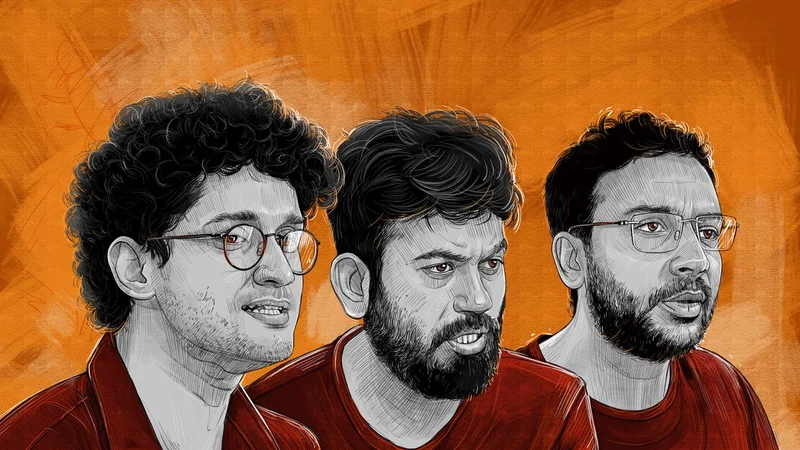
Yet behind the viral posts, soaring follower counts and colourful symbolism stood a trio: Abhijeet Dipke (30), Ashutosh Ranka (30) and Saurav Das (27), whose skills complemented one another. They come from different parts of the country, different social backgrounds and possess markedly different temperaments.
Those who have spent time around Jantar Mantar since the movement began describe Mr. Dipke as politically intuitive, though at times a touch emotional, and the beating heart of the movement. On July 18, after activist Sonam Wangchuk was removed from Jantar Mantar, it was Mr. Dipke who argued that the movement should escalate its demands. Instead of limiting itself to seeking Mr. Pradhan’s resignation, he proposed demanding the resignation of Prime Minister Narendra Modi.
Mr. Dipke loves discussing A.R. Rahman’s music and reciting Shah Rukh Khan’s dialogues from Swades. He brought a sense of lightness to the protest, spending time in the evenings talking to the protesters, posing for pictures with them and cracking a joke every now and then.
Mr. Ranka, meanwhile, has been described as decisive, though at times authoritarian, and quicker to lose his temper than others. He remains the mind of the movement and its principal strategist. Mr. Das, the youngest of the three, is known as much for his affable demeanour as for his outreach skills, though colleagues say he can occasionally be indecisive.
If Mr. Ranka and Mr. Dipke rave about Shah Rukh Khan starrer Swades and Aamir Khan’s Rang De Basanti, Mr. Das represents the other end of the social spectrum where his favourite series is Modern Family — a mockumentary about a multigenerational family based out of Los Angeles.
Association with AAP
One obvious thread connecting the three is their association with the Aam Aadmi Party (AAP), a link none of them has sought to conceal. Both Mr. Dipke and Mr. Ranka have worked for the party, while Mr. Das’s proximity to former Delhi Chief Minister Arvind Kejriwal is hardly a secret.
Mr. Dipke was born in Chhatrapati Sambhajinagar (formerly Aurangabad), Maharashtra, into a Dalit family, though his caste identity largely remained in the background during the protest. “He is a student leader who is also a Dalit and not the other way round,” a leader associated with the 36-day protest said. One occasion on which he publicly asserted his caste identity came after ink was thrown at him at Jantar Mantar on July 18. His response was brief: “Blue is my colour. Jai Bhim.”
He studied journalism at Tilak Maharashtra Vidyapeeth in Pune before moving to the U.S. in 2023 to pursue a Master’s degree in Public Relations at Boston University. Mr. Dipke worked in political communications and was associated with the AAP social media team between 2020 and 2023, working closely with senior leader Manish Sisodia.
Mr. Ranka’s journey to the CJP was unlike that of most protest leaders. Born and raised in Jaipur, he studied Materials Science and Engineering at IIT-Kanpur, where he was elected president of the Students’ Gymkhana, an early indication of his interest in public life.
He served as a Delhi Assembly Fellow during 2019-20, working closely with the team of former Delhi Chief Minister and current Leader of Opposition Atishi during the pandemic, before pursuing a Master’s in Public Administration at the London School of Economics. He subsequently worked with McKinsey & Company and with Gavi, the Vaccine Alliance, before gradually moving away from the worlds of consulting and international policy in favour of Indian public life.
Mr. Ranka also worked on the AAP campaign for the February 2025 Delhi Assembly election, focusing exclusively on the New Delhi constituency, where Mr. Kejriwal was the candidate. He was part of the team examining voter deletions and continued to publicly defend Mr. Kejriwal and the party even after the election. His most recent article as AAP’s “national spokesperson” was published on March 16.
Unlike many political organisers, Mr. Ranka has never hidden his ambitions. He has often expressed a desire to focus on Rajasthan politics. Following the 2025 Assembly election, he turned his attention to the State, running campaigns to protect a 100-acre forest near Jaipur. More recently, he gave Rajasthan Education Minister Madan Dilawar a three-month ultimatum to address issues faced by students at Rajasthan University, warning that the CJP would otherwise seek the vice-chancellor’s resignation.
Saurav Das, the movement’s young spokesman, became its public face. A journalist before he became a protest leader, he understood how newsrooms functioned, how narratives were shaped and, more important, how to keep a movement in the headlines.
Mr. Das spent part of his childhood in Puducherry and speaks a smattering of Tamil. He studied Journalism and Mass Communication at Amity University, Noida, graduating in 2019. He is best known for his detailed profile of former Chief Justice of India D.Y. Chandrachud for The Caravan, and has also written for Frontline and other publications.
‘The language of Gen Z’
Mr. Das is also the co-founder of Climate Action Front, an initiative focused on climate governance, sustainability and environmental policy. Alongside journalism, he has been working on his debut book, Complicit Silence: The Court’s Role in India’s Quiet Suffering, which examines the judiciary’s role in contemporary India through a series of case studies involving citizens seeking justice. Videos of Mr. Das dancing after Mr. Pradhan’s resignation also went viral, attracting admiration as well as criticism. Mr. Das defended the celebrations as “the language of Gen Z”, arguing that young people express political victories differently.
None of the three had ever led a protest of this scale before they laid siege to the government near the 18th century observatory, Jantar Mantar. Nor had the majority of the protesters who took to the streets of Delhi, in response to their call. For now, the three insist that the CJP will continue to function as a pressure group rather than a political party.
Published - August 02, 2026 03:00 am IST