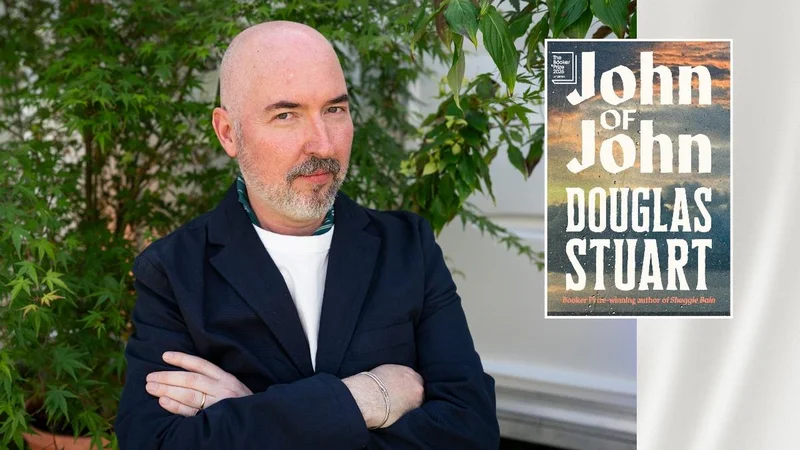
I am John of John of Iain of Iain the Breabadair,” says John ‘Cal’ Macleod to an old Scottish woman who asks about his “sloinntireachd”, his lineage. When we meet Cal at the start of the novel, he’s a newly-minted graduate in textile weaving, unemployed, mostly drunk, and living a closeted life. He learns from his father, John Senior, that his maternal grandmother Ella has feet that are “as purple as calf liver”. She is unwell, and Cal decides to return home.
John Senior is a scold of god, devoutly Protestant in the manner of those who feel permanently guilty. On the island of Harris, he is a well-regarded figure but also an object of pity. His wife Grace leaves him for his brother Uilleam, abandoning Cal and her mother Ella in the process. Instead of having the decency to move away, Grace chooses to hang about the island, have children with Uilleam, and most unforgivably, be happy.
To put things in perspective, John Senior also lives a closeted life. This enclosure includes his childhood friend and lover, Innes MacInnes. Like Cal, John Senior too is a weaver. But unlike his gentle offspring, John Senior is a taciturn, angry man who cannot forgive in others what he cannot forgive in himself.
Unmasking vulnerabilities
Douglas Stuart’s new novel John of John — longlisted for this year’s Booker Prize — is set in Scotland in the 90s, before mobile phones and the Internet. It’s a setting that the author has explored earlier, though in a more violent key, in his 2022 novel Young Mungo. There is an old-fashioned feel to the story. This is not due to the ’90s setting alone.
The closet issues aside, the Heimkehrroman (the story of a young person who returns to their hometown to figure things out) was quite popular in the West in the ’80s and ’90s. It played out in movies like Beautiful Girls, Peggy Sue Got Married and Grosse Pointe Blank, and in novels like Proulx’s The Shipping News, Swift’s Waterland and Russo’s Empire Falls.
These stories often also include a local character, suitably attractive, whose main narrative role is to lead the protagonist to the right decision. John of John has such a character in Cal’s classmate, Isla Macdonald, a smart and ambitious young woman.
The movie critic Roger Ebert was fond of saying that what mattered in art was how things were depicted, not what was depicted. Stuart’s novel is a great example of what good writing can do with well-worn narrative material.
The dialogues, unusually lengthy and numerous for a literary novel, feel like conversations. The characterisation of the novel’s people makes me change my mind several times during the reading. This is especially true of John Senior: the more one learns about him, the more hesitant and nuanced one’s judgments about him tend to become.
But even relatively minor characters are given a depth that makes one feel we would recognise them were we to meet them. This is because the novel’s interactions often unclothe vulnerabilities. For instance, at one point, Cal makes the mistake of insulting ‘Beady’, the community’s moral watch-guard. Post-insult, there is a pause. “She smiled the smallest, tightest smile he had ever seen in his life.” And then the author tells us, through Cal, what that smile will entail.
Enjoyable read
The relationship between Ella and Cal similarly deepens as the novel steps through its 400 pages. Cal and his grandma have an easy relationship, near unconditional; one of its dimensions includes a mutual fondness for obscure and obscene words. The reader is the happy beneficiary.
Lengthy, family-centric narratives tend towards soap-opera. This is evident in John of John as well. The last quarter-half is a relatively hurried wrapping up of plot threads, complete with dramatic drownings, grieving mothers, screams, out-of-wedlock babies and so on. The last dozen pages cram a revenge scene and a counter-revenge scene. There’s even a final chase, or rather, since this is a literary novel, a trot. Tragedy deferred sometimes turns into farce.
Those who struggled with Stuart’s linguistic flex, Shuggie Bain, which won the 2020 Booker Prize, may approach John of John with some trepidation. They needn’t. This is an enjoyable and accessible novel, one that competently lives up to the expectations raised by its long and honourable sloinntireachd.
The reviewer is an author, most recently of The Coincidence Plot.
Published - July 31, 2026 06:15 am IST