Pioneer cohort to graduate from the University of the Arts Singapore in August
AI generated
SINGAPORE – Singapore’s first arts university will see its inaugural cohort of students graduate in August, two years after it opened.
The University of the Arts Singapore (UAS), formed by an alliance between Lasalle College of the Arts and the Nanyang Academy of Fine Arts (NAFA), is a private university supported by the government.
A total of 135 students will graduate on August 7, comprising 102 from Lasalle and 33 from NAFA. Most of them were on the two-year pathway after completing a related diploma.
Another 52 Master of Arts degree holders from Lasalle graduated in November 2025.
UAS has taken in about 760 students each year since 2024 and is expected to have an annual intake of about 1,000 students within the next five years.
The university launched with 29 programmes, including eight new degrees in areas such as biophilic design, design for social futures, as well as Master of Arts degrees in arts and ecology, fine art, and music therapy.
One graduate, Jolene Ariana, 22, who studied biophilic design, was drawn to the benefits of incorporating nature into human spaces.
Biophilic design aims to connect building occupants more closely to nature through elements like natural lighting, materials and ventilation to improve overall well-being.
“I was intrigued because it’s an area that isn’t well known in the industry yet,” said Ariana.
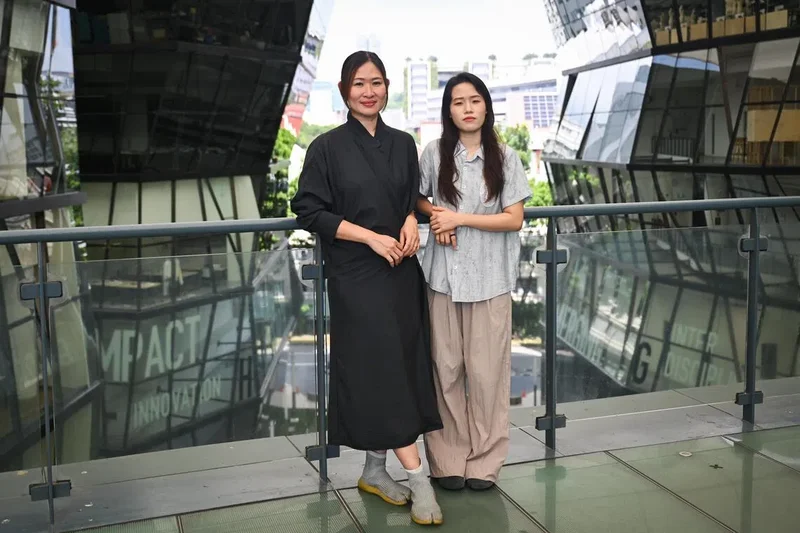
Graduate Tiew Fang Kee, 25, is from the design for social futures course. She aims to design solutions for societal issues like environmental sustainability and the challenges of an aging population.
The interdisciplinary programme spans areas such as service design, speculative design and systems design.
Tiew said a unique experience from the course was the masterclasses she attended. She learnt from renowned design futurists Clive van Heerden and Jack Mama – founders of London-based design consultancy vHM Design Futures – and speculated on Singapore’s coastal resilience against rising sea levels.
“I designed a system that placed a levy on seafood purchases to encourage more responsible and conscious consumption in a hypothetical future,” says Tiew, who hopes to enter the social or environmental sectors.
UAS’ deputy vice-chancellors Venka Purushothaman and Tan-Soh Wai Lan say there is strong demand for such interdisciplinary courses.
Purushothaman, who is also president of Lasalle, said this is especially so for programmes that combine artistic excellence with interdisciplinary and future-focused skills, like art histories and curatorial practices or music business.
Tan, who is also president of Nafa, added: “We are seeing aspiring creatives seek an education that not only deepens artistic excellence, but also equips them to engage meaningfully with communities, and respond to evolving cultural, social and environmental challenges.”
Pauline Lim, 40, from the inaugural batch of Master of Arts in arts and ecology course, is an adjunct lecturer at Lasalle who teaches the Bachelor of Arts (Honours) in fashion design and textiles.
Having her own fashion label previously highlighted the issue of fabric waste in the industry from excess raw materials and offcuts. This led her to question her purpose in the field. Seeking a more sustainable approach, she decided to sign up for the programme.
“The course isn’t just about making art about nature, it’s about embedding ecological thinking into creative practice. And that wasn’t an approach that was familiar for me, it was something I wanted to explore,” she said.
As part of her course, she looked at how she could extend the lifespan of materials and decided to repurpose old kimonos into new garments.
As kimonos are constructed from rectangular lengths, they lend themselves to a low-waste approach. By utilising rectangular and square cuts for her tops and dresses, Lim minimised offcuts.
She said her course was a reminder about the need to learn continuously.
“I thought enrolling in the programme would make me an expert in sustainability, but I think it gave me humility instead. The more you learn about ecology, the more you realise that you don’t know a lot,” she said.
May Tan, the National Arts Council’s director for education & manpower development, said the graduation of UAS’ inaugural cohort marks a significant milestone that reflects Singapore’s commitment to nurturing a strong and diverse local talent core.
Noting that UAS equips graduates with more than artistic or technical skills, Tan says its practice-led curriculum ensures industry readiness while providing structured pathways to advance research in the applied arts. Graduates also get to leverage on the strengths of NAFA and Lasalle to build professional networks and collaboration.
She adds that arts graduates today have more career options. Beyond becoming artists or performers, many apply their creative skills in areas like arts management, creative production, design and education.
“Arts education develops capabilities such as creativity, critical thinking, collaboration and problem-solving. Outside of the creative sector, these are skills that are transferable and increasingly valued across many industries,” she said.