August gardening checklist: How to help your garden survive the heatwave - and create a haven to attract the 'gardener's best ally', the ladybird, even during a dry spell
- READ MORE: Gardening guru reveals the dreaded garden tasks people hate and often get wrong - here's how to tackle them this summer
- SHOP: Is your garden heatwave ready? Here are the nine hot weather essentials all middle-class gardens need
- See more Daily Mail on Google - save us as a Preferred Source
Daily Mail journalists select and curate the products that feature on our site. If you make a purchase via links on this page we will earn commission - learn more
The last month of summer is looming, and garden gurus will want to make the most of their outdoor spaces before cooler temperatures force us all indoors again.
But no need to despair, as there are plenty of things to do in the garden this month so you can enjoy it for the last few sunny days and balmy nights.
The experts have offered their best tips and tricks for keeping gardens flourishing, including what to prune and water, as well as how to attract birds and pollinators.
Outdoor living expert Simon Parry, from leading composite decking manufacturer Trex, revealed how to let your lawn breathe and why you shouldn't worry if it's a little brown - especially in the midst of the UK's recent hosepipe ban.
Tessa Cobley, plant pest expert and owner of Ladybird Plantcare, explained how to attract your 'garden's greatest ally', ladybugs, who act as a natural pest control for sap-sucking insects.
According to James Ewens at Green Feathers, creating an environment for wildlife should be a gardener's focus as well.
'Looking after our feathered friends and pollinators is a priority for August; watering responsibly to support birds through the end of breeding season and creating a bee bath will keep our wildlife happy and healthy,' he said.
Below, the pros share their expertise so you can lap up the last of summer in a healthy, happy, blooming garden.
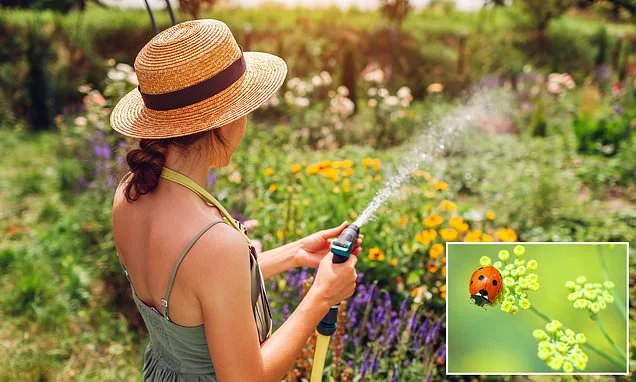
The experts have offered their best tips and tricks for keeping gardens flourishing in August, including what to prune and water, as well as how to attract birds and pollinators (stock image)
- LET YOUR LAWN BREATHE
When mowing the lawn in summer, mower blades should be raised to help grass cope with the heat, according to Simon.
'Raising the cutting height will keep the grass slightly longer, which helps to shield the roots from the heat,' he explained.
'It is best to cut your lawn every one to two weeks and leave the short clippings where they are, so when it is hot they can act like mulch.'
He also said browning grass during this summer's heatwave is no reason to panic.
'Don't worry if your lawn is brown, as this can be normal in hot weather - the autumn rain will turn it green again,' he said.
'Established grass is luckily very resilient; it'll recover if it's treated right. Grass naturally goes dormant as a self-protection tactic in hot weather - clever, right?' James agreed.
He recommended giving grass a 'deep soak' after a prolonged period of hot, dry weather rather than 'light watering little and often'.
'The best approach is actually to give it space and let nature run its course, besides some deep watering now and again,' James said.
Finally, Simon advised against using fertiliser on lawns in August.
Fertilising grass now will encourage new grass growth, leaving it vulnerable to autumn pests, trapped debris and lawn diseases.
- CREATE A SAFE SPACE FOR LADYBIRDS
'Many people worry when they see lots of insects in their garden, but they're an essential part of a thriving outdoor space,' Tessa said.
'Ladybirds are a great example of this. They're a natural part of the garden's ecosystem and help keep pest populations balanced.'
The beloved spotty bugs are the natural predator of aphids, teeny sap-sucking insects that breed quickly, damage a huge variety of plants and are considered one of the most harmful garden pests.
Ladybugs make light work of aphids and their ravenous larvae and also feed on other damaging pests like fruit flies, mites and scale insects, so they are your best friends in the garden.
However, Tessa warns: 'Ladybirds need a reliable food source, so don't be too quick to remove every pest you see'.
'Leaving a small number of aphids on less valuable plants can encourage ladybirds to visit and settle in your garden.'
To give your garden a boost, Tessa recommended introducing live ladybirds from a specialist supplier but warns they are not guaranteed to stay if conditions aren't right.
'Like all wildlife, ladybirds will stay where they have access to food, shelter and a safe environment,' she said.
'By making your garden a welcoming place for them, you'll be rewarded with one of nature's most helpful little garden visitors.'
Ladybugs make light work of aphids and their larvae and feed on other damaging pests like fruit flies, mites and scale insects, so they are your best friends in the garden (stock image)
- ADD POLLINATOR PITSTOPS
Ladybirds aren't the only creepy crawlies you'll want to see enjoying your greenery - bees and butterflies are also welcome friends.
James recommended setting up 'pollinator pitstops', so these critters can rest, recharge and rehydrate in your garden - and be encouraged to return time and time again.
'It can be as simple as a shallow bowl of fresh water with stones for insects to land on, surrounded by nectar-rich plants like lavender or echinacea,' he said.
'Even a tiny little pitstop can make a big impact for pollinators; a few pollinator-friendly plants on a balcony or patio next to a shallow water source can be a valuable stepping stone for wildlife.
'Keep the water clean and replenished, and shallow for pollinators. Use pebbles or stones to give a perching place for insects to top up without the risk of drowning.'
Ladybugs feed on nectar and pollen, so introducing a range of nectar-rich plants to your garden beds and pots can provide an extra food source.
The helpful bugs are drawn to 'flat-topped, umbrella-shaped flowers and herbs' including dill, fennel, coriander, yarrow, angelica and sweet alyssum.
'Bright yellow and orange flowers, including marigolds and calendula, are also great choices,' Tessa said.
'Not only will they catch a ladybird's eye, but they'll add plenty of cheerful colour to your borders and containers too.'
- FEED THE BIRDS
'It's a divisive topic in the gardening world, but I'm here to cut through the noise to tell you that birds do need supplementary feeding in summer; it just needs to be done responsibly,' James said.
'Supplementary feeding is always necessary, especially in August when birds are still active for long daylight hours and still feeding their young.'
Summer brings about certain diseases birds are susceptible to, so James said hygiene is 'critical'.
'Keep feeders topped up little and often, clean feeders by scrubbing thoroughly once a week, and keep water replenished for birds to hydrate and bathe,' he said.
'Avoid foods that spoil quickly in heat and use hanging feeders rather than flat ones, and provide nutrient-rich and easily digestible foods like sunflower hearts, mealworms and quality seed mixes.'
- WATER WISELY
James said watering is one of the most important gardening tasks to get right.
'Focus on time of day first and foremost; midday sun is not a good time to water,' he said.
'Early morning or evening when temperatures are mild are best, and if I had to choose, morning watering wins because it reduces evaporation, ensuring plants absorb moisture properly.'
Like lawns, James said that less frequent but deep watering is more beneficial than the little-and-often approach in August.
Water deeply a few times a week rather than little and often to encourage stronger root systems,' he said.
'This is general advice though, and you should always play it by ear!'
For fruits and vegetables, Simon said regular watering is still necessary in August, with hotter weather causing quicker evaporation.
'Compost heaps can also dry out and then stop working through dry, hot spells. By giving them a water, they will continue the composting process,' he added.
Hanging baskets and newer plants will require more watering, James said and shared his golden rule of thumb.
'Stick your finger around an inch into the soil, and if it's dry, it needs some water,' he explained.
- DEADHEAD FLOWERS
One task that should carry over from your July gardening task checklist is to 'deadhead' flowers.
'Deadheading flowers promotes new growth by stopping plants from wasting energy on seed production,' Simon said.
'Annual bedding plants and perennials, if dead-headed in August, will encourage them to flower in autumn.'
James added that deadheading blooms neatens up plants and makes way for new flowers and prevents them from dropping their petals too soon.
'Remove flowers as soon as they start to fade; it's a case of out with the old, in with the new,' he said.
'You'll keep displays looking better for longer by diverting their focus on using energy for seed production.
'Bedding plants, roses, cosmos, and dahlias, and summer-flowering perennials all benefit from a few minutes each week of deadheading, along with shrubs like tree peonies and climbers.'
To deadhead flowers, Simon explained: 'pinch, snap or cut off faded blooms, using your finger and thumb or scissors'.
He added that herbs can also do with a trim as cutting them back can promote a 'new flush of tasty leaves'.
However, be mindful, James warned, not to deadhead plants with seeds that are appetising to birds, like sunflowers, rudbeckias and cornflowers, to encourage frequent visits.
- HARVEST FRUITS AND VEGGIES
'August is one of the best times of year for harvesting fruit and vegetables, as lots are now ready to pick,' Simon said.
'Fruits and vegetables such as tomatoes, artichokes, cucumbers, potatoes and plums will now be ready to eat.
'Make sure to also harvest your fruit trees, which should be ripe.'
August is the perfect month for harvesting, as not only will you have a pile of incredible home-grown produce, but it will also stop fruits and vegetables from getting overripe or even mouldy.
It will also prevent rats and mice from coming into the garden for a snack and make way for new growth - it's a win-win!