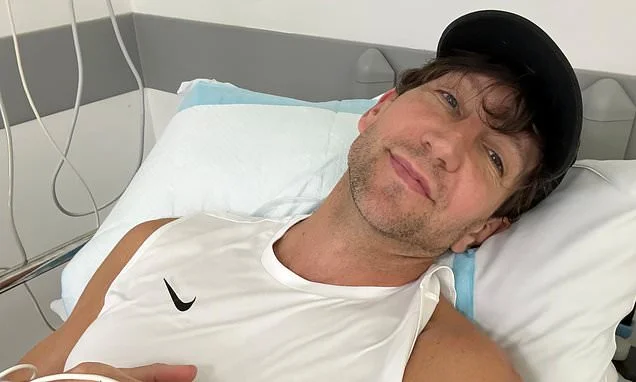
More than 2.7million people have now watched the moment when Ross Aldred tried to come to terms with the news that he had advanced bowel cancer.
Perched on a hospital bed and hooked up to an intravenous drip, the 43-year-old fights back tears as he recounts – in heartbreaking detail – the chain of events that led to the devastating diagnosis.
Lean and healthy-looking, Ross tells his 38,000 Instagram followers that only weeks earlier he had been ‘living a normal life’. ‘I was going to the gym, I was seeing my friends and family... I was getting ready for a summer,’ he says.
What he didn’t realise was that the ‘funny’ lumps that had suddenly appeared on his neck were the first sign of something far more sinister.
‘They discovered through the biopsy of the neck that I have stage four bowel cancer,’ he says, explaining that the disease had already spread to his liver, spleen, lungs and the lymph nodes in his neck.
The video ends not in despair but with a plea for help funding treatment that offers him the best chance of extending his life but is unavailable on the NHS. Ross and his husband Matt, 38, had hoped to raise enough money to pay for private care after learning it could cost up to £100,000 a year.
Speaking to The Mail on Sunday, Ross, a TV and film digital director, says: ‘I thought, well, OK, we’ll remortgage the house. I’ll not take sick leave and keep working full time. Maybe I can ask my parents to draw out part of their pension. We will make this work.’
Instead, the appeal, which Ross and Matt had hoped ‘might add a couple of thousand’ took on a life of its own. Shared by celebrities including Dawn French and radio presenter Zoe Ball, the clip has so far helped to raise more than £246,000.
Ross Aldred noticed a pea-sized lump on his neck when he was brushing his teeth. By the end of that week, there were two lumps
Ross believes one reason his story has resonated so widely is the ‘terrifying’ reality that bowel cancer is increasingly striking people his own age.
And the figures suggest he is right.
Once regarded as a disease of older age, bowel cancer diagnoses among adults under 50 have risen by about 50 per cent since the 1990s.
Indeed, earlier this year actor James Van Der Beek, best known for starring in the 1990s US teen drama Dawson’s Creek, died aged just 48 – just over two years after his diagnosis.
Doctors treating these patients say many are otherwise fit and healthy. And Ross certainly fits that mould. A keen gym-goer, he follows a healthy vegan diet and hasn’t touched alcohol in three years.
Scientists have proposed a range of explanations for the rise in young-onset bowel cancer – from pollution and food poisoning bugs to, most commonly, the consumption of ultra-processed foods.
‘The majority of the patients I treat are now young, mostly under 50, and otherwise healthy,’ says Dr Ravindhi Murphy, a consultant medical oncologist who works in both NHS and private hospitals. ‘Most of these cases are diagnosed at late stages. Either they’re missed by doctors who assume it couldn’t possibly be cancer because of their age, or it just happens to be a particularly aggressive form.’
Now preparing to begin the treatment made possible by the fundraising campaign, Ross says he still struggles to comprehend how quickly his life changed. It never occurred to him that the lumps in his neck, which he spotted while brushing his teeth, could be a red flag.
Ross was told he had stage four bowel cancer that had already spread throughout his body
‘When I moved my neck from side to side, I saw a little lump in the mirror, about the size of a pea,’ he says. ‘And by the end of the week, there were two of them.’
He assumed it was simply a throat infection – a sign he was run down. ‘I just carried on. I thought the funny thing on my neck was an inconvenience that would probably be nothing.’
While Ross’ GP urgently referred him to hospital, the specialist who analysed his ultrasound reassured him it was ‘a low-grade infection’.
‘They said, “It’s probably just swollen. You’ve probably been run down,” – that sort of thing.’
On May 22 doctors performed a biopsy and told him to expect the results in about a week. They also prescribed antibiotics to ‘get ahead’ of any infection.
But within 24 hours, Ross had developed what he describes as a ‘hideous clamping feeling’ in his stomach. ‘It was the worst pain possible,’ he says. ‘I thought it could be a hernia, or maybe even a reaction to the antibiotics.’
That bank holiday weekend, on his way to the theatre, he vomited on the Tube. ‘I called my GP the next morning and said, “something’s not right here”.’
The doctor referred him for further investigations into his gut, but he was told he faced at least a six-week wait.
Three days later, he was vomiting blood.
A keen gym-goer, Ross follows a healthy vegan diet and hasn’t touched alcohol in three years
Ross and Matt, a marketing manager, rushed to their local A&E, where scans revealed several growths on his liver. But doctors initially reassured him they were ‘likely benign’ and ‘nothing to worry about’. A few days later, he returned to hospital for an examination of his stomach and bowel – an endoscopy and colonoscopy.
‘The following evening I got a phone call from the colorectal cancer department asking me to come in two days later,’ Ross recalls.
When he arrived for the appointment, on June 1, he was greeted in the waiting room by a Macmillan cancer nurse.
‘I thought, “That’s not a good sign.” It was the first time it hit me that this could be something pretty serious.’
Minutes later an oncologist delivered the body blow. Ross had stage four bowel cancer that had already spread throughout his body.
Only one in ten patients diagnosed at this stage will still be alive five years later.
‘I was in shock,’ he says. ‘I found it very difficult to make the connection between lumps in my neck and bowel cancer.
‘And I was doing everything right. I hadn’t drunk in three years, I was vegan, I was at the gym all the time. Clearly what I was doing wasn’t right enough.’
Ross will soon begin targeted therapies alongside chemotherapy and remains positive
His family – including his mother, who is undergoing treatment for leukaemia – were ‘heartbroken’ by the news, but resolved to take it ‘one small step at a time’.
Ross’ diagnosis marked the beginning of a whirlwind of operations and treatments – all within the space of a month.
First, surgeons performed an operation to fit a stoma after finding an 11cm tumour was blocking his bowel and leaving him in agonising pain.
But while Ross was recovering, doctors uncovered another life-threatening complication.
Tumours in his liver were blocking the ducts needed to flush waste products from his body. As toxins built up, he developed jaundice – causing the skin and eyes to turn yellow – and was at high risk of liver failure. Worse still, without a functioning liver, chemotherapy – the only NHS treatment available to Ross – would not be safe.
‘The liver is responsible for clearing chemotherapy drugs from the body,’ explains Dr Ravindhi Murphy. ‘If it isn’t working properly, the medicine builds up to poisonous levels.’
Ross’ oncologist proposed a high-risk procedure to drain the toxins using a series of tubes and stents inserted into his liver.
‘I thought, if I don’t get this tube put in I can’t have chemotherapy and that’ll be it for me,’ Ross says. ‘I had no choice but to go ahead with it.’
Earlier this year actor James Van Der Beek, best known for starring in the 1990s US teen drama Dawson’s Creek, died aged just 48 – just over two years after his colorectal cancer diagnosis
The operation was successful and his liver function slowly began to recover.
‘But then,’ he adds, ‘of course, I got sepsis.’
The life-threatening condition – in which the body’s immune system begins attacking its organs in response to an infection – is a recognised complication of procedures involving the liver, says Dr Murphy. Remarkably, Ross recovered within a week and was discharged home.
Then, at last, came some much-needed good news.
Genetic tests of Ross’ cancer revealed that he had a subtype known as BRAF – a particularly aggressive form of the disease that also responds especially well to a new combination of drugs.
BRAF accounts for about one in ten bowel cancers and is the same subtype that affected Dame Deborah James, who died from the disease aged 40 in 2022.
‘These cancers tend to affect younger patients and are often very aggressive,’ says Dr Murphy.
Campaigners argue that BRAF patients have been neglected by NHS drug watchdogs, which have denied access to promising experimental treatments.
In 2023, The Mail on Sunday published experts’ calls for more UK clinical trials offering targeted therapies to BRAF patients – drugs designed to destroy tumours by attacking their genetic quirks.
A recent international study involving 637 patients found that giving the combination of the drugs encorafenib and cetuximab alongside chemotherapy doubled life expectancy – from about 15 months to 30.
What’s more, patients given the three-drug combination faced no greater risk of side effects – such as nausea and extreme fatigue – than those receiving chemotherapy alone.
However, the treatment is not routinely available on the NHS.
Some British patients have accessed the treatment through clinical trials in recent years. However, there are currently no UK trials recruiting patients.
Two of the drugs – encorafenib and cetuximab – are available on the NHS, but only after chemotherapy has stopped working. By that stage, studies suggest the treatment is significantly less effective than when all three drugs are given together from the outset.
Private hospitals can offer the full three-drug combination alongside chemotherapy, but at eye-watering monthly costs – prompting Ross and his family to launch a fundraising appeal to cover the treatment.
Ross, who is due to begin the treatment within days, remains admirably positive.
‘When you’ve been faced with the opportunity of your life ending sooner than you thought, suddenly everything else becomes more important,’ he says.
‘Whether it’s just eating dinner at home with friends, or spending time with my mum and dad, it feels precious. Euphoric, even.
‘That’s what life is about, isn’t it? Being with the people you love and making the most of the time you have. That’s what I’ve done since the day I was diagnosed. And that’s how I’ll continue.’