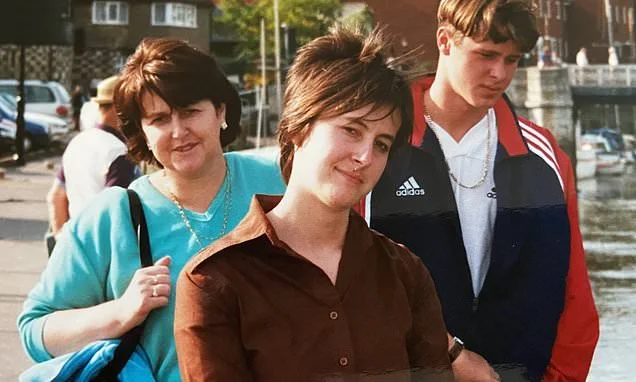
- These Wild English by Nicola Wilding (Profile Books £20, 320pp)
Looking for a punchy ‘story in a sentence’, TV documentary maker Nicola Wilding was skim-reading an article about an alcoholic father of three who’d been arrested for trying to carjack a police officer at gunpoint in Dover.
The officer had got out of his car, gun pointing at him, but something about the attacker made him sniff weakness, and the officer tried to apprehend him.
There was a struggle, and the officer managed to get hold of the gun and fling it away.
Nicola Wilding
Then, weirdly, the fight appeared to go out of the attacker, who said the gun was just a replica. Suddenly he just seemed ‘depressed and hopeless’.
He was named as ‘Bryan’, so it took a while for Nicola to realise that he was in fact her feckless, binge-drinking younger brother, Billy. (Bryan was his first name.)
Billy had been her mother’s pride and joy, ‘her little blond-haired, brown-eyed waif’, her ‘handsome little man’.
So how had he turned into ‘the attacker’ in a news story in 2013 (he was jailed for three-and-a-half years for that crime)? The question Nicola Wilding asks at the beginning of her vivid and beautifully written family memoir is ‘How the hell did we end up here?’
If you want to get under the skin of the ‘white working class’ experience in this country, this book will give you a memorable picture of one white working-class family’s trajectory.
The fact that the author managed to become a successful producer (she admits she’s now firmly ‘middle class’) shows that no one is imprisoned in their social class. But it’s not easy to achieve mobility if you grow up in a family whose keynote is chaos.
And Billy did grow up in chaos, chiefly thanks to their mother Sandra’s disastrous taste in husbands. As his elder sister, Nicola was protective of Billy, and feels bad that she wasn’t there to keep an eye on him when their violent stepfather, a soldier called Simon, was posted to Cyprus, bringing Billy and his younger sisters with him. (Nicola was on her way to college by then.)
Far from home, Billy was at the mercy of Simon’s moods. When he wouldn’t eat his beans on toast, Simon dragged him to the balcony and held him over it, threatening to throw him off.
A narcissist and bully, Simon terrified the whole family. A ‘thickset bulldog of a man’, a ‘manipulative toddler’, he ‘needed to be loved, and trouble started when he wasn’t’. So clever was he at being self-pitying and needy that it took Sandra ten years to gather the strength to leave him.
Nicola Wilding and mother Sandra
Alongside Billy’s story, Nicola tells the moving life-story, and the political trajectory, of their mother Sandra, who struggled on through those disastrous relationships, in spite of having a heart attack aged 41.
She’d grown up in another kind of chaos, the eighth child of a farm labourer in Cumbria whose wife kept running away to escape the poverty and drudgery. So young Sandra had to wash the sheets in the bath after the siblings she’d had to share a bed with had wet themselves.
In search of fun, she became a teenage skinhead and joined a gang of Carlisle football hooligans. That was the start of her journey to becoming a member of the
far-Right English Defence League. Aged 18 she became pregnant with Nicola and married the father. There were ‘shiny new radiators’ in their council house, ‘but no love’.
Her heavy-drinking second husband used to vanish at Christmas and return on Boxing Day ‘loaded with presents he’d swept from the shelves of the Esso garage’.
After the birth of the longed-for Billy, the couple bought their council house under Margaret Thatcher’s ‘right to buy’ scheme, but they were always behind on the mortgage payments and threatened with repossession – which indeed happened just
five years later. When, after ten years, Sandra eventually found the strength to leave the third
disastrous husband – Simon – she moved to Deal, Kent, and became a carer in a home for adults with learning difficulties. Nicola pays homage to Sandra’s unsung heroism in doing this job.
‘Knackered and demoralised’, Sandra felt as if market forces had turned care into a commodity. She felt ‘adrift in a world that she felt was changing too quickly’.
This took her along the road to going on EDL marches as a Tommy Robinson follower, shouting ‘England till I die!’
As a Brexiteer, she was branded a bigot, xenophobe, Little Englander and racist. As an EDL marcher, she was branded a fascist.
For Sandra, there was a nagging sense of racial injustice that drove her to protest: ‘Why was it OK to be black and proud, or Muslim or gay and proud, but not white and proud?’
Wilding, who is clear-eyed enough to see both sides of the Brexit argument, likens her mother’s ‘England till I die!’ slogan with the cries of the radical George Edwards 200 years ago, who spoke of ‘These wild English, the freeborn slaves of the nineteenth century’. Hence the title of this book.
Meanwhile Billy, in his later teens, tried moving in with his biological father in Penrith, but his father’s new wife ‘went ballistic’ at him when he stashed some tyres in the garden. ‘Billy felt a pattern repeating,’ Nicola writes. ‘Another parent not having his back. Another step-parent not wanting him around.’
The lack of male role models, Nicola surmises, was a catalyst for his disastrous early adulthood. He failed to get any GCSEs at a sink comprehensive in Canterbury, and gave up his apprenticeship as a mechanical engineer when it was discovered he’d bumped up his grades on the CV.
I dared to hope things might improve when he met a Dover girl called Jen and became a father. But it seemed to set off a pressure cooker. Nicola relays this moment in a pub: ‘Something had been expanding inside him, and it was starting to feel like the boundaries that were supposed to hold him together were pinning him in. He ordered another pint and sunk it, then another.’
From that day, Billy morphed into an alcoholic husband and father who didn’t come home at night, and who inanely held a policeman at gunpoint with a fake weapon – thus sowing a new generation of chaos.