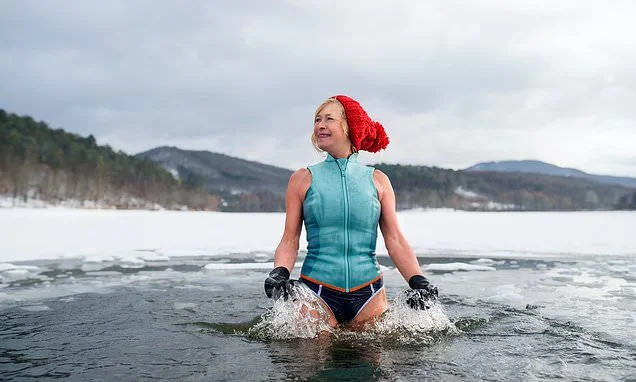
- The Plunge by Chris Ballard (Viking £22, 320pp)
We’ve all been there. You roll off the sun lounger, dip a toe in the pool, then a foot, then a leg, and as your stomach slides in… a gasp in case onlookers hadn’t clocked that the water is really cold. Invariably followed by a cocky, ‘it’s fine once you’re in’.
Author Chris Ballard
But what would you do if your pool was not 20 degrees, but below four? In this fantastic book about the power of really cold water, Chris Ballard finds out.
The Scandinavians have always known about the benefits of hot and cold therapy – and 5.5 million people live in Finland and enjoy 3.5 million saunas. But it is only in the last few decades that concerted scientific effort has been put in to discovering what happens to us when we plunge.
Studies have found that submerging in cold water improves your immune system, can cause a 250 per cent boost in dopamine, benefit cardiovascular health, and stabilise mood swings.
But someone who didn’t bother with the science, and simply went off the feeling, is Ram Barkai. Through sheer force of will, and love of the euphoric feeling the cold provides, he carved a globally recognised sport out of the ice.
Beginning with the ‘ice mile’, which does exactly what it says on the tin, he dreamed bigger – founding the International Ice Swimming Association (IISA). He set up a world championships and is chasing a Winter Olympics slot. With sponsors like Garmin and Dryrobe, and more than 70 countries and 750 swimmers involved, Olympic recognition does not seem far off.
Reading this book, the powerful effect of cold water is undeniable – not only on the body, but also on the mind and soul.
Gilly McArthur is a cold-water guide in the Lake District who has swum with David Beckham. When Gilly learnt that Cumbria has a 55 per cent higher suicide rate than the rest of the UK, she vowed to take ‘a different bloke’ swimming each day for 100 days one winter. That idea became Blue Mind Men, a weekly plunge where anyone can take part.
In Dover there is a pub, the White Horse, whose walls are covered in messages written by those who have swum the English Channel. One such message was left by Colorado swimmer Sarah Thomas.
Thomas swam out from Dover, arrived in France and swam back. At Dover, she once more turned round and headed to France, only to arrive and turn one last time. She arrived back in England following four crossings, ‘caked in Desitin [a skin protectant], bleary-eyed, and barely able to stand – the first person in history to complete a four-way crossing’, 54 hours after she had set out.
But what kept her going? Between booking her crossing slot in 2017 and completing the swim in 2019, Thomas was diagnosed with breast cancer. She underwent 16 rounds of chemo, a mastectomy and 25 rounds of radiation. When she completed the swim, her hair was only just starting to grow back. Swimming was the one thing that made her feel normal.
This is a sport that allows people to surmount impossible feats of endurance. Ballard writes with such vigour and sensitivity about the subject, partly because while researching the book he dived into the experience with both feet. Plunging every day, swimming whenever possible, competing for the US team at the IISA world championships, and attempting an ‘ice kilometre’ (failing only because of terrible conditions), he knows the pain and elation that combine when water gets really cold.
Finishing this book you will be left with the inescapable sense that ordinary people can achieve extraordinary things.