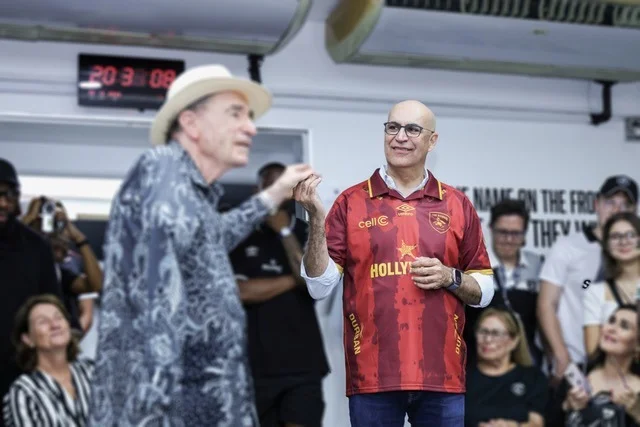
As unlikely as it sounds, lawyer Marco Masotti runs the Sharks from a high-rise in Manhattan, New York City, checking in once a week, working after hours and on weekends on Sharks business and flying to Durban when he can.
He is the major financier of the whole operation, but he cannot run the day-to-day admin from 13,200km away.
There must be easier ways for the global head of private equity at a prestigious New York law firm to spend his free time. But Masotti, who is from Amanzimtoti, is mad about rugby and the Sharks, so they sit somewhere between a legitimate business venture and a passion project for him.
Five years ago, when Masotti led the MVM consortium that bought a 51% controlling stake in the Sharks, his ambition was to turn a struggling provincial union into something resembling a global superclub. Although he has never explicitly stated that the Sharks were aiming to be the âLiverpool or Manchester Unitedâ of rugby, itâs a phrase that has been bandied about since he took over in 2021. Itâs not a comparison he particularly enjoys.
âI think we have achieved a lot, but also made mistakes. You canât really look at it as one period either,â Masotti told Daily Maverick in an interview from Manhattan.
âWe came in the middle of Covid and I would probably describe the first two years as a rescue operation. The Sharks really needed to be rescued â they were haemorrhaging players, there were no fans in the stands and they were heading the way of some of the other franchises that have been battling in South Africa.
âIt was more about shoring it up financially during that initial period and bringing in some players who provided a little bit more profile to the franchise. We were very successful in that regard and did okay on the rugby field.â
Five years on, Masotti is candid about what he bought into. Itâs not a business that makes money â yet.
On the field, the Sharks won the secondary European Challenge Cup in 2024 and have been hit and miss in qualifying for the United Rugby Championship (URC) playoffs. They missed out altogether in 2026, which Masotti sees as a chance to reset.
He has rebuilt the franchiseâs off-field operation along lines he compares openly to American major-league ownership. The old model, he said, had key functions isolated from each other. âWe had a head of recruitment sitting with management, not close to the coach, like itâs just... it makes no sense.â
Masotti installed a chief of staff, a general manager and a dedicated recruitment committee under Ruan Jacobs, with Mike Leslie on commercial deals and current CEO Shaun Bryans, a former banker, staying on in a supervisory role.
Operation Isandlwana
The restructuring extends to how rugby itself is planned. After a season in which he says 27% of the squad was injured at one point, Masotti sat down last December and, using AI, drew up what he calls âOperation Isandlwanaâ, in reference to the famous battle in 1879 when Zulu warriors defeated the British army.
The plan is splitting the season into three distinct phases rather than treating it as one block â an early, away-heavy stretch typically without Springboks in the squad, followed by two further phases built around when the Boks are released back to the franchise.
Masotti is also leaning harder on data. His general manager and analytics lead, Dave Williams, sends him cohesion metrics before matches that predict the margin of victory or defeat. âItâs astonishing to me how accurate it is in rugby,â he reveals.
âThis [owning the Sharks] is an investment. It is a little bit of a passion project. I think thatâs what sports teams are. Youâre investing in community development, media and entertainment, the sport itself. It has so many benefits. In sports, itâs a little bit like artwork. If you sell it one day, thatâs when you make the return. I think the Sharks are going to be a much more valuable franchise than when I invested in them.â
Masotti wonât put a number on what he has personally sunk into the franchise, deflecting the question when itâs put to him directly.
What he does disclose is that despite being the head of the consortium, the actual investment has been mostly his own money. There is a handful of American friends who âdidnât put in a lot of moneyâ but wanted to feel invested in a rugby team, and six South Africans who came in at the start and whom he hasnât asked to keep funding the operation.
The Americans, he said, keep telling him to spend more to win. The South Africans worry about the size of the hole. âWhat happens if Marco stops?â is how he characterises their anxiety.
Tough environment
Fortunately, he has no intention of walking away just yet, but the environment is challenging. Itâs no secret that South Africaâs leading four clubs â the Bulls, Lions, Sharks and Stormers â have at times been at loggerheads with the South African Rugby Union (Saru).
The Sharks were one of the clubs that blocked Saruâs potential equity sale to another American consortium two years ago, believing the deal was undervalued and not transparent enough. Although the deal was blocked, the tension between the clubs and Saru is never far from the surface.
Saruâs mandate is to fund all rugby in South Africa, which requires a great deal of spending on the other 10 unions that make up the membership. The four URC clubs might receive the biggest income from Saru annually, but they also carry the biggest costs â particularly playersâ wages. Saru identifies players of national interest and compensates the unions, but the general feeling is that itâs not enough.
Masotti believes that private owners like him are not just funding their franchises, but are in effect subsidising the entire South African professional game, including the Springboks. âYouâre basically financing South African rugby and the Springboks, because youâre paying the compensation on the Springboks and you get money payments.
âAnd then the goalposts keep on getting moved. You need to be getting a bigger share of the pie to stay competitive, but it is going more to the Springboks and less and less to the union. So the financial obligation of the rugby system is increasingly being put on you,â he said.
Getting to a sustainable structure
Pressed on what should change, Masotti stopped short of a direct attack on Saru. But he didnât hide his view that the structure of 14 professional unions all drawing on the same pool of funding is unsustainable.
âIâm not sure Saru is divvying up the pie right, because thereâs 14 mouths to feed, not just the four of us in the URC,â Masotti said. âMy personal feeling is we shouldnât have 14 professional unions sucking funding from Saru. Thatâs probably something you canât say.â
He feels the Sharks, Bulls, Stormers and Lions should cooperate more like the franchises do in the USâs National Football League, competing on the field while running the business side jointly so that the financial model no longer leans so heavily on individual owners to keep the whole Âpyramid standing.
âIf Iâm at the Saru level, Iâm also trying to do whatâs right for the Springboks. But sometimes it takes a little bit more discussion, a little bit more thought-out decision-making. Right now, too much of the obligation is being put on someone like me.â
None of this has cooled any of Masottiâs enthusiasm for the Sharks, though. âIâm in this for the long term. Itâs my passion. Iâm not giving up,â he said.
He believes that the Sharks will be genuinely competitive in the URC within a season or two, and in the Champions Cup by âprobably the eighth yearâ of his ownership. âI think the role of the owner is to support the budget, but by always sticking to a plan.â
Whether that plan survives contact with South African rugbyâs funding politics is, by Masottiâs own account, still an open question.
âSomethingâs got to give to make it sustainable,â he said. âSpringbok rugby and the South African rugby ecosystem really do need the clubs and club rugby to be successful to sustain Springbok rugby.â DM
This story first appeared in our weekly DM168 newspaper, available countrywide for R35.