The Surya river has been a part of our lives ever since 2004, when my husband Ravi began to farm a plot of land in Dahanu in Maharashtra’s Palghar district. We have seen its ebbs and flows for more than two decades so we were not unduly worried when it began to rise almost to the level of our farm on July 23, after three days of unusually heavy rains.
We had no inkling of the ordeal that lay in store for us. Around noon, the Surya crashed through the fences, cascaded through our farm and swept all our rice crops away.
For over five hours that day, the waters swirled furiously around our house before gradually abating.
A few minutes before the water entered the farm, our neighbour, Hemant Gharat, his wife, Hema and their three children, ran into our farm. “The water’s coming,” they yelled as they fled the water rushing into their home.
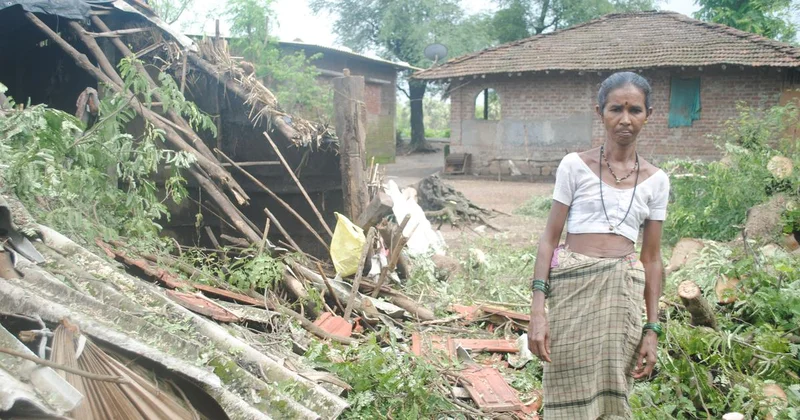
A little later, their house collapsed.
At the same time, our neighbour, the filmmaker Praveen Kumar, was stuck on the terrace of his house with a visitor as the river swamped his house and submerged his car. The mobile network stopped working so he could not communicate with us.
He had, however, managed to call the helplines of the National Disaster Management Authority, and the police. But no help was forthcoming. It was only at 1.30 am, as the water level fell, that two of his friends rescued him.
Kumar described the hardship he faced, the lack of response from the authorities and the mental anguish and financial loss he has suffered in a petition he sent government officials on July 25.
“We were left to fend for ourselves in the middle of a life-threatening flood, abandoned in our darkest hour by the very machinery that is meant to protect citizens in times of disaster,” he wrote. “This failure of response, coming on top of the failure to warn us before the water was released, is unpardonable and demands the strongest accountability.”
It was only five days after the floods that I was able to visit other villages in the area. Everywhere, I heard horror stories. Shubham Sugandh Gorewala told me how he and his eight-member family – including four children and his mother- in-law – clambered atop the 20-foot-high stack of bricks at their kiln opposite their home in Bharad village around 10 am on July 23 to escape the rising river waters.
They spent the whole day perched on the pile before they were rescued by the fire brigade and the police. Luckily for Gorewala, he still had a phone network and was able to call a revenue official he knew to inform him of his situation.
But the water flowed in through the windows of his home, damaging his possessions, including a fridge and cots. Gorewala said that 40,000 bricks from his kiln were washed away, as was his mini-tractor. He lost several fruit trees, and two acres of rice. He says it will be impossible for him to sell his remaining bricks as the road by the kiln had been washed away.
In Bharad village, the flood destroyed the house of Subhash Mali, who suffers from paralysis. He watched the water inundate his rice field opposite his home and cover it with mud. His wife Ratne said the water gushed into the area and they found it difficult to stay afloat. No one warned them that this would happen. Subhash Mali said he did not have a phone, so there was no question of getting any warnings.
We would later learn that the rain had left 23 people in Palghar dead in July. A preliminary damage assessment report by the district administration said that 15,802 homes had been inundated, The Times of India noted. The damage to private property and public infrastructure was estimated at Rs 180 crore.
The incessant rain had started on July 20 in South Gujarat and the areas bordering Palghar. Dahanu town, about 150 km from Mumbai, was paralysed. The Surya river was flowing much above its normal level but residents had not been warned that the gates of the Dhamni dam upstream were going to be opened to discharge water from its rapidly filling reservoir.
That happened on July 23. According to official information, the Dhamni dam was 94% full at 10 am and the spillway gates were increased by 50 cm, opening to 125 cm. As a result, 18,037 cusecs of water was discharged. The reservoir from the eathern Kawadas dam below Dhamni was also overflowing. It is a pickup weir and has no gates. It discharged a total of 59,599 cusecs of water.
At 11 am, the gates of the Dhamni dam were opened further to 150 cm, discharging 30,671 cusecs. Together with the overflow from Kawadas, this amounted to a massive 116,235.75 cusecs.
According to official sources, the gram sevaks and talatis – village-level revenue officials – were sent Whatsapp messages telling them to inform villagers that a flood was likely. However, the collapse of the mobile phone networks meant the warning could not be passed on to the villages downstream of the Dhamni.
The Palghar District Disaster Management Plan 2024-2025 says that the residents of 17 villages should be shifted in case of floods. But it is not clear whether that happened. The Palghar district collector had only issued instructions warning villagers to move to safer locations and be in touch with the gram panchayat for updates.
By the time district officials held a meeting about the flooding at 5.30 pm on July 23, the water had already started abating.
As we realised, electricity was not available for five or six days as many trees and poles had fallen during the heavy rain. Even drinking water was not supplied in most places for several days.
In an emergency, the plan also says that food, clothing and shelter should be provided to the affected population if necessary. But the flood kits that were distributed had only a single bedsheet, a small toothpaste, a bar of soap and a towel – a single packet for each family. Now, grain is also being provided.
On July 27, I sent questions by Whatsapp to the district collector Indu Rani Jakhar and the deputy resident collector on how many villages had been notified about the flood, the extent of flood damage and about relief measures. Newspapers reported that 200 villages in Dahanu and Talasari talukas of Palghar district had been cut off and 800-odd people were evacuated so I also sought information about this.
This article will be updated if they respond.
In the past, we enjoyed the sound of falling rain but it now portends disaster. Extreme weather events like this one will only intensify due to climate change. On average, the district receives 2,458 mm of rain for the entire year. This year, until July 31, Palghar district had already received 1,758 mm.
Just over a week after the deluge, farmers are back to planting rice and going about their activities. There is a crowd at the talati’s office to submit claims for compensation and documents. But our neighbours, the Gharat family, are living in a make-shift shelter with a plastic roof because their house collapsed.
Ravi and I had a narrow escape this time. We suffered only material damage to our crops, trees and fences. But we cannot ride on providence and luck all the time. The administration must take greater responsibility and issue early warnings in situations like this.
Meena Menon is a freelance journalist and a postdoctoral visiting fellow at the Leeds Arts and Humanities Research Institute, University of Leeds, UK.
We welcome your comments at letters@scroll.in.